Results by title
7 books match the query 'Consensus (Social sciences)'
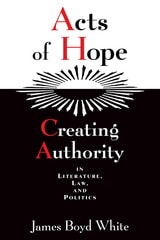
Acts of Hope
Creating Authority in Literature, Law, and PoliticsJames Boyd White
University of Chicago Press, 1994
To which institutions or social practices should we grant authority? When should we instead assert our own sense of what is right or good or necessary?
In this book, James Boyd White shows how texts by some of our most important thinkers and writers—including Plato, Shakespeare, Dickinson, Mandela, and Lincoln—answer these questions, not in the abstract, but in the way they wrestle with the claims of the world and self in particular historical and cultural contexts. As they define afresh the institutions or practices for which they claim (or resist) authority, they create authorities of their own, in the very modes of thought and expression they employ. They imagine their world anew and transform the languages that give it meaning.
In so doing, White maintains, these works teach us about how to read and judge claims of authority made by others upon us; how to decide to which institutions and practices we should grant authority; and how to create authorities of our own through our thoughts and arguments. Elegant and accessible, this book will appeal to anyone wanting to better understand one of the primary processes of our social and political lives.
[more]

Beyond Adversary Democracy
Jane J. Mansbridge
University of Chicago Press, 1983
"Beyond Adversary Democracy should be read by everyone concerned with democratic theory and practice."—Carol Pateman, Politics
"Sociologists recurrently complain about how seldom it is that we produce books that combine serious theorizing about important issues of public policy with original and sensitive field research. Several rounds of enthusiastic applause, then, are due Jane Mansbridge . . . for having produced a dense and well written book whose subject is nothing less ambitious than the theory of democracy and its problems of equality, solidarity, and consensus. Beyond Adversary Democracy, however, is not simply a work of political theory; Mansbridge explores her abstract subject matter by close studies (using ethnographic, documentary, and questionnaire methods) of two small actual democracies operating at their most elemental American levels (1) a New England town meeting ("Selby," Vermont) and (2) an urban crisis center ("Helpline"), whose 41 employees shared a New Left-Counterculture belief in participatory democracy and consensual decision-making. [Mansbridge] is a force to contend with. It is in our common interest that she be widely read."—Bennett M. Berger, Contemporary Sociology
"Sociologists recurrently complain about how seldom it is that we produce books that combine serious theorizing about important issues of public policy with original and sensitive field research. Several rounds of enthusiastic applause, then, are due Jane Mansbridge . . . for having produced a dense and well written book whose subject is nothing less ambitious than the theory of democracy and its problems of equality, solidarity, and consensus. Beyond Adversary Democracy, however, is not simply a work of political theory; Mansbridge explores her abstract subject matter by close studies (using ethnographic, documentary, and questionnaire methods) of two small actual democracies operating at their most elemental American levels (1) a New England town meeting ("Selby," Vermont) and (2) an urban crisis center ("Helpline"), whose 41 employees shared a New Left-Counterculture belief in participatory democracy and consensual decision-making. [Mansbridge] is a force to contend with. It is in our common interest that she be widely read."—Bennett M. Berger, Contemporary Sociology
[more]

Beyond Self-Interest
Edited by Jane J. Mansbridge
University of Chicago Press, 1990
A dramatic transformation has begun in the way scholars think about human nature. Political scientists, psychologists, economists, and evolutionary biologists are beginning to reject the view that human affairs are shaped almost exclusively by self-interest—a view that came to dominate social science in the last three decades.
In Beyond Self-Interest, leading social scientists argue for a view of individuals behavior and social organization that takes into account the powerful motivations of duty, love, and malevolence. Economists who go beyond "economic man," psychologists who go beyond stimulus-response, evolutionary biologists who go beyond the "selfish gene," and political scientists who go beyond the quest for power come together in this provocative and important manifesto.
The essays trace, from the ancient Greeks to the present, the use of self-interest to explain political life. They investigate the differences between self-interest and the motivations of duty and love, showing how these motivations affect behavior in "prisoners' dilemma" interactions. They generate evolutionary models that explain how altruistic motivations escape extinction.
They suggest ways to model within one individual the separate motivations of public spirit and self-interest, investigate public spirit and self-interest, investigate public spirit in citizen and legislative behavior, and demonstrate that the view of democracy in existing Constitutional interpretations is not based on self-interest. They advance both human evil and mothering as alternatives to self-interest, this last in a penetrating feminist critique of the "contract" model of human interaction.
[more]

Character, Community, and Politics
Clarke E. Cochran
University of Alabama Press, 1982
A classic political philosophy text, available again
The revival of political philosophy has frequently assumed that a theory of human well-being and fulfillment is necessary, preoccupied with questions of epistemology and technical conceptual analysis. In instances where the nature of the human good is considered, the paradigm of autonomous individualism customarily dominates. In Character, Community, and Politics, Cochran moves away from these prevailing ideas to develop a communal theory of political order, helping to redefine a number of fundamental, but often neglected, ideas. Chief among them are commitment, community, responsibility, and character—concepts Cochran develops through discussions of authority, freedom, pluralism, and the common good.
Drawing on a wide variety of fields, such as philosophy, ethics, literature, moral theology, and sociology, the author renews these concepts to outline a theory of human life and political order distinct from sclerotic categories such as conservatism, socialism, radicalism, or Marxism.
[more]

Consensual Policy-making in the Nordic World
Peter Munk Christiansen
University of Wisconsin Press, 2023
This book examines the model developed in the Scandinavian countries for handling labor market relations between employers and employees—a model that has secured flexible and well-functioning labor market relations with comparatively high remuneration in case of sickness or unemployment. Consensual—and comparatively efficient—policies have likewise been pursued in agricultural, industrial, environmental policies, and in many policies related to public services.
The preconditions for these policies are strong civil societies, that is, strong capacities for collective mobilization and collective action among groups, relatively strong unitary states, and high levels of generalized trust. The institutional apparatus of these consensual policies has been labeled corporatism. Scandinavian corporatism has implied consent to a norm of affected interests. Groups that are supposedly affected by state policies have access to the processes leading up to political decision-making and are involved in the implementation of policies. This access often has public commissions or committees charged with preparing political decisions and delivering advice, as well as policy implementation committees.
Corporatist and consensual policymaking come at a price. The exchange between interest groups (in pursuit of policy influence) and state actors (in pursuit of information and political support from groups) tends to be time-consuming and confined to solutions that are accepted by all actors. Corporatist policies are consequently not very conducive to more radical reforms. After the heyday of corporatist policymaking in the 1970s, all the Scandinavian countries have loosened their corporatist structures to pave the way for reforms.
[more]

Fanatical Schemes
Proslavery Rhetoric and the Tragedy of ConsensusPatricia Roberts-Miller
University of Alabama Press, 2009
What was the relationship between rhetoric and slavery, and how did rhetoric fail as an alternative to violence, becoming instead its precursor?
Fanatical Schemes is a study of proslavery rhetoric in the 1830s. A common understanding of the antebellum slavery debate is that the increased stridency of abolitionists in the 1830s, particularly the abolitionist pamphlet campaign of 1835, provoked proslavery politicians into greater intransigence and inflammatory rhetoric. Patricia Roberts-Miller argues that, on the contrary, inflammatory rhetoric was inherent to proslavery ideology and predated any shift in abolitionist practices.
She examines novels, speeches, and defenses of slavery written after the pamphlet controversy to underscore the tenets of proslavery ideology and the qualities that made proslavery rhetoric effective. She also examines anti-abolitionist rhetoric in newspapers from the spring of 1835 and the history of slave codes (especially anti-literacy laws) to show that anti-abolitionism and extremist rhetoric long preceded more strident abolitionist activity in the 1830s.
The consensus that was achieved by proslavery advocates, argues Roberts-Miller, was not just about slavery, nor even simply about race. It was also about manhood, honor, authority, education, and political action. In the end, proslavery activists worked to keep the realm of public discourse from being a place in which dominant points of view could be criticized--an achievement that was, paradoxically, both a rhetorical success and a tragedy.
[more]

The Nordic Model
Scandinavia since 1945Mary Hilson
Reaktion Books, 2008
The political structures of the Scandinavian nations have long stood as models for government and public policy. This comprehensive study examines how that “Nordic model” of government developed, as well as its far-reaching influence.
Respected Scandinavian historian Mary Hilson surveys the political bureaucracies of the five Nordic countries—Denmark, Finland, Iceland, Norway, and Sweden—and traces their historical influences and the ways they have changed, individually and as a group, over time. The book investigates issues such as economic development, foreign policy, politics, government, and the welfare state, and it also explores prevailing cultural perceptions of Scandinavia in the twentieth century. Hilson then turns to the future of the Nordic region as a unified whole within Europe as well as in the world, and considers the re-emergence of the Baltic Sea as a pivotal region on the global stage.
The Nordic Model offers an incisive assessment of Scandinavia yesterday and today, making this an essential text for students and scholars of political science, European history, and Scandinavian studies.
[more]