Results by title
82 books match the query 'Conservatism' and 7 start with a
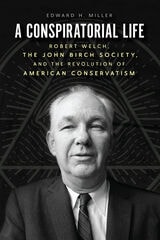
A Conspiratorial Life
Robert Welch, the John Birch Society, and the Revolution of American ConservatismEdward H. Miller
University of Chicago Press, 2021
Though you may not know his name, Robert Welch (1899-1985)—founder of the John Birch Society—is easily one of the most significant architects of our current political moment. In A Conspiratorial Life, the first full-scale biography of Welch, Edward H. Miller delves deep into the life of an overlooked figure whose ideas nevertheless reshaped the American right.
A child prodigy who entered college at age 12, Welch became an unlikely candy magnate, founding the company that created Sugar Daddies, Junior Mints, and other famed confections. In 1958, he funneled his wealth into establishing the organization that would define his legacy and change the face of American politics: the John Birch Society. Though the group’s paranoiac right-wing nativism was dismissed by conservative thinkers like William F. Buckley, its ideas gradually moved from the far-right fringe into the mainstream. By exploring the development of Welch’s political worldview, A Conspiratorial Life shows how the John Birch Society’s rabid libertarianism—and its highly effective grassroots networking—became a profound, yet often ignored or derided influence on the modern Republican Party. Miller convincingly connects the accusatory conservatism of the midcentury John Birch Society to the inflammatory rhetoric of the Tea Party, the Trump administration, Q, and more. As this book makes clear, whether or not you know his name or what he accomplished, it’s hard to deny that we’re living in Robert Welch’s America.
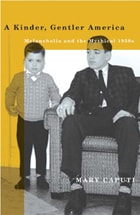
A Kinder, Gentler America
Melancholia and the Mythical 1950sMary Caputi
University of Minnesota Press, 2005
Analyzing these competing uses of the past, A Kinder, Gentler America reveals how longing for the era of “the greatest generation” actually exposes a disillusionment with the present. Caputi draws on the theoretical frameworks of Julia Kristeva and Walter Benjamin to look at how the decade has been portrayed in movies such as Pleasantville and Far from Heaven and delves further to investigate our disenchantment’s lost origins in early modernity through a reading of the poetry of Baudelaire. What emerges is a stark contrast between the depictions of a melancholic present and a cheerful, shiny past. In the right’s invocation of the mythical 1950s and the left’s criticism of the same, Caputi recognizes a common unfulfilled desire, and proposes that by understanding this loss both sides can begin to accept that American identity, despite chaos and confusion, lies in the here and now.
Mary Caputi is professor of political science at California State University, Long Beach, and is author of Voluptuous Yearnings: A Feminist Theory of the Obscene.
A Partisan Church
Todd Scribner
Catholic University of America Press, 2015
A Second Look at First Things
A Case for Conservative Politics: The Hadley Arkes FestschriftFrancis J. Beckwith
St. Augustine's Press, 2013
American Conservatism
Thinking It, Teaching ItPaul Lyons
Vanderbilt University Press, 2009
Lyons begins with the premise that most universities have been negligent in helping undergraduates understand a movement that has shaped the political landscape for half a century. In addition, in a series of essays that frame the teaching log, he makes the case that conservatives have too often failed to adhere to basic, Burkean principles, and that the best of conservatism has often appeared as a form of liberalism from thinkers such as Hannah Arendt, Reinhold Niebuhr, and George Kennan. The essays also cover the history of conservatism, conservative use of the city-on-a-hill metaphor, and an examination of how the promise of Camelot sophistication was subverted by a resurgence of right-wing populism.
American Multiculturalism and the Anti-Discrimination Regime
The Challenge to Liberal PluralismThomas F. Powers
St. Augustine's Press, 2023
Asia First
China and the Making of Modern American ConservatismJoyce Mao
University of Chicago Press, 2015
Mao explores the deep resonance American conservatives felt with the defeat of Chiang Kai-Shek and his exile to Taiwan, which they lamented as the loss of China to communism and the corrosion of traditional values. In response, they fomented aggressive anti-communist positions that urged greater action in the Pacific, a policy known as “Asia First.” While this policy would do nothing to oust the communists from China, it was powerfully effective at home. Asia First provided American conservatives a set of ideals—American sovereignty, selective military intervention, strident anti-communism, and the promotion of a technological defense state—that would bring them into the global era with the positions that are now their hallmark.