Results by title
214 books match the query 'Constitutional' and 9 start with a
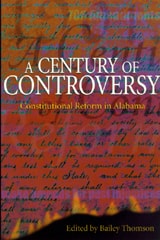
A Century of Controversy
Constitutional Reform in AlabamaH. Bailey Thomson
University of Alabama Press, 2002
A timely examination of Alabama’s severely criticized state constitution
Alabama’s present constitution, adopted in 1901, is widely viewed as the source of many, if not most, of the state’s historic difficulties and inequities. Chief among these is a poorly funded school system, an imbalanced tax system that favors special business interests, legislated racism, and unchecked urban sprawl. Many citizens believe that, after 100 years of overburdening amendments and confusing addendums, the constitution urgently needs rewriting.
With this book, Bailey Thomson has assembled the best scholarship on the constitution, its history, and its implications for the future. Historian Harvey H. Jackson III details the degree to which the 1901 document was drafted as a legal tool to ensure white supremacy at the expense of poor whites and blacks, while Joe A. Sumners illustrates how the constitution ties the hands of elected civic leaders by handing authority for local decisions to state government in Montgomery. James W. Williams Jr. explores the impact of the state constitution on the beleaguered tax system and the three principal “revenue crises” it has engendered. Thomson’s own contribution explains how, in contrast to the previous failed attempts for constitutional change by past governors who appealed to their fellow power brokers, the current reform movement arose from the grassroots level.
As citizens and politicians in Alabama review the 1901 constitution for revision, as they navigate the pitfalls and opportunities inherent in change, it is incumbent that they inform themselves adequately on the controversies that have swirled around the constitution since its adoption. The future of Alabama’s government will depend upon it, as will the fortunes of Alabama’s business interests and the well-being of every citizen in the state for years to come.
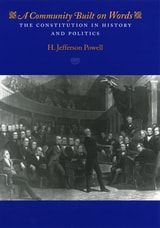
A Community Built on Words
The Constitution in History and PoliticsH. Jefferson Powell
University of Chicago Press, 2002
Combining history and theory, Powell analyzes a series of constitutional controversies from 1790 to 1944 to demonstrate that constitutional law from its very beginning has involved politically charged and ideologically divisive arguments. Nowhere in our past can one find the golden age of apolitical constitutional thinking that a great deal of contemporary scholarship seeks or presupposes. Viewed over time, American constitutional law is a history of political dispute couched in constitutional terms.
Powell then takes his conclusions one step further, claiming that it is precisely this historical tradition of argument that has given American constitutional law a remarkable coherence and integrity over time. No matter what the particular political disputes of the day might be, constitutional argument has provided a shared language through which our political community has been able to fight out its battles without ultimately fracturing.
A Community Built on Words will be must reading for any student of constitutional history, theory, or law.
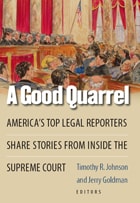
A Good Quarrel
America's Top Legal Reporters Share Stories from Inside the Supreme CourtTimothy R. Johnson and Jerry Goldman, Editors
University of Michigan Press, 2009
While reading what top legal reporters say about some of the most important U.S. Supreme Court oral arguments in recent history, go to www.goodquarrel.com to listen to audio and hear for yourself the very style and delivery of the oral arguments that have shaped the history of our nation's highest law. See Preface for full instructions.
Contributors
- Charles Bierbauer, CNN
- Lyle Denniston, scotusblog.com
- Fred Graham, Court TV
- Brent Kendall, Los Angeles Daily Journal
- Steve Lash, Houston Chronicle
- Dahlia Lithwick, Slate.com
- Tony Mauro, American Lawyer Media
- Tim O'Brien, ABC News
- David Savage, Los Angeles Times
- Greg Stohr, Bloomberg News
- Nina Totenberg, NPR
Timothy R. Johnson teaches in the Department of Political Science and the Law School at the University of Minnesota.
Jerry Goldman teaches political science at Northwestern University and directs the OYEZ Project, a multimedia archive devoted to the Supreme Court, at www.oyez.org.
Cover sketch by Dana Verkouteren
"Supreme Court oral arguments are good government in action. A Good Quarrel brilliantly showcases this important aspect of the Court's work."
---Paul Clement, Partner, King & Spalding, and former United States Solicitor General
"Few legal experiences are as exhilarating as a Supreme Court oral argument---a unique art form that this superb collection brings vividly to life."
---Kathleen Sullivan, Partner, Quinn Emanuel Urquhart Oliver and Hedges, and former Dean, Stanford Law School
"[A Good Quarrel] shines a brilliant spotlight on the pivotal moment of advocacy when the Supreme Court confronts the nation's most profound legal questions."
---Thomas C. Goldstein, Partner, Akin Gump, and Lecturer, Supreme Court Litigation, Harvard Law School and Stanford Law School
"A brilliant way to understand America's most important mysterious institution."
---Lawrence Lessig, Stanford Law School

A Liberal Tide?
Immigration and Asylum Law and Policy in Latin AmericaEdited by David James Cantor, Luisa Feline Freier, and Jean-Pierre Gauci
University of London Press, 2015
A Ministry of Presence
Chaplaincy, Spiritual Care, and the LawWinnifred Fallers Sullivan
University of Chicago Press, 2014
In A Ministry of Presence, Winnifred Fallers Sullivan explores how chaplaincy works in the United States—and in particular how it sits uneasily at the intersection of law and religion, spiritual care, and government regulation. Responsible for ministering to the wandering souls of the globalized economy, the chaplain works with a clientele often unmarked by a specific religious identity, and does so on behalf of a secular institution, like a hospital. Sullivan's examination of the sometimes heroic but often deeply ambiguous work yields fascinating insights into contemporary spiritual life, the politics of religious freedom, and the never-ending negotiation of religion's place in American institutional life.
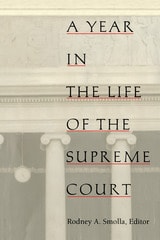
A Year in the Life of the Supreme Court
Rodney A. Smolla, ed.
Duke University Press, 1995
The cases heard by the Supreme Court are, first and foremost, disputes involving real people with actual stories. The accidents and twists of circumstance that have brought these people to the last resort of litigation can make for compelling drama. The contributors to this volume bring these dramatic stories to life, using them as a backdrop for the larger issues of law and social policy that constitute the Court’s business: abortion, separation of church and state, freedom of speech, the right of privacy, crime, violence, discrimination, and the death penalty. In the course of these narratives, the authors describe the personalities and jurisprudential leanings of the various Justices, explaining how the interplay of these characters and theories about the Constitution interact to influence the Court’s decisions.
Highly readable and richly informative, this book offers an unusually clear and comprehensive portrait of one of the most influential institutions in modern American life.
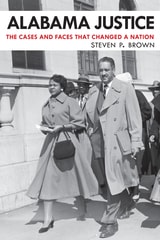
Alabama Justice
The Cases and Faces That Changed a NationSteven P. Brown
University of Alabama Press, 2020
WINNER OF THE ANNE B. & JAMES B. MCMILLAN PRIZE IN SOUTHERN HISTORY
Examines the legacies of eight momentous US Supreme Court decisions that have their origins in Alabama legal disputes.
Unknown to many, Alabama has played a remarkable role in a number of Supreme Court rulings that continue to touch the lives of every American. In Alabama Justice: The Cases and Faces That Changed a Nation, Steven P. Brown has identified eight landmark cases that deal with religion, voting rights, libel, gender discrimination, and other issues, all originating from legal disputes in Alabama.
Written in a concise and accessible manner, each case law chapter begins with the circumstances that created the dispute. Brown then provides historical and constitutional background for the issue followed by a review of the path of litigation. Excerpts from the Court’s ruling in the case are also presented, along with a brief account of the aftermath and significance of the decision. The First Amendment (New York Times v. Sullivan), racial redistricting (Gomillion v. Lightfoot), the Equal Protection Clause of the Fourteenth Amendment (Frontiero v. Richardson), and prayer in public schools (Wallace v. Jaffree) are among the pivotal issues stamped indelibly by disputes with their origins in Alabama legal, political, and cultural landscapes. By examining such landmark twentieth-century milestones and eras such as the Scottsboro Boys trial, the Civil Rights movement, and the fight for women’s rights through a legal lens, Brown sheds new and unexpected light on the ways that events in Alabama have shaped the nation.
In addition to his analysis of cases, Brown discusses the three associate Supreme Court justices from Alabama to the Supreme Court: John McKinley, John Archibald Campbell, and Hugo Black. Their cumulative influence on constitutional interpretation, the institution of the Court, and the day-to-day rights and liberties enjoyed by every American is impossible to measure. A closing chapter examines the careers and contributions of these three Alabamians.
Alaska Constitution
Edited by University of Alaska Press
University of Alaska Press, 2020
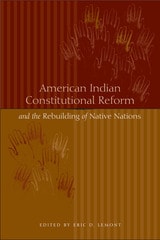
American Indian Constitutional Reform and the Rebuilding of Native Nations
Edited by Eric D. Lemont
University of Texas Press, 2006
Since 1975, when the U.S. government adopted a policy of self-determination for American Indian nations, a large number of the 562 federally recognized nations have seized the opportunity to govern themselves and determine their own economic, political, and cultural futures. As a first and crucial step in this process, many nations are revising constitutions originally developed by the U.S. government to create governmental structures more attuned to native people's unique cultural and political values. These new constitutions and the governing institutions they create are fostering greater governmental stability and accountability, increasing citizen support of government, and providing a firmer foundation for economic and political development.
This book brings together for the first time the writings of tribal reform leaders, academics, and legal practitioners to offer a comprehensive overview of American Indian nations' constitutional reform processes and the rebuilding of native nations. The book is organized in three sections. The first part investigates the historical, cultural, economic, and political motivations behind American Indian nations' recent reform efforts. The second part examines the most significant areas of reform, including criteria for tribal membership/citizenship and the reform of governmental institutions. The book concludes with a discussion of how American Indian nations are navigating the process of reform, including overcoming the politics of reform, maximizing citizen participation, and developing short-term and long-term programs of civic education.