Results by title
7 books match the query 'Constitutional amendments'
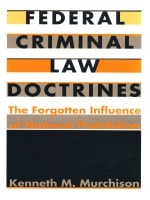
Federal Criminal Law Doctrines
The Forgotten Influence of National ProhibitionKenneth M. Murchison
Duke University Press, 1994
In this detailed examination, Murchison considers a portion of the Supreme Court’s work prior to the New Deal crisis, a period insufficiently considered until now. Among the developments he discusses are those relating to the defense of entrapment, the Fourth Amendment’s protection against unreasonable search and seizure, the Fifth Amendment’s prohibition against double jeopardy, property forfeitures, and the jury trial guarantees for criminal proceedings. His analysis reveals a court less rigid, less consistently divided along modern ideological lines, and more tolerant of governmental authority than traditional wisdom would suggest. Thus, Murchison offers a framework for a revisionist view of the Supreme Court’s activities during this period.
Exploring an important connection between the Eighteenth Amendment, the Volstead Act, and the development of federal criminal law, this book documents what was arguably the nation’s first criminal law revolution at the federal level. Explaining the modern origins of doctrines that still inform federal criminal law, Murchison also provides a case study of how legal doctrine responds to changing social conditions. Federal Criminal Law Doctrines will add immeasurably to the work of historians and legal scholars alike.
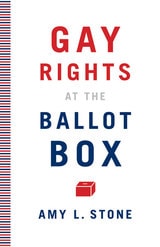
Gay Rights at the Ballot Box
Amy L. Stone
University of Minnesota Press, 2012
The passage of the anti-gay marriage Proposition 8 in California in 2008 stunned gay rights activists across the country. Although facing a well-funded campaign in support of the ballot measure, LGBT activists had good reasons for optimism, including the size and strength of their campaign. Since 1974, the LGBT movement has fought 146 anti-gay ballot initiatives sponsored by the religious right and has developed innovative strategies to oppose these measures. In Gay Rights at the Ballot Box, Amy L. Stone examines how the tactics of LGBT activists have evolved and unravels the complex relationship between ballot measure campaigns and the broader goals of the LGBT movement.
The first comprehensive history of anti-gay ballot measures, both those merely attempted and those successfully put before voters, this book draws on archival research and interviews with more than one hundred LGBT activists to provide a detailed account of the campaigns to stop such ballot measures from passing into law. As Stone shows through in-depth case studies, although LGBT activists lost the vast majority of these fights, they also won significant statewide victories in Oregon in 1992 and Arizona in 2006, and local successes, including ones in Ypsilanti, Michigan, in 1998 and 2002.
Stone analyzes how LGBT activists constantly refined their campaign tactics in response to both victories and defeats. She also stresses that such campaigns have played both a complementary and contradictory role within the LGBT movement. Specific anti-ballot campaigns and the broader movement do often strengthen each other. However, ballot measure campaigns sometimes distract activists from the movement’s more general goals, and activists at the movement level can pressure local campaigns to take on more than they can handle. With gay rights coming under increasing assault from the religious right, this book is a vital resource for LGBT activists and others working to block their efforts.
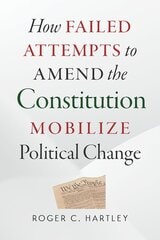
How Failed Attempts to Amend the Constitution Mobilize Political Change
Roger C. Hartley
Vanderbilt University Press, 2017
This book is a demonstration of how social reformers and politicians have used the amendment process to achieve favorable political results even as their proposed amendments have failed to be adopted. For example, the ERA "failed" in the sense that it was never ratified, but the mobilization to ratify the ERA helped build the feminist movement (and also sparked a countermobilization). Similarly, the Supreme Court's ban on compulsory school prayer led to a barrage of proposed amendments to reverse the Court. They failed to achieve the requisite two-thirds support from Congress, but nevertheless had an impact on the political landscape. The definition of the relationship between Congress and the President in the conduct of foreign policy can also be traced directly to failed efforts to amend the Constitution during the Cold War.
Roger Hartley examines familiar examples like the ERA, balanced budget amendment proposals, and pro-life attempts to overturn Roe v. Wade, but also takes the reader on a three-century tour of lesser-known amendments. He explains how often the mere threat of calling a constitutional convention (at which anything could happen) effected political change.
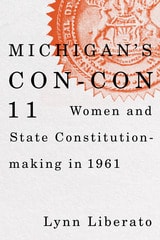
Michigan's Con-Con 11
Women and State Constitution-making in 1961Lynn Liberato
Michigan State University Press, 2025
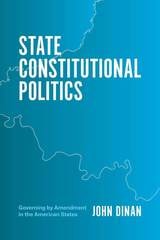
State Constitutional Politics
Governing by Amendment in the American StatesJohn Dinan
University of Chicago Press, 2018
With State Constitutional Politics, John Dinan looks at the various occasions in American history when state constitutional amendments have served as instruments of governance. Among other things, amendments have constrained state officials in the way they levy taxes and spend money; enacted policies unattainable through legislation on issues ranging from minimum wage to the regulation of marijuana; and updated understandings of rights, including religious liberty, equal protection, and the right to bear arms. In addition to comprehensively chronicling the ways amendments shape politics in the states, Dinan also assesses the consequences of undertaking changes in governance through amendments rather than legislation or litigation. For various reasons, including the greater stability and legitimacy of changes achieved through the amendment process, he argues that it might be a more desirable way of achieving change.
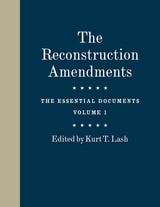
The Reconstruction Amendments
The Essential Documents, Volume 1Edited by Kurt T. Lash
University of Chicago Press, 2021
Volume I outlines a broad historical context for the Reconstruction Amendments and contains materials related to the Thirteenth Amendment, which abolished slavery, while Volume 2 covers the Fourteenth and Fifteenth Amendments on the rights of citizenship and enfranchisement. The documents in this collection encompass a sweeping range of primary sources, from congressional debates to court cases, public speeches to newspaper articles. As a whole, the volumes meticulously depict a significant period of legal change even as they illuminate the ways in which people across the land grappled with the process of constitutional reconstruction. Filling a major gap in the literature on the era, The Reconstruction Amendments will be indispensable for readers in politics, history, and law, as well as anyone seeking a better understanding of the post–Civil War basis of American constitutional democracy.
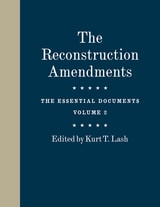
The Reconstruction Amendments
The Essential Documents, Volume 2Edited by Kurt T. Lash
University of Chicago Press, 2021
Volume I outlines a broad historical context for the Reconstruction Amendments along with materials related to the Thirteenth Amendment, which abolished slavery, while Volume II covers the Fourteenth and Fifteenth Amendments on the rights of citizenship and enfranchisement. The documents in this collection encompass a sweeping range of primary sources, from congressional talks to court cases, public speeches to newspaper articles. As a whole, the volumes meticulously depict a significant period of legal change even as they illuminate the ways in which people across the land grappled with the process of constitutional reconstruction. Filling a major gap in the literature on the era, The Reconstruction Amendments will be indispensable for readers in politics, history, and law, as well as anyone seeking a better understanding of the post–Civil War basis of American constitutional democracy.