Results by title
75 books match the query 'Construction' and 5 start with a
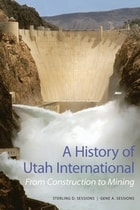
A History of Utah International
From Construction to MiningSterling D Sessions
University of Utah Press, 2005
The story of how the Utah Construction Company, founded in Ogden, Utah in 1900, became Utah International, a multinational corporation, is known to historians of the American West but perhaps not by the general public. The publication of this book remedies that omission.
During its first decades, the company built railroads and dams and was one of the Six Companies Consortium that built Hoover Dam. Utah Construction was also engaged in numerous war-contract activities during World War II. In the postwar period, the company expanded its activities into mining and land development and moved its headquarters to San Francisco. Changing its name to Utah Construction and Mining, and eventually to Utah International, the corporation became one of the most successful multinational mining companies in the world. In 1976, Utah International and General Electric negotiated the largest yet corporate merger in the United States.
Based on the Utah International archives housed in the Stewart Library at Weber State University, the story of Utah International describes more than projects: it is also the story of how two remarkable entrepreneurs, Marriner Stoddard Eccles and Edmund Wattis Littlefield, transformed the company incorporated in 1900 by the Wattis brothers into the largest and most profitable mining company in the United States.

Applied Building Performance Simulation
Joe Clarke
The Institution of Engineering and Technology, 2024
Architectural Records
Managing Design and Construction RecordsWaverly B. Lowell
Society of American Archivists, 2006
As Legend Has It
History, Heritage, and the Construction of Swedish American IdentityJennifer Eastman Attebery
University of Wisconsin Press, 2023
The legends Swedish Americans tell about their past are both similar to and distinct from those of others who migrated westward; they participated in settler colonialism while maintaining a sense of their specific, Swedish ethnicity. Unlike racial minority groups, Swedish Americans could claim membership in a majority white community without abandoning their cultural heritage. Their legends and local histories reflect that positioning. Attebery reveals how Swedish American legends are embedded within local history writing, how ostension and rhetoric operate in historical legends, and how vernacular local history writing works in tandem with historical legends to create a common message about a communal past. This impeccably researched study points to ways in which legends about the past possess qualities unique to their subgenre yet can also operate similarly to contemporary legends in their social impact.
Authority
Construction and CorrosionBruce Lincoln
University of Chicago Press, 1994
Employing a vast array of examples drawn from classical antiquity, Scandinavian law, Cold War scholarship, and American presidential politics, Lincoln offers a telling analysis of the performance of authority, and subversions of it, from ancient times to the present. Using a small set of case studies that highlight critical moments in the construction of authority, he goes on to offer a general examination of "corrosive" discourses such as gossip, rumor, and curses; the problematic situation of women, who often are barred from the authorizing sphere; the role of religion in the construction of authority; the question of whether authority in the modern and postmodern world differs from its premodern counterpart; and a critique of Hannah Arendt's claims that authority has disappeared from political life in the modern world. He does not find a diminution of authority or a fundamental change in the conditions that produce it. Rather, Lincoln finds modern authority splintered, expanded, and, in fact, multiplied as the mechanisms for its construction become more complex—and more expensive.