Results by title
5 books match the query 'Constructivism (Philosophy)'
Constructivism Reconsidered
Past, Present, and FutureMariano E. Bertucci, Jarrod Hayes, and Patrick James, Editors
University of Michigan Press, 2018
Constructivism Reconsidered synthesizes the nature of and debates on constructivism in international relations, providing a systematic assessment of the constructivist research program in IR to answer specific questions: What extent of (dis)agreement exists with regard to the meaning of constructivism? To what extent is constructivism successful as an alternative approach to rationalism in explaining and understanding international affairs? Constructivism Reconsidered explores constructivism’s theoretical, empirical, and methodological strengths and weaknesses, and debates what these say about its past, present, and future to reach a better understanding of IR in general and how constructivism informs IR in particular.
Interpretive Quantification
Methodological Explorations for Critical and Constructivist IRJ. Samuel Barkin and Laura Sjoberg, editors
University of Michigan Press, 2017
In Interpretive Quantification, ten highly regarded scholars in the field of International Relations apply quantitative methods and formal models to specific constructivist and critical research questions. In this way, each chapter serves not only as evidence that methods can productively be applied across paradigms, but also as a guide as to how this may be done. In sum, the contributors make a compelling case that when researchers cordon off particular methods for merely ideological reasons, they circumscribe their own paradigms and hinder their own research agenda.
Making Natural Knowledge
Constructivism and the History of Science, with a new PrefaceJan Golinski
University of Chicago Press, 2005
Viewing scientific knowledge as a product of human culture, Jan Golinski challenges the traditional trajectory of the history of science as steady and autonomous progress. In exploring topics such as the social identity of the scientist, the significance of places where science is practiced, and the roles played by language, instruments, and images, Making Natural Knowledge sheds new light on the relations between science and other cultural domains.
"A standard introduction to historically minded scholars interested in the constructivist programme. In fact, it has been called the 'constructivist's bible' in many a conference corridor."—Matthew Eddy, British Journal for the History of Science
Making Theory/Constructing Art
On the Authority of the Avant-GardeDaniel Herwitz
University of Chicago Press, 1993
Spurred by the theoretical claims of Arthur Danto, a leader in the philosophy of the avant-garde, Herwitz reexamines the art and theory of major figures in the avant-garde movement including John Cage, Jean-François Lyotard, Jean Baudrillard, and Andy Warhol.
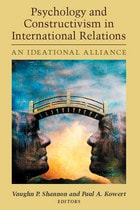
Psychology and Constructivism in International Relations
An Ideational AllianceVaughn P. Shannon and Paul A. Kowert, Editors
University of Michigan Press, 2011
"The conversation between political psychology and constructivism is essential and long overdue. By exploring the interaction of individual cognition and social processes, this 'ideational alliance' more fully explains how ideas work all the way down to shape world politics."
---Theo Farrell, King's College London
"This is a worthwhile and engaging volume. Political psychology is gaining ground as an essential perspective to consider when analyzing international relations, and the book's focus on constructivism provides key insights into the relationship between identity, norms, and behavior---bedrock concepts in understanding the social underpinnings of global politics."
---Mira Sucharov, Carleton University
"An indispensable guide to understanding what distinguishes and what unites psychology and constructivism. A wonderful resource for political psychologists, constructivists, and their critics."
---Jonathan Mercer, University of Washington
Constructivist IR scholars study the ways in which international norms, culture, and identities---all intersubjective phenomena---inform foreign policy and affect the reaction to and outcomes of international events. Political psychologists similarly investigate divergent national self-conceptions as well as the individual cognitive and emotional propensities that shape ideology and policy. Given their mutual interest in human subjectivity and identity politics, a dialogue and synthesis between constructivism and political psychology is long overdue.
The contributors to this volume discuss both theoretical and empirical issues of complementarity and critique, with an emphasis on the potential for integrating the viewpoints within a progressive ideational paradigm. Moreover, they make a self-conscious effort to interrogate, rather than gloss over, their differences in the hope that such disagreements will prove particularly rich sources of analytical and empirical insight.
Jacket illustration © Ocean Photography/Veer