Results by title
2 books match the query 'Consumer Participation'
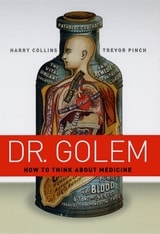
Dr. Golem
How to Think about MedicineHarry Collins and Trevor Pinch
University of Chicago Press, 2005
Dr. Golem explores some of the mysteries and complexities of medicine while untangling the inherent conundrums of scientific research and highlighting its vagaries. Driven by the question of what to do in the face of the fallibility of medicine, Dr. Golem encourages a more inquisitive attitude toward the explanations and accounts offered by medical science. In eight chapters devoted to case studies of modern medicine, Collins and Pinch consider the prevalence of tonsillectomies, the placebo effect and randomized control trials, bogus doctors, CPR, the efficacy of Vitamin C in fighting cancer, chronic fatigue syndrome, AIDS cures, and vaccination. They also examine the tension between the conflicting faces of medicine: medicine as science versus medicine as a source of succor; the interests of an individual versus the interests of a group; and the benefits in the short term versus success rates in the long term. Throughout, Collins and Pinch remind readers that medical science is an economic as well as a social consideration, encapsulated for the authors in the timeless struggle to balance the good health of the many—with vaccinations, for instance—with the good health of a few—those who have adverse reactions to the vaccine.
In an age when the deaths of research subjects, the early termination of clinical trials, and the research guidelines for stem cells are front-page news, Dr. Golem is a timely analysis of the limitations of medicine that never loses sight of its strengths.
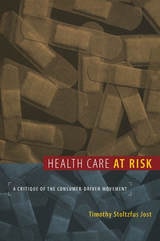
Health Care at Risk
A Critique of the Consumer-Driven MovementTimothy Stoltzfus Jost
Duke University Press, 2007
In this concise, straightforward analysis, Jost challenges the historical and theoretical assumptions on which the consumer-driven health care movement is based and reexamines the empirical evidence that it claims as support. He traces the histories of both private health insurance in the United States and the CDHC movement. The idea animating the drive for consumer-driven health care is that the fundamental problem with the American health care system is what economists call “moral hazard,” the risk that consumers overuse services for which they do not bear the cost. Jost reveals moral hazard as an inadequate explanation of the complex problems plaguing the American health care system, and he points to troubling legal and ethical issues raised by CDHC. He describes how other countries have achieved universal access to high-quality health care at lower cost, without relying extensively on cost sharing, and he concludes with a proposal for how the United States might do the same, incorporating aspects of CDHC while recognizing its limitations.