Results by title
2 books match the query 'Containing'
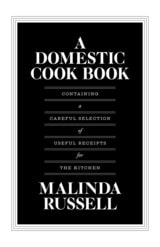
A Domestic Cook Book
Containing a Careful Selection of Useful Receipts for the KitchenMalinda Russell
University of Michigan Press, 2025
A Domestic Cook Book (1866) by Malinda Russell is the oldest known published cookbook written by an African American woman. Born in Tennessee, and descended from Virginia freemen, Russell decided to move to Liberia at the age of 19. When her money for the trip was stolen, she was stranded in Lynchburg, Virginia, and began working as a cook and companion, traveling with women as a nurse. After living in Lynchburg for only four years, Russell’s husband died and she moved with her son to Tennessee where she kept a boarding house and then went on to run a pastry shop. After a second dramatic robbery in 1864, Russell moved to Paw Paw, Michigan, because she had heard it was the “garden of the west” and published a cookbook “with the intention of benefiting the public” as well as supporting herself.
A Domestic Cook Book contains 260 recipes and household tips that draw from Malinda Russell’s twenty years of experience cooking in Southern kitchens, her boarding house, and her pastry shop, and showcase her skills as a pastry chef. This new edition includes a foreword by scholar Rafia Zafar as well as an introduction by the late food historian Janice Bluestein Longone that contextualize Russell’s cookbook. Using the only known copy of the original book housed in the Janice Bluestein Longone Culinary Archive at the University of Michigan Library's Special Collections Research Center, this new edition preserves an important part of Michigan and American history and makes it widely available to readers for the first time.
A Domestic Cook Book contains 260 recipes and household tips that draw from Malinda Russell’s twenty years of experience cooking in Southern kitchens, her boarding house, and her pastry shop, and showcase her skills as a pastry chef. This new edition includes a foreword by scholar Rafia Zafar as well as an introduction by the late food historian Janice Bluestein Longone that contextualize Russell’s cookbook. Using the only known copy of the original book housed in the Janice Bluestein Longone Culinary Archive at the University of Michigan Library's Special Collections Research Center, this new edition preserves an important part of Michigan and American history and makes it widely available to readers for the first time.
[more]
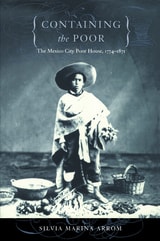
Containing the Poor
The Mexico City Poor House, 1774-1871Silvia Marina Arrom
Duke University Press, 2001
In 1774 Mexico City leaders created the Mexico City Poor House—the centerpiece of a bold experiment intended to eliminate poverty and impose a new work ethic on former beggars by establishing a forcible internment policy for some and putting others to work. In Containing the Poor Silvia Marina Arrom tells the saga of this ill-fated plan, showing how the asylum functioned primarily to educate white orphans instead of suppressing mendicancy and exerting control over the multiracial community for whom it was designed.
For a nation that had traditionally regarded the needy as having the undisputed right to receive alms and whose affluent citizens felt duty-bound to dispense them, the experiment was doomed from the start, explains Arrom. She uses deep archival research to reveal that—much to policymakers’ dismay—the Poor House became an orphanage largely because the government had underestimated the embeddedness of this moral economy of begging. While tracing the course of an eventful century that also saw colonialism give way to republicanism in Mexico, Arrom links the Poor House’s transformation with other societal factors as well, such as Mexican women’s increasing impact on social welfare policies.
With poverty, begging, and homelessness still rampant in much of Latin America today, this study of changing approaches to social welfare will be particularly valuable to student and scholars of Mexican and Latin American society and history, as well as those engaged in the study of social and welfare policy.
[more]