Results by title

6 books match the query 'Contemporary Germany'
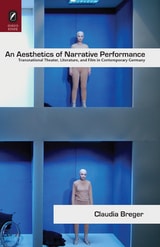
cover of An Aesthetics of Narrative Performance: Transnational Theater, Literature, and Film in Contemporary Germany

An Aesthetics of Narrative Performance

Transnational Theater, Literature, and Film in Contemporary Germany

Claudia Breger

The Ohio State University Press, 2012
The contemporary moment has been described in terms of both a “narrative” and a “performative turn,” but the overlap between these two has largely escaped attention. This curious gap is explained by the ways in which scholars across the humanities have defined narrative and performance as opposite forces, emphasizing their respective affiliations with time vs. space and identity constitution vs. its undoing. Although the opposition has been acknowledged as false by many in this simple form, its shifting instantiations continue to shape the ways we make sense of the arts as well as society. Instead, An Aesthetics of Narrative Performance: Transnational Theater, Literature, and Film in Contemporary Germany by Claudia Breger maps the complexities of imaginative worldmaking in contemporary culture through an aesthetics of narrative performance: an ensemble of techniques exploring the interplay of rupture and recontextualization in the process of configuration. Interlacing diverging definitions of both narrative and performance, the study outlines two clusters of such techniques—scenic narration and narrative “presencing” in performance vs. forms of narrative theatricalization—and analyzes the cultural work they do in individual works in three different media: literature, film, and theater. These readings focus on the rich configurations of contemporary worldmaking “at location Germany.” In the discussed representations of German unification, contemporary cultures of migration, and the transnational War on Terror, the aesthetics of narrative performance finds its identity as a multifaceted imaginative response to the post/modern crisis of narrative authority.
[more]
cover of Beyond Left, Right, and Center: The Politics of Gender and Ethnicity in Contemporary Germany

Beyond Left, Right, and Center

The Politics of Gender and Ethnicity in Contemporary Germany

Christina Xydias

Temple University Press, 2024

Women’s political representation is often expected to be better on “the left.” However, the reality is more complicated. Using Germany’s multi-party system as its central case study, Beyond Left, Right, and Center challenges this conventional wisdom on political ideology.

Christina Xydias shows that some right-leaning parties advocate for women’s rights and interests, while left- and right-leaning parties can be equally indifferent to lack of representation for women from marginalized groups. These findings follow from analyses of election results, transcripts from debates and speeches, and personal interviews, as well as from a close reading of intertwined military and citizenship policies that illustrate how women’s and ethnic minority groups’ rights are constructed.

Beyond Left, Right, and Center concludes with an analysis of women’s representation across OECD countries, showing that right-leaning parties are more likely to support women’s rights and interests in societies that are more egalitarian.

[more]
cover of Blood and Culture: Youth, Right-Wing Extremism, and National Belonging in Contemporary Germany

Blood and Culture

Youth, Right-Wing Extremism, and National Belonging in Contemporary Germany

Cynthia Miller-Idriss

Duke University Press, 2009

Over the past decade, immigration and globalization have significantly altered Europe’s cultural and ethnic landscape, foregrounding questions of national belonging. In Blood and Culture, Cynthia Miller-Idriss provides a rich ethnographic analysis of how patterns of national identity are constructed and transformed across generations. Drawing on research she conducted at German vocational schools between 1999 and 2004, Miller-Idriss examines how the working-class students and their middle-class, college-educated teachers wrestle with their different views about citizenship and national pride. The cultural and demographic trends in Germany are broadly indicative of those underway throughout Europe, yet the country’s role in the Second World War and the Holocaust makes national identity, and particularly national pride, a difficult issue for Germans. Because the vocational-school teachers are mostly members of a generation that came of age in the 1960s and 1970s and hold their parents’ generation responsible for National Socialism, many see national pride as symptomatic of fascist thinking. Their students, on the other hand, want to take pride in being German.

Miller-Idriss describes a new understanding of national belonging emerging among young Germans—one in which cultural assimilation takes precedence over blood or ethnic heritage. Moreover, she argues that teachers’ well-intentioned, state-sanctioned efforts to counter nationalist pride often create a backlash, making radical right-wing groups more appealing to their students. Miller-Idriss argues that the state’s efforts to shape national identity are always tempered and potentially transformed as each generation reacts to the official conception of what the nation “ought” to be.
[more]
cover of Cosmopolitan Parables: Trauma and Responsibility in Contemporary Germany

Cosmopolitan Parables

Trauma and Responsibility in Contemporary Germany

David D. Kim

Northwestern University Press, 2017

Cosmopolitan Parables explores the global rise of the heavily debated concept of cosmopolitanism from a unique German literary perspective. Since the early 1990s, the notion of cosmopolitanism has acquired a new salience because of an alarming rise in nationalism, xenophobia, migration, international war, and genocide. This upsurge has transformed how artists and scholars worldwide assess the power of international civil society and its moral obligation to unite regardless of cultural background, religious affiliation, or national citizenship. It rejuvenates an ancient yet timely framework within which contemporary political crises are to be overcome, especially after the collapse of communist states and the intersection of postwar and postcolonial trajectories.

To exemplify this global challenge, Kim examines three internationally acclaimed writers of German origin—Hans Christoph Buch, Michael Krüger, and W. G. Sebald—joined by their own harrowing experiences and stunning entanglements with Holocaust memory, postcolonial responsibility, and communist legacy. This bold new study is the first of its kind, interrogating transnational memories of trauma alongside globally shared responsibilities for justice. More important, it addresses the question of remembrance—whether the colonial past or the postwar legacy serves as a proper foundation upon which cosmopolitanism is to be pursued in today's era of globalization.

 
[more]
cover of Inside the Antisemitic Mind: The Language of Jew-Hatred in Contemporary Germany

Inside the Antisemitic Mind

The Language of Jew-Hatred in Contemporary Germany

Monika Schwarz-Friesel and Jehuda Reinharz

Brandeis University Press, 2017

Antisemitism never disappeared in Europe. In fact, there is substantial evidence that it is again on the rise, manifest in violent acts against Jews in some quarters, but more commonly noticeable in everyday discourse in mainstream European society. This innovative empirical study examines written examples of antisemitism in contemporary Germany. It demonstrates that hostility against Jews is not just a right-wing phenomenon or a phenomenon among the uneducated, but is manifest among all social classes, including intellectuals. Drawing on 14,000 letters and e-mails sent between 2002 and 2012 to the Central Council of Jews in Germany and to the Israeli embassy in Berlin, as well as communications sent between 2010 and 2011 to Israeli embassies in Austria, Switzerland, Belgium, England, Ireland, the Netherlands, Sweden, and Spain, this volume shows how language plays a crucial role in activating and re-activating antisemitism. In addition, the authors investigate the role of emotions in antisemitic argumentation patterns and analyze “anti-Israelism” as the dominant form of contemporary hatred of Jews.
[more]
cover of The Power of Intellectuals in Contemporary Germany

The Power of Intellectuals in Contemporary Germany

Edited by Michael Geyer

University of Chicago Press, 2001

A decade after reunification, with Germany laboring to define a new national identity, the defunct German Democratic Republic has gained a second life in the pages of history. The former GDR, and particularly the fate of its intellectuals, has become the subject of novels, memoirs, and films, and it has also become the backdrop for general debates over the power of intellectuals in contemporary media and society.

This new collection of essays considers the demise of the GDR and its impact on the place of intellectuals in Germany today. Distinguished contributors from Germany, Austria, and the United States survey aspects of high and low culture, including the current nostalgia for East German film, the demise of the GDR rock scene, the pivotal role of East German poets, the consolidation and privatization of German media, and the frightening new resurgence of right-wing violence. The result is a timely volume that charts Germany's rocky transition from one world to another.

Contributors:
Mitchell G. Ash
Simone Barck
David Bathrick
John Borneman
Dorothea Dornhof
Michael Geyer
Andreas Graf
Dietrich Hohmann
Andreas Huyssen
Konrad Jarausch
Alexander Kluge
Loren Kruger
Martina Langermann
Siegfried Lokatis
Patricia Anne Simpson
Frank Trommler
Katie Trumpener
[more]