Results by title
13 books match the query 'Contemporary Poetry'

A FIELD Guide to Contemporary Poetry and Poetics
Edited by Stuart Friebert, David Walker, andDavid Young
Oberlin College Press, 1997
Distant Reading
Performance, Readership, and Consumption in Contemporary PoetryPeter Middleton
University of Alabama Press, 2005
A dynamic account of the history, practice, and theory of poetry as performance.
Distant Reading considers poetry as performance, offers new insights into its popularity, and proposes a new history of its origins. It also explores related issues concerning the reception of poetry, the impact of the computer on how we read poetry, the persistence of the letter "I" in poems by avant-garde poets, the strangeness of the line-break as a demand on the reader's attention, and the idea of the reader as consumer. These themes are connected by a historically contextualized and theoretically sophisticated discussion of contemporary American and British poets continuing to work in the modernist tradition.
The introductory essay establishes a new methodology that transforms close reading into what Middleton calls "distant reading," interpretive reading that acknowledges the distances that texts travel from their point of composition to readers in other geographical and historical locations. It indicates that poetic innovation is often driven by a desire on the part of the poet to make this distance do cultural work in the meanings that the poem generates.
Ultimately, Distant Reading treats poetry as a cultural practice that is always situated within specific sites of performance—recited on stage, displayed in magazines, laid out on a page, scrolled on the computer screen—rather than as a transcendent cloud of meaning tethered only to its words.
Heresy and the Ideal
On Contemporary PoetryDavid Baker
University of Arkansas Press, 2000
History Matters
Contemporary Poetry on the Margins of American CultureIra Sadoff
University of Iowa Press, 2009
Much of our most adventurous writing has occurred at history’s margins, simultaneously making use of and resisting tradition. By tracking key contemporary poets—including John Ashbery, Olena Kaltyiak Davis, Louise Glück, Czeslaw Milosz, Frank O’Hara, and C. K. Williams—as well as musing on jazz and other creative enterprises, Sadoff investigates the lively poetic art of those who have grappled with late twentieth-century attitudes about history, subjectivity, contingency, flux, and modernity. In plainspoken writing, he probes the question of the poet’s capacity to illuminate and universalize truth. Along the way, we are called to consider how and why art moves and transforms human beings.
Innovative Women Poets
An Anthology of Contemporary Poetry and InterviewsElisabeth A. Frost
University of Iowa Press, 2007
Songs of Degrees
Essays on Contemporary Poetry and PoeticsJohn Taggart
University of Alabama Press, 1994
Strange Good Fortune
Essays on Contemporary PoetryDavid Wojahn
University of Arkansas Press, 2000

Tendentious
Humor as Critique in Postwar and Contemporary PoetryScott Inniss
University of Iowa Press, 2027
The Art of Breaking Worlds
On Contemporary Poetry and Public LanguagePaul Jaussen
Northwestern University Press, 2027
Showing how poetics provides a path for building new imagined possibilities
Drawing together a robust corpus of contemporary USAmerican poetry, The Art of Breaking Worlds explores social and political breaks: disasters, failures, and disruptions that simultaneously constitute and fracture the world. These breaks range from unsuccessful political movements and acts of resistance to mass incarceration and biopolitical violence, from anti-Black racism to the infrastructural catastrophes of climate collapse. Paul Jaussen shows how poetry responds to such disasters by incorporating public-facing genres and discourses into its literary practice, thereby rewriting into aesthetic form the public languages used to perpetuate or contain that rupture. This poetic integration of public language thus generates a third space, located between the rhetorical and the aesthetic, a literary practice of both world-breaking and world-making that transforms existing genres while also creating newly imagined modes of collectivity. Grounded in contemporary theory and close readings of works by poets such as Claudia Rankine, Juliana Spahr, and Ilya Kaminsky, this book proposes that these dynamics require a distinctive critical poetics, one simultaneously attuned to discourses of struggle and discourses of art, modeling a fresh approach to the relationship between politics and literature.
The Collaborative Artist's Book
Evolving Ideas in Contemporary Poetry and ArtAlexandra J. Gold
University of Iowa Press, 2023
The Collaborative Artist’s Book offers a rare glimpse into collaborations between poets and painters from 1945 to the present, and highlights how the artist’s book became a critical form for experimental American artists in the twentieth and twenty-first centuries. Alexandra Gold provides a broad overview of the artist’s book form and the many ongoing debates and challenges, from the disciplinary to the institutional, that these forms continue to pose.
Gold presents five case studies and details not only how each individual collaboration came to be but how all five together engage and challenge conventional ideals about art, subjectivity, poetry, and interpersonal relations, as well as complex social questions related to gender and race. Taking several of these books out of special collections libraries and museum archives and making them available to a broad readership, Gold brings to light a whole genre that has been largely forgotten or neglected.
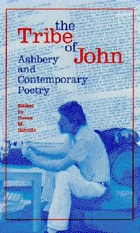
The Tribe of John
Ashbery and Contemporary PoetrySusan M. Schultz
University of Alabama Press, 1995
This concentration on Ashbery's influence on contemporary American poetry provides new methods for interpreting and understanding his poetic achievement.
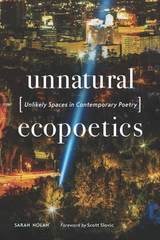
Unnatural Ecopoetics
Unlikely Spaces in Contemporary PoetrySarah Nolan
University of Nevada Press, 2017
By approaching environments in a new way, Nolan closes this gap and recognizes how contemporary poets employ self-reflexive commentary and formal experimentation in order to create new natural/cultural environments on the page. She proposes a radical new direction for ecopoetics and deploys it in relation to four major American poets. Working from literal to textual spaces through the contemporary poetry of A.R. Ammons’s Garbage, Lyn Hejinian’s My Life, Susan Howe’s The Midnight, and Kenneth Goldsmith’s Seven American Deaths and Disasters, the book presents applications of unnatural ecopoetics in poetic environments, ones that do not engage with traditional ideas of nature and would otherwise remain outside the scope of ecocritical and ecopoetic studies.
Nolan proposes a new practical approach for reading poetic language. Ecocriticism is a very fluid and evolving discipline, and Nolan’s pioneering new book pushes the boundaries of second-wave ecopoetics—the fundamental issue being what is nature/natural, and how does poetic language, particularly self-conscious contemporary poetic agency, contribute to and complicate that question.
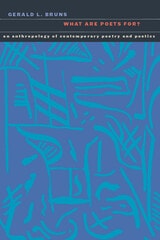
What Are Poets For?
An Anthropology of Contemporary Poetry and PoeticsGerald L. Bruns
University of Iowa Press, 2012
Conceptions and practices of poetry change not only from time to time and from place to place but also from poet to poet. This has never been more the case than in recent years. Gerald Bruns’s magisterial What Are Poets For? explores typographical experiments that distribute letters randomly across a printed page, sound tracks made of vocal and buccal noises, and holographic poems that recompose themselves as one travels through their digital space. Bruns surveys one-word poems, found texts, and book-length assemblies of disconnected phrases; he even includes descriptions of poems that no one could possibly write, but which are no less interesting (or no less poetic) for all of that. The purpose of the book is to illuminate this strange poetic landscape, spotlighting and describing such oddities as they appear, anomalies that most contemporary poetry criticism ignores.