Results by title
5 books match the query 'Contemporary Religion'
Baha'i
Studies in Contemporary ReligionMargit Warburg
Signature Books, 2001
In fact, Baha’i draws on a diverse heritage that encompasses both East and West. Reflecting their Islamic roots, they observe daily prayers and the reading of sacred texts; a month of fast; pilgrimage to Haifa, Israel, where the religion’s relics are preserved; and abstinence from alcohol. They face toward their prophet Baha’u'llah’s resting place when praying, which is reminiscent of Muslims facing Mecca to pray.
In other ways, the Baha’i religion has dissociated itself from orthodox Shi’ism. Adherents avoid communal prayer, reject the idea of a professional clergy, promote gender equality, and devote a great deal of attention to education, health care, and environmental issues. They work actively through the United Nations system to promote their view of a new world order of peace and harmony that they feel will one day unify humankind across all nations, races, and religions.
Hare Krishna
(Studies in Contemporary Religion)Federico Squarcini
Signature Books, 2004
When Bhaktivedanta arrived in America, it was a bold step because historically a guru who ventured outside of India was stripped of his Brahman status. However, the effort bore fruit—not the least of which was the type of intercultural understanding promoted by the current authors through their study of ISKCON’s place within the religion and culture of India.
Osho Rajneesh
Studies in Contemporary ReligionJudith M. Fox
Signature Books, 2002
Highly unorthodox, he courted controversy and was condemned for being a “sex guru.” His Oregon headquarters, Rajneeshpuram, proved to be a short-lived utopia that provoked antagonism and only added to his notoriety. But his ashram in Poona, India, continues to thrive, as do Osho centers in Europe and elsewhere. His adherents number in the thousands. His books have become bestsellers around the globe.
Soka Gakkai
Studies in Contemporary ReligionKarel Dobbelaere
Signature Books, 2001
Professor Dobbelaere points to several reasons for its growth. Soka Gakkai emphasizes inner peace rather than rules of behavior or hierarchical allegiance. Sociologists describe it as “trans-modern,” meaning that it blends ancient and contemporary sensitivities such as Buddhist mysticism, science, art and music, a concern for the environment, and social activism.
Initially there was a reliance on aggressive proselyting, later replaced with a more moderate encouragement to share with friends. The movement now engages other faiths in cultural and intellectual exchanges and in pursuit of common ethical objectives. This adaptability and sincere concern for its membership and for society as a whole bode well for its future success.
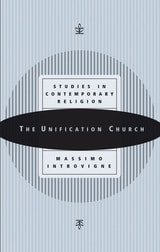
The Unification Church
Studies in Contemporary ReligionMassimo Introvigne
Signature Books, 2000
Where they depart from traditional Christianity is in their acceptance of the Divine Principle as a companion to the Bible and in their assertion that founder Rev. Sun Myung Moon is Lord of the Second Advent, that with his wife (together the “True Parents”), Original Sin is conquered through special blessings.
Since 1954 Unificationism has evolved toward a more normative approach to worship and lifestyle, if not belief—a point that Italian scholar Massimo Introvigne emphasizes in his balanced overview of the church’s history, doctrine, spirituality, missionary activities, and controversies. He notes that in doctrine Unificationism has moved away from mainstream churches toward increased emphasis on contact with the spirit world, numerology, and construction of a modern “Garden of Eden” in Brazil.