Results by title
3 books match the query 'Contemporary Russia'
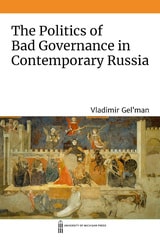
The Politics of Bad Governance in Contemporary Russia
Vladimir Gel'man
University of Michigan Press, 2022
In this book, Vladimir Gel’man considers bad governance as a distinctive politico-economic order that is based on a set of formal and informal rules, norms, and practices quite different from those of good governance. Some countries are governed badly intentionally because the political leaders of these countries establish and maintain rules, norms, and practices that serve their own self-interests. Gel’man considers bad governance as a primarily agency-driven rather than structure-induced phenomenon. He addresses the issue of causes and mechanisms of bad governance in Russia and beyond from a different scholarly optics, which is based on a more general rationale of state-building, political regime dynamics, and policy-making. He argues that although these days, bad governance is almost universally perceived as an anomaly, at least in developed countries, in fact human history is largely a history of ineffective and corrupt governments, while the rule of law and decent state regulatory quality are relatively recent matters of modern history, when they emerged as side effects of state-building. Indeed, the picture is quite the opposite: bad governance is the norm, while good governance is an exception. The problem is that most rulers, especially if their time horizons are short and the external constraints on their behavior are not especially binding, tend to govern their domains in a predatory way because of the prevalence of short-term over long-term incentives. Contemporary Russia may be considered as a prime example of this phenomenon. Using an analysis of case studies of political and policy changes in Russia after the Soviet collapse, Gel’man discusses the logic of building and maintaining the politico-economic order of bad governance in Russia and paths of its possible transformation in a theoretical and comparative perspective.
[more]
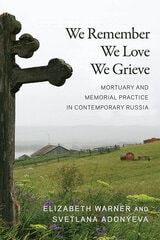
We Remember, We Love, We Grieve
Mortuary and Memorial Practice in Contemporary RussiaElizabeth Warner and Svetlana Adonyeva
University of Wisconsin Press, 2021
This is a book about death, comprehensive in its discussion of strategies for coping with loss and grief in rural northern Russia. Elizabeth Warner and Svetlana Adonyeva bring forth the voices of those for whom caring for their dead is deeply personal and firmly rooted in practices of everyday life. Thoroughly researched chapters consider lamenting traditions, examine beliefs surrounding natural symbols, and parse sensitive and profound funereal rituals.
“We remember, we love, we grieve” is a common epitaph in this part of the world. As contemporary Russia contends with the Soviet Union’s legacy of dismantling older ways of life, the phrase ripples beyond individual loss—it encapsulates communities’ determination to preserve their customs when faced with oppression. This volume offers insight into a core cultural practice, exploring the dynamism of tradition.
“We remember, we love, we grieve” is a common epitaph in this part of the world. As contemporary Russia contends with the Soviet Union’s legacy of dismantling older ways of life, the phrase ripples beyond individual loss—it encapsulates communities’ determination to preserve their customs when faced with oppression. This volume offers insight into a core cultural practice, exploring the dynamism of tradition.
[more]

Women's Activism in Contemporary Russia
Linda Racioppi
Temple University Press, 1997
Through in-depth interviews with activists, the authors provide a broad and thorough introduction to the emerging women's movement and women's organizations in Russia. The focus is on the development of women's activism in late Soviet and post-Soviet Russia and the challenges for activists in a time of resurgent nationalism and turmoil over democratic reform.
Linda Racioppi and Katherine O'Sullivan See present a concise history of women's situation in tsarist Soviet Russia, which shows how their ability to organize was constrained by social strictures and state policies. They also analyze how the state-sponsored Soviet Women's Committee and new groups like the Independent Women's Forum, the Women's League, and the International Institute for Entrepreneurial Development responded to the challenges and opportunities of the transition. The authors examine the dynamics among these groups as well. The personal life histories of the activists reflect the ways women have responded to the changing political, economic, and social landscape in the former Soviet Union.
Linda Racioppi and Katherine O'Sullivan See present a concise history of women's situation in tsarist Soviet Russia, which shows how their ability to organize was constrained by social strictures and state policies. They also analyze how the state-sponsored Soviet Women's Committee and new groups like the Independent Women's Forum, the Women's League, and the International Institute for Entrepreneurial Development responded to the challenges and opportunities of the transition. The authors examine the dynamics among these groups as well. The personal life histories of the activists reflect the ways women have responded to the changing political, economic, and social landscape in the former Soviet Union.
[more]