Results by title
3 books match the query 'Contemporary Society'
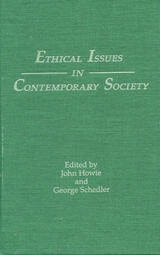
Ethical Issues in Contemporary Society
John Howie
Southern Illinois University Press, 1995
In this volume of Leys Lectures, the third collection of Wayne Leys Memorial Lectures, six distinguished essayists demonstrate the relevance of ethics to contemporary concerns by constructively exploring major ethical issues deeply embedded in our society.
The essays, written by noted scholars Tom Regan, Carol C. Gould, James Rachels, James P. Sterba, Louis P. Pojman, and David L. Norton, focus on issues of feminism, the exploitation of animals, economic injustice, racial prejudice, naive moral relativism, and the failure of public education.
Tom Regan and Louis P. Pojman both address the issue of animal rights. Regan directs his attention to an ethic-of-care feminism, which contends that the ideology of male superiority—not only to women but to all creatures—must be destroyed. By means of a "consistency argument," he extends ethic-of-care feminism to the treatment of animals, insisting that we must not permit to be done to animals "in the name of science" what we would not allow to be done to human beings. Pojman, on the other hand, addresses the question of animal rights through a critical analysis of seven theories of the moral status of animals, arguing that while animals have no natural "rights" since they are unable to enter into contracts, they do deserve to be treated kindly. In his view, much animal research could be abandoned without significant loss.
What rethinking of democracy in terms of freedom and equality is required by economic justice? Carol C. Gould offers an answer to this question by arguing that economic justice requires that workers control the production process as well as the distribution process. Such justice would provide the basis of "positive freedom" as self-development without ignoring the importance of the absence of constraints.
Taking racial prejudice as his paradigm, James Rachels explores the deeper meaning of prejudice and what equality of treatment involves. Noting the subtlety of prejudicial reasoning, he examines how stereotypes, unconscious bias, and the human tendency toward rationalization make it difficult even for people of good will to prevent prejudice from influencing their actions.
James P. Sterba invites the reader to consider a different and more general problem of how to persuade people to act for moral reasons. To accomplish this aim he shows morality to be a requirement of rationality and "the welfare liberal ideal" (the right to welfare and the right to equal opportunity) to be a fusion of the practical ends of five ideals—liberty, fairness, common good, androgyny, and equality.
For David L. Norton, one of our most pressing problems is the failure of our educational system. The system fails to enable students to make wise "life-shaping" choices involving vocation, marriage, children, and friendship. In order to make good choices, human beings must live and work in an environment that provides experiences that authenticate "personal truths" indispensable to worthy living. These personal truths include direct acquaintance with vocational alternatives and participation in actual service to others.
Collectively, these essays bring into sharp focus the urgent moral issues confronting our society and the need for ongoing discussion and examination of these issues in order to gain deeper understanding of and possible solutions to the problems they present.
Natural Moral Law in Contemporary Society
Holger Zaborowski
Catholic University of America Press, 2010
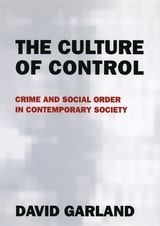
The Culture of Control
Crime and Social Order in Contemporary SocietyDavid Garland
University of Chicago Press, 2001
Garland explains how the new policies of crime and punishment, welfare and security—and the changing class, race, and gender relations that underpin them—are linked to the fundamental problems of governing contemporary societies, as states, corporations, and private citizens grapple with a volatile economy and a culture that combines expanded personal freedom with relaxed social controls. It is the risky, unfixed character of modern life that underlies our accelerating concern with control and crime control in particular. It is not just crime that has changed; society has changed as well, and this transformation has reshaped criminological thought, public policy, and the cultural meaning of crime and criminals. David Garland's The Culture of Control offers a brilliant guide to this process and its still-reverberating consequences.