Results by title
6 books match the query 'Contention'

Bones of Contention
Controversies in the Search for Human OriginsRoger Lewin
University of Chicago Press, 1997
in many ways, remains contentious.
"[An] un-put-downable book."—John Gribbon, Times Educational Supplement
"Not just another 'stones and bones' account of human evolution. It is Lewin's thesis, amply demonstrated, that paleoanthropology is the most subjective of sciences because it engages the emotions of virtually everyone; and since the evidence is scrappy, interpretation is everything. . . . A splendid, stirring, and eye-opening account, to be devoured."—Kirkus Reviews, starred review
"[Lewin shows] 'how very unscientific the process of scientific inquiry can be.'. . . Bones of Contention is . . . serious intellectual history."—Edward Dolnick, Wall Street Journal
"[Lewin] documents his thesis in persuasive detail. . . . The reader is carried along by the power of Mr. Lewin's reporting."—Robert Wright, New York Times Book Review

Bones of Contention
The living archive of Vasil Levski and the making of Bulgaria's national heroMaria Todorova
Central European University Press, 2009
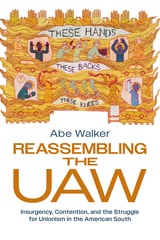
Reassembling the UAW
Insurgency, Contention, and the Struggle for Unionism in the American SouthAbe Walker
Temple University Press, 2026
Abe Walker chronicles the organizing campaign from its origin in 2014 to the union’s breakthrough victory in 2024, illustrating what went wrong—and what went right—along the way. Walker provides a systematic analysis of the strategic challenges and tactical shifts, showing the patterns that persisted across three election cycles while highlighting their differences, from global-level alliances to local labor issues.
Reassembling the UAW also demonstrates how rebel rank-and-file workers ousted the old-guard leadership and transformed the UAW into a militant union to achieve results. Ultimately, Walker offers valuable lessons for organizational strategy, the power of collective action, and the future of the labor movement.
Regimes of Contention
Resistance and the Governmentality of Resources in Indigenous PhilippinesMacario Lacbawan
Campus Verlag, 2021
The notion of indigeneity in the Philippines is politically fraught. Most who live on the archipelago are descendants of aboriginal peoples, whether they claim tribal affiliation or not, and those who do enact traditional identities share little else in common. As a result, the term “indigenous” remains unstable and malleable seventy-five years after independence. Connecting insights from Tillian and Foucauldian social theory, Regimes illuminates how the ever-changing Philippine state, from the 1970s through today, constructs artificial subjectivities that Indigenous peoples must embody to access ancestral resources held by the federal government. What emerges is a lucid illustration of how governmentality is entangled with indigeneity in the Philippines.

Solidarity And Contention
Networks Of Polish OppositionMaryjane Osa
University of Minnesota Press, 2003
Offers an innovative model for understanding how social movements occur in repressive societies
After a series of failed attempts at mobilizing society, Poland’s opposition sprang to surprising—and newly effective—life with the formation of the Solidarity trade union in 1980. If not for those past failures, this book suggests, Solidarity might never have succeeded. Solidarity and Contention deftly reconstructs the networks of protest in Communist Poland to show how waves of dissent during the 1950s, 1960s, and 1970s left an organizational residue that both instructed and enabled Solidarity and, ultimately, the Polish revolution.
Using newly available documentary sources, Maryjane Osa establishes links between activists during three waves of protest: 1954 to 1959, 1966 to 1970, and 1976 to 1980. She shows how political challengers, applying lessons drawn from past failures, developed an ideological formula to de-emphasize divisive issues and promote symbolic concerns, thus facilitating coalition building. Solidarity was therefore able to take advantage of a large opposition network already well in place before the founding of the union. An important case study in itself, the book also answers one of the most intriguing questions in social movement research: how can movements emerge in authoritarian states—where media are state controlled, the rights of assembly and speech are restricted, and the risks of collective action are high?
Stones of Contention
A History of Africa’s DiamondsTodd Cleveland
Ohio University Press, 2014
Africa supplies the majority of the world’s diamonds, yet consumers generally know little about the origins and history of these precious stones beyond sensationalized media accounts of so-called blood diamonds.
Stones of Contention explores the major developments in the remarkable history of Africa’s diamonds, from the earliest stirrings of international interest in the continent’s mineral wealth in the first millennium A.D. to the present day. In the European colonial period, the discovery of diamonds in South Africa ushered in an era of unprecedented greed during which monopolistic enterprises exploited both the mineral resources and the indigenous workforce. In the aftermath of World War II, the governments of newly independent African states, both democratic and despotic, joined industry giant De Beers and other corporations to oversee and profit from mining activity on the continent.
The book also considers the experiences of a wide array of Africans—from informal artisanal miners, company mineworkers, and indigenous authorities to armed rebels, mining executives, and premiers of mineral-rich states—and their relationships to the stones that have the power to bring both wealth and misery. With photos and maps, Stones of Contention illustrates the scope and complexity of the African diamond trade as well as its impact on individuals and societies.