Results by title
8 books match the query 'Continental philosophy'

A Thing of This World
A History of Continental Anti-RealismLee Braver
Northwestern University Press, 2007
Using a framework derived from prominent analytic thinkers, Lee Braver traces the roots of anti-realism to Kant's idea that the mind actively organizes experience. He then shows in depth and in detail how this idea evolves through the works of Hegel, Nietzsche, Heidegger, Foucault, and Derrida. This narrative presents an illuminating account of the
history of continental philosophy by explaining how these thinkers build on each other's attempts to develop new concepts of reality and truth in the wake of the rejection of realism. Braver demonstrates that the analytic and continental traditions have been discussing the same issues, albeit with different vocabularies, interests, and approaches.
By developing a commensurate vocabulary, his book promotes a dialogue between the two branches of philosophy in which each can begin to learn from the other.

Displacing Christian Origins
Philosophy, Secularity, and the New TestamentWard Blanton
University of Chicago Press, 2007
Displacing Christian Origins traces the current critical engagement of Agamben, Derrida, and Žižek, among others, back into nineteenth- and early-twentieth-century philosophers of early Christianity. By comparing these crucial moments in the modern history of philosophy with exemplars of modern biblical scholarship—David Friedrich Strauss, Adolf Deissmann, and Albert Schweitzer—Blanton offers a new way for critical theory to construe the relationship between the modern past and the biblical traditions to which we seem to be drawn once again.
An innovative contribution to the intellectual history of biblical exegesis, Displacing Christian Origins will promote informed and fruitful debate between religion and philosophy.

Emerging Trends in Continental Philosophy
Edited by Todd May
University of Chicago Press, 2010
From Kant to Kierkegaard, from Hegel to Heidegger, continental philosophers have indelibly shaped the trajectory of Western thought since the eighteenth century. Although much has been written about these monumental thinkers, students and scholars lack a definitive guide to the entire scope of the continental tradition. The most comprehensive reference work to date, this eight-volume History of Continental Philosophy will both encapsulate the subject and reorient our understanding of it. Beginning with an overview of Kant’s philosophy and its initial reception, the History traces the evolution of continental philosophy through major figures as well as movements such as existentialism, phenomenology, hermeneutics, and poststructuralism. The final volume outlines the current state of the field, bringing the work of both historical and modern thinkers to bear on such contemporary topics as feminism, globalization, and the environment. Throughout, the volumes examine important philosophical figures and developments in their historical, political, and cultural contexts.
The first reference of its kind, A History of Continental Philosophy has been written and edited by internationally recognized experts with a commitment to explaining complex thinkers, texts, and movements in rigorous yet jargon-free essays suitable for both undergraduates and seasoned specialists. These volumes also elucidate ongoing debates about the nature of continental and analytic philosophy, surveying the distinctive, sometimes overlapping characteristics and approaches of each tradition. Featuring helpful overviews of major topics and plotting road maps to their underlying contexts, A History of Continental Philosophy is destined to be the resource of first and last resort for students and scholars alike.

John Dewey and Continental Philosophy
Edited by Paul Fairfield
Southern Illinois University Press, 2010
“These essays build a valuable, if virtual, bridge between the thought of John Dewey and that of a host of modern European philosophers. They invite us to entertain a set of imagined conversations among the mighty dead that no doubt would have intrigued Dewey and each of the interlocutors gathered here.”—Robert Westbrook, author of John Dewey and American Democracy and/or Democratic Hope: Pragmatism and the Politics of Truth.
John Dewey and Continental Philosophy provides a rich sampling of exchanges that could have taken place long ago between the traditions of American pragmatism and continental philosophy had the lines of communication been more open between Dewey and his European contemporaries. Since they were not, Paul Fairfield and thirteen of his colleagues seek to remedy the situation by bringing the philosophy of Dewey into conversation with several currents in continental philosophical thought, from post-Kantian idealism and the work of Friedrich Nietzsche to twentieth-century phenomenology, hermeneutics, and poststructuralism.
John Dewey and Continental Philosophy demonstrates some of the many connections and opportunities for cross-traditional thinking that have long existed between Dewey and continental thought, but have been under-explored. The intersection presented here between Dewey’s pragmatism and the European traditions makes a significant contribution to continental and American philosophy and will spur new and important developments in the American philosophical debate.
Kant, Kantianism, and Idealism
The Origins of Continental PhilosophyEdited by Thomas J. Nenon
University of Chicago Press, 2010
From Kant to Kierkegaard, from Hegel to Heidegger, continental philosophers have indelibly shaped the trajectory of Western thought since the eighteenth century. Although much has been written about these monumental thinkers, students and scholars lack a definitive guide to the entire scope of the continental tradition. The most comprehensive reference work to date, this eight-volume History of Continental Philosophy will both encapsulate the subject and reorient our understanding of it. Beginning with an overview of Kant’s philosophy and its initial reception, the History traces the evolution of continental philosophy through major figures as well as movements such as existentialism, phenomenology, hermeneutics, and poststructuralism. The final volume outlines the current state of the field, bringing the work of both historical and modern thinkers to bear on such contemporary topics as feminism, globalization, and the environment. Throughout, the volumes examine important philosophical figures and developments in their historical, political, and cultural contexts.
The first reference of its kind, A History of Continental Philosophy has been written and edited by internationally recognized experts with a commitment to explaining complex thinkers, texts, and movements in rigorous yet jargon-free essays suitable for both undergraduates and seasoned specialists. These volumes also elucidate ongoing debates about the nature of continental and analytic philosophy, surveying the distinctive, sometimes overlapping characteristics and approaches of each tradition. Featuring helpful overviews of major topics and plotting road maps to their underlying contexts, A History of Continental Philosophy is destined to be the resource of first and last resort for students and scholars alike.

Philosophical Topics 27.2
The Intersection of Analytic and Continental PhilosophyHubert L. Dreyfus
University of Arkansas Press, 1999
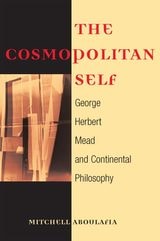
The Cosmopolitan Self
George Herbert Mead and Continental PhilosophyMitchell Aboulafia
University of Illinois Press, 2001
In this incisive commentary, Mitchell Aboulafia examines the relevance of the American pragmatist philosopher George Herbert Mead to current debates on pluralism, universalism, and the fostering of a democratic temper. Addressing the relationship between Mead's notions of self and society and those of important continental thinkers, The Cosmopolitan Self demonstrates that Mead's ideas not only speak to resolving the tension between universalism and pluralism, they do so in a manner that challenges and advances the positions of these continental theoreticians.
Aboulafia examines how Mead's insights illuminate Hannah Arendt's reading of Immanual Kant's third Critique and Jürgen Habermas's understanding of the relationship among communicative action, universality, and individuation. Teasing out strands of agreement and disagreement among Mead and these theorists on topics such as impartiality and good judgment, Aboulafia develops a conception of universalism that is compatible with contemporary notions of pluralism. He also addresses the serious challenge presented to Mead's approach to pluralism by Emmanuel Levinas, who holds that true pluralism, presupposing an irreducible individualism, is fundamentally irreconcilable with universalism.
The Cosmopolitan Self offers a model of the democratically inclined individual who embodies both a capacity to establish common ground with others and a sensitivity to their uniqueness. This important volume appreciably advances the dialogue between continental thought and classical American philosophy.

The History of Continental Philosophy
Edited by Alan D. Schrift
University of Chicago Press, 2010
From Kant to Kierkegaard, from Hegel to Heidegger, continental philosophers have indelibly shaped the trajectory of Western thought since the eighteenth century. Although much has been written about these monumental thinkers, students and scholars lack a definitive guide to the entire scope of the continental tradition. The most comprehensive reference work to date, this eight-volume History of Continental Philosophy will both encapsulate the subject and reorient our understanding of it. Beginning with an overview of Kant’s philosophy and its initial reception, the History traces the evolution of continental philosophy through major figures as well as movements such as existentialism, phenomenology, hermeneutics, and poststructuralism. The final volume outlines the current state of the field, bringing the work of both historical and modern thinkers to bear on such contemporary topics as feminism, globalization, and the environment. Throughout, the volumes examine important philosophical figures and developments in their historical, political, and cultural contexts.
The first reference of its kind, A History of Continental Philosophy has been written and edited by internationally recognized experts with a commitment to explaining complex thinkers, texts, and movements in rigorous yet jargon-free essays suitable for both undergraduates and seasoned specialists. These volumes also elucidate ongoing debates about the nature of continental and analytic philosophy, surveying the distinctive, sometimes overlapping characteristics and approaches of each tradition. Featuring helpful overviews of major topics and plotting road maps to their underlying contexts, A History of Continental Philosophy is destined to be the resource of first and last resort for students and scholars alike.