Results by title
6 books match the query 'Continuities'

Celestina's Brood
Continuities of the Baroque in Spanish and Latin American LiteratureRoberto González-Echevarría
Duke University Press, 1993
Roberto González Echevarría, one of the most eminent and influential critics of Hispanic literature writing today, uses Rojas' text as his starting point to offer an exploration of modernity in the Hispanic literary tradition, and of the Baroque as an expression of the modern. His analysis of Celestina reveals the relentless probing of the limits of language and morality that mark the work as the beginning of literary modernity in Spanish, and the start of a tradition distinguished by a penchant for the excesses of the Baroque. González Echevarría pursues this tradition and its meaning through the works of major figures such as Cervantes, Lope de Vega, Calderón de la Barca, Alejo Carpentier, Carlos Fuentes, Gabriel García Márquez, Nicolás Guillén, and Severo Sarduy, as well as through the works of lesser-known authors.
By revealing continuities of the Baroque, Celestina's Brood cuts across conventional distinctions between Spanish and Latin American literary traditions to show their profound and previously unimagined affinity.

Continuities in Popular Culture
The Present in the Past and the Past in the Present and FutureEdited by Ray B. Brown and Ronald J. Ambrosetti
University of Wisconsin Press, 1993
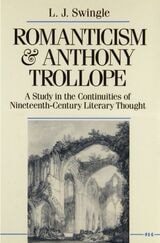
Romanticism and Anthony Trollope
A Study in the Continuities of Nineteenth-Century Literary ThoughtL. J. Swingle
University of Michigan Press, 1990
Sociology for the Twenty-first Century
Continuities and Cutting EdgesEdited by Janet L. Abu-Lughod
University of Chicago Press, 1999
The chapters in part 1 revise theory and methods to comprehend the economic and political institutions that increasingly dominate the lives of individuals and groups, arguing that these giants must be made more democratically accountable. Part 2 explores the social effects that growing globalization, transnationalization, and information technologies are having on politics, economics, and the environment. The final chapters compare how new immigrants from increasingly diversified backgrounds are being absorbed in Canada and the United States, exploring the impact that immigrants are having on preexisting ethnic minorities and on the dominant political culture.
While it is a major attempt to refocus the discipline of sociology, the book's clear, nontechnical style and its attention to issues of central concern to all citizens make it also highly accessible to nonspecialists.
Contributors are Janet L. Abu-Lughod, Tomas Almaguer, Giovanni Arrighi, Gilles Bourque, Randall Collins, Jules Duchastel, Joe Feagin, Harriet Friedmann, Pierre Hamel, Moon-Kie Jung, Joel Levine, Henri Lustiger-Thaler, Louis Maheu, Joel Perlmann, Saskia Sassen, Gideon Sjoberg, Dorothy Smith, Roger Waldinger, and Barry Wellman.
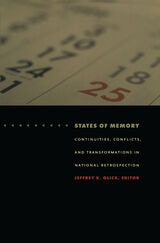
States of Memory
Continuities, Conflicts, and Transformations in National RetrospectionJeffrey K. Olick, ed.
Duke University Press, 2003
The contributors—including historians and social scientists—describe societies’ struggles to produce and then use ideas of what a “normal” past should look like. They examine claims about the genuineness of revolution (in fascist Italy and communist Russia), of inclusiveness (in the United States and Australia), of innocence (in Germany), and of inevitability (in Israel). Essayists explore the reputation of Confucius among Maoist leaders during China’s Cultural Revolution; commemorations of Martin Luther King Jr. in the United States Congress; the “end” of the postwar era in Japan; and how national calendars—in signifying what to remember, celebrate, and mourn—structure national identification. Above all, these essays reveal that memory is never unitary, no matter how hard various powers strive to make it so.
States of Memory will appeal to those scholars—in sociology, history, political science, cultural studies, anthropology, and art history-who are interested in collective memory, commemoration, nationalism, and state formation.
Contributors. Paloma Aguilar, Frederick C. Corney, Carol Gluck, Matt K. Matsuda, Jeffrey K. Olick, Francesca Polletta, Uri Ram, Barry Schwartz, Lyn Spillman, Charles Tilly, Simonetta Falasca Zamponi, Eviatar Zerubavel, Tong Zhang
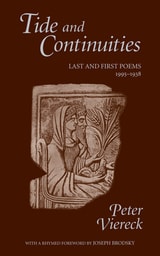
Tide and Continuities
Last and First Poems, 1995-1938Peter Viereck
University of Arkansas Press, 1995
Peter Viereck’s career in poetry is an ongoing experiment in the symbiosis of poetry and history. In Tide and Continuities that experiment has yielded its finest results. Included are many new poems, never before published, and stunning revisions from work as recent as his 1987 epic, Archer in the Marrow: The Applewood Cycles, and as early as his 1948 Pulitzer Prize-winning collection, Terror and Decorum.
This collection is the revelation of a great American poet. The Nobel laureate Joseph Brodsky calls Viereck “possibly the greatest rhymer of / the modern period.” This is Viereck’s most lyrical, most passionate book; hence Brodsky rhymes “lyric” with “Viereck.”
Tide and Continuities marks Viereck’s complete evolution as a poet, and brilliantly describes the arc of more than a half century’s work.