Results by title
3 books match the query 'Contract'

A Probable State
The Novel, the Contract, and the JewsIrene Tucker
University of Chicago Press, 2000
Whereas previous critics have explored the relationship between liberalism and the novel by studying the novel's liberal characters, Tucker argues that the liberal subject is represented not merely within the novel, but in the experience of the novel's form as well. With special attention to George Eliot, Henry James, Oliver Wendell Holmes, and S. Y. Abramovitch, Tucker shows how we can understand liberalism and the novel as modes of recognizing and negotiating with history.
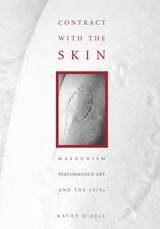
Contract With The Skin
Masochism, Performance Art, and the 1970sKathy O'Dell
University of Minnesota Press, 1998
Places masochistic performance within a social and historical context.
Having yourself shot. Putting out fires with your bare hands and feet. Biting your own body and photographing the marks. Sewing your own mouth shut. These seemingly aberrant acts were committed by performance artists during the 1970s. Why would anyone do these things? What do these kinds of masochistic performances tell us about the social and historical context in which they occurred? Fascinating and accessibly written, Contract with the Skin addresses such questions through a reconsideration of these acts in relation to psychoanalytic and legal concepts of masochism.
O’Dell argues that the growth of masochistic performance during the 1970s must be seen in the context of society’s response to the Vietnam War and contemporaneous changes in theories of contract. She contends that the dynamic that exists between audience and performer during these masochistic acts relates to tensions resulting from ruptures in the social contract. Indeed, as the war in Vietnam waned, so did masochistic performance, only to reemerge in the 1980s in relation to the “war on AIDS” and the censorious “culture wars.”Focusing on 1970s performance artists Vito Acconci, Chris Burden, Gina Pane, and collaborators Marina Abramovi´c/Ulay as well as those with similar sensibilities from the late 1980s onward (Bob Flanagan, David Wojnarowicz, Simon Leung, Catherine Opie, Ron Athey, Lutz Bacher, and Robby Garfinkel), O’Dell provides photographic documentation of performances and quotations from interviews with many of the artists. Throughout, O’Dell asks what we can do about the institutionalized forms of masochism for which these performances are metaphors. Contract with the Skin is a provocative guide to this little-studied area, and offers new ways of thinking about performance art and artistic production.
DEATH OF CONTRACT
SECOND EDITIONGrant Gilmore / Edited by Ronald K. L. Collins
The Ohio State University Press, 1995
The second edition, with an instructive and timely foreword by Ronald K. L. Collins, challenges anyone interested in the life of the law to think about where it has come from and where it is trending. A new bibliography of early reviews and contemporary responses reveals how considerable the interest was, and continues to be, in this modern anti-classic.