Results by title
11 books match the query 'Contracting out'

Going Private
Outsourcing the Administrative StateRachel Augustine Potter
University of Chicago Press, 2027
Shows how the proliferation of contractors within the federal agencies is fundamentally reshaping American governance.
Much of what the federal government does today is carried out by people the public rarely sees. While debates focus on bureaucrats and political appointees, agencies increasingly rely on a vast contractor workforce to perform functions ranging from tech support to policy analysis to regulatory drafting services. This quiet transformation has altered how the government functions while simultaneously preserving the public-facing image of a bureaucracy run by civil servants. The federal government does not keep reliable data on how many contractors it employs, but many estimates suggest that contractors outnumber career bureaucrats.
In Going Private, Rachel Augustine Potter explains how this shift reshapes the everyday operation of the administrative state and coalesces power within the presidency. Easily hired and easily fired, contractors have strong incentives to please their clients, making them malleable to the president’s will. Presidents from both parties have leveraged these features and learned to rely on contractors to advance political priorities, bypass uncooperative bureaucrats, and gain increased control over agency work.
Drawing on new data and interviews, Going Private argues that outsourcing is not merely an administrative convenience. Rather, it is a defining feature of contemporary governance—one that complicates accountability, blurs the boundaries of the administrative state, and alters the exercise of presidential power.

International Trade in Services and Intangibles in the Era of Globalization
Edited by Marshall B. Reinsdorf and Matthew J. Slaughter
University of Chicago Press, 2009
Quantitative measures of international exchange have historically focused on trade in tangible products or capital. However, services have recently become a larger portion of developed economies and international trade, and will only increase in the future. In International Trade in Services and Intangibles in the Era of Globalization, Marshall Reinsdorf and Matthew J. Slaughter examine new and emerging patterns of trade, especially the growing importance of transactions involving services or intangible assets such as intellectual property.
A distinguished team of contributors analyzes the challenges involved in measuring trade in intangibles, the comparative advantages enjoyed by United States service industries, and the heightened international competition for jobs, capital investment, economic growth, and tax revenue that results from trade in services. This comprehensive volume will be necessary reading for scholars seeking to understand the rapidly changing global economy.

Library Technology Buying Strategies
Marshall Breeding
American Library Association, 2016
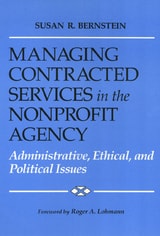
Managing Contracted Services in the Nonprofit Agency
Administrative, Ethical, and Political IssuesSusan R. Bernstein, foreword by Roger A. Lohmann
Temple University Press, 1991
Through interviews conducted with nonprofit agency managers in the New York City metropolitan area, Susan Bernstein vividly describes their experiences with "contracting out," the principal way that the "reluctant" American welfare state has of providing public services through the private sector. The agency administrators look upon this as a nightmarish game and their stories illuminate how welfare state mechanisms work in practice as well as the tangled nature of bureaucracies Bernstein illustrates and analyzes these administrators’ strategies for managing the administrative, ethical, and political issues of contracted services. Managing Contracted Services is one of the first books to examine how administrators manage contracted services in a bureaucratic and political environment.

Medical Research for Hire
The Political Economy of Pharmaceutical Clinical TrialsFisher, Jill A
Rutgers University Press, 2008
According to Jill A. Fisher, this major change in the way medical research is performed is the outcome of two problems in U.S. health care: decreasing revenue for physicians and decreasing access to treatment for patients. As physicians report diminishing income due to restrictive relationships with insurers, increasing malpractice insurance premiums, and inflated overhead costs to operate private practices, they are attracted to pharmaceutical contract research for its lucrative return. Clinical trials also provide limited medical access to individuals who have no or inadequate health insurance because they offer "free" doctors' visits, diagnostic tests, and medications to participants. Focusing on the professional roles of those involved, as well as key research practices, Fisher assesses the risks and advantages for physicians and patients alike when pharmaceutical drug studies are used as an alternative to standard medical care.
A volume in the Critical Issues in Health and Medicine series, edited by Rima D. Apple and Janet Golden

Monumental Ambivalence
The Politics of HeritageBy Lisa C. Breglia
University of Texas Press, 2006
From ancient Maya cities in Mexico and Central America to the Taj Mahal in India, cultural heritage sites around the world are being drawn into the wave of privatization that has already swept through such economic sectors as telecommunications, transportation, and utilities. As nation-states decide they can no longer afford to maintain cultural properties—or find it economically advantageous not to do so in the globalizing economy—private actors are stepping in to excavate, conserve, interpret, and represent archaeological and historical sites. But what are the ramifications when a multinational corporation, or even an indigenous village, owns a piece of national patrimony which holds cultural and perhaps sacred meaning for all the country's people, as well as for visitors from the rest of the world?
In this ambitious book, Lisa Breglia investigates "heritage" as an arena in which a variety of private and public actors compete for the right to benefit, economically and otherwise, from controlling cultural patrimony. She presents ethnographic case studies of two archaeological sites in the Yucatán Peninsula—Chichén Itzá and Chunchucmil and their surrounding modern communities—to demonstrate how indigenous landholders, foreign archaeologists, and the Mexican state use heritage properties to position themselves as legitimate "heirs" and beneficiaries of Mexican national patrimony. Breglia's research masterfully describes the "monumental ambivalence" that results when local residents, excavation laborers, site managers, and state agencies all enact their claims to cultural patrimony. Her findings make it clear that informal and partial privatizations—which go on quietly and continually—are as real a threat to a nation's heritage as the prospect of fast-food restaurants and shopping centers in the ruins of a sacred site.

Private Prisons in America
A Critical Race PerspectiveMichael A. Hallett
University of Illinois Press, 2006

The Future of Futurity
Affective Capitalism and Potentiality in a Global CityPurnima Mankekar and Akhil Gupta
Duke University Press, 2025

The Politics of Solidarity
Privatisation, Precarious Work and Labour in South AfricaCarmen Ludwig
Campus Verlag, 2019
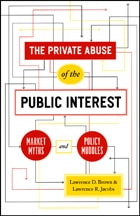
The Private Abuse of the Public Interest
Market Myths and Policy MuddlesLawrence D. Brown and Lawrence R. Jacobs
University of Chicago Press, 2008
The authors support their pragmatic approach with evidence drawn from in-depth analyses of education, transportation, and health care policies. In each policy area, initiatives such as school choice, deregulation of airlines and other carriers, and the promotion of managed care have introduced or enlarged the role of market forces with the aim of eliminating bureaucratic inefficiency. But in each case, the authors show, reality proved to be much more complex than market models predicted. This complexity has resulted in a political cycle—strikingly consistent across policy spheres—that culminates in public interventions to sustain markets while protecting citizens from their undesirable effects. Situating these case studies in the context of more than two hundred years of debate about the role of markets in society, Brown and Jacobs call for a renewed focus on public-private partnerships that recognize and respect each sector’s vital—and fundamentally complementary—role.

Virtual Migration
The Programming of GlobalizationA. Aneesh
Duke University Press, 2006
Aneesh draws on the sociology of science, social theory, and research on migration to illuminate the practical and theoretical ramifications of virtual migration. He combines these insights with his extensive ethnographic research in offices in three locations in India—in Delhi, Gurgaon, and Noida—and one in New Jersey. Aneesh contrasts virtual migration with “body shopping,” the more familiar practice of physically bringing programmers from other countries to work on site, in this case, bringing them from India to New Jersey. A significant contribution to the social theory of globalization, Virtual Migration maps the expanding transnational space where globalization is enacted via computer programming code.