Results by title
7 books match the query 'Control systems'

Code of Practice for Building Automation and Control Systems
The Institution of Engineering and Technology
The Institution of Engineering and Technology, 2020
Within the modern built environment, advanced engineering systems allow us to go about our daily lives in a relative degree of safety, comfort and security. Often, we do not give too much thought about what is happening behind the scenes.
[more]
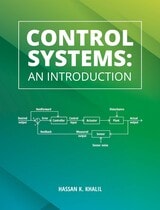
Control Systems
An IntroductionHassan K. Khalil
Michigan Publishing Services, 2023
The textbook Control Systems: An Introduction by Professor Hassan Khalil of Michigan State University is intended to serve the standard course on control systems commonly required by undergraduate degrees in electrical and computer engineering. The book introduces the mathematical tools used to characterize the operation of a wide range of control systems, from those used to control a car to travel at a specified speed to a more elaborate systems used to control the flight of a rocket.
[more]
Fault Diagnosis and Fault-Tolerant Control of Robotic and Autonomous Systems
Andrea Monteriù
The Institution of Engineering and Technology, 2020
Robotic systems have experienced exponential growth thanks to their incredible adaptability. Modern robots require an increasing level of autonomy, safety and reliability. This book addresses the challenges of increasing and ensuring reliability and safety of modern robotic and autonomous systems. The book provides an overview of research in this field to-date, and addresses advanced topics including fault diagnosis and fault-tolerant control, and the challenging technologies and applications in industrial robotics, robotic manipulators, mobile robots, and autonomous and semi-autonomous vehicles.
[more]
Flexible Robot Manipulators
Modelling, simulation and controlM. Osman Tokhi
The Institution of Engineering and Technology, 2008
The ever increasing utilisation of robotic manipulators for various applications in recent years has been motivated by the requirements and demands of industrial automation. Among these, attention is focused more towards flexible manipulators, due to various advantages they offer compared to their rigid counterparts. Flexural dynamics have constituted the main research challenge in modelling and control of such systems; research activities have accordingly concentrated on the development of methodologies to cope with this.
[more]
Language and Learning for Robots
Colleen Crangle and Patrick Suppes
CSLI, 1994
Robot technology will find wide-scale use only when a robotic device can be given commands and taught new tasks in a natural language. How could a robot understand instructions expressed in English? How could a robot learn from instructions? Crangle and Suppes begin to answer these questions through a theoretical approach to language and learning for robots and by experimental work with robots.
The authors develop the notion of an instructable robot—one which derives its intelligence in part from interaction with humans. Since verbal interaction with a robot requires a natural language semantics, the authors propose a natural-model semantics which they then apply to the interpretation of robot commands. Two experimental projects are described which provide natural-language interfaces to robotic aids for the physically disabled. The authors discuss the specific challenges posed by the interpretation of "stop" commands and the interpretation of spatial prepositions.
The authors also examine the use of explicit verbal instruction to teach a robot new procedures, propose ways a robot can learn from corrective commands containing qualitative spatial expressions, and discuss the machine-learning of a natural language use to instruct a robot in the performance of simple physical tasks. Two chapters focus on probabilistic techniques in learning.
The authors develop the notion of an instructable robot—one which derives its intelligence in part from interaction with humans. Since verbal interaction with a robot requires a natural language semantics, the authors propose a natural-model semantics which they then apply to the interpretation of robot commands. Two experimental projects are described which provide natural-language interfaces to robotic aids for the physically disabled. The authors discuss the specific challenges posed by the interpretation of "stop" commands and the interpretation of spatial prepositions.
The authors also examine the use of explicit verbal instruction to teach a robot new procedures, propose ways a robot can learn from corrective commands containing qualitative spatial expressions, and discuss the machine-learning of a natural language use to instruct a robot in the performance of simple physical tasks. Two chapters focus on probabilistic techniques in learning.
[more]
Singular Perturbation Methodology in Control Systems
D.S. Naidu
The Institution of Engineering and Technology, 1988
Many realistic engineering systems are large in dimension and stiff for computation. Their analysis and control require extensive numerical algorithms. The methodology of singular perturbations and time scales (SPTS), crowned with the remedial features of order reduction and stiffness relief is a powerful technique to achieve computational simplicity.
[more]
Wide Area Monitoring, Protection and Control Systems
The enabler for smarter gridsAlfredo Vaccaro
The Institution of Engineering and Technology, 2016
Wide area monitoring, protection and control systems (WAMPACs) have been recognized as the most promising enabling technologies to meet challenges of modern electric power transmission systems, where reliability, economics, environmental and other social objectives must be balanced to optimize the grid assets and satisfy growing electrical demand. To this aim WAMPAC requires precise phasor and frequency information, which are acquired by deploying multiple time synchronized sensors, known as Phasor Measurement Units (PMUs), providing precise synchronized information about voltage and current phasors, frequency and rate-of-change-of-frequency.
[more]