Results by title
7 books match the query 'Convents'
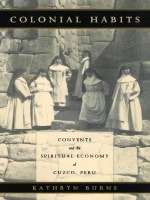
Colonial Habits
Convents and the Spiritual Economy of Cuzco, PeruKathryn Burns
Duke University Press, 1999
Based on unprecedented archival research, Colonial Habits demonstrates how nuns became leading guarantors of their city’s social order by making loans, managing property, containing “unruly” women, and raising girls. Coining the phrase “spiritual economy” to analyze the intricate investments and relationships that enabled Cuzco’s convents and their backers to thrive, Burns explains how, by the late 1700s, this economy had faltered badly, making convents an emblem of decay and a focal point for intense criticism of a failing colonial regime. By the nineteenth century, the nuns had retreated from their previous roles, marginalized in the construction of a new republican order.
Providing insight that can be extended well outside the Andes to the relationships articulated by convents across much of Europe, the Americas, and beyond, Colonial Habits will engage those interested in early modern economics, Latin American studies, women in religion, and the history of gender, class, and race.
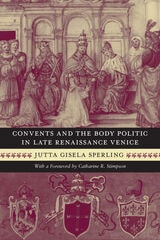
Convents and the Body Politic in Late Renaissance Venice
Jutta Gisela Sperling
University of Chicago Press, 2000
Sperling explains how women were not allowed to marry beneath their social status while men could, especially if their brides were wealthy. Faced with a shortage of suitable partners, patrician women were forced to offer themselves as "a gift not only to God, but to their fatherland," as Patriarch Giovanni Tiepolo told the Senate of Venice in 1619. Noting the declining birth rate among patrician women, Sperling explores the paradox of a marriage system that preserved the nobility at the price of its physical extinction. And on a more individual level, she tells the fascinating stories of these women. Some became scholars or advocates of women's rights, some took lovers, and others escaped only to survive as servants, prostitutes, or thieves.
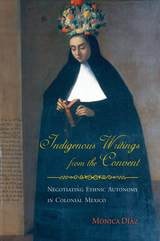
Indigenous Writings from the Convent
Negotiating Ethnic Autonomy in Colonial MexicoMónica Díaz
University of Arizona Press, 2010
While colonial sources that refer to indigenous women are not scant, documents in which women emerge as agents who actively participate in shaping their own identity are rare. Looking at this minority agency—or subaltern voice—in various religious discourses exposes some central themes. It shows that an indigenous identity recast in Catholic terms was able to be effectively recorded and that the religious participation of these women at a time when indigenous parishes were increasingly secularized lent cohesion to that identity.
Indigenous Writings from the Convent examines ways in which indigenous women participated in one of the most prominent institutions in colonial times—the Catholic Church—and what they made of their experience with convent life. This book will appeal to scholars of literary criticism, women’s studies, and colonial history, and to anyone interested in the ways that class, race, and gender intersected in the colonial world.

Isadore's Secret
Sin, Murder, and Confession in a Northern Michigan TownMardi Link
University of Michigan Press, 2010
"In Isadore's Secret, Mardi Link shines a journalist's lamp on this dark, quiet corner of Michigan's history, assuring that the tragic story of Sister Janina is not forgotten. Link's telling is fascinating and thorough, making a story you will not soon forget."
---Steve Lehto, author of Death's Door
A gripping account of the mysterious 1907 disappearance of a young nun in a northern Michigan town and the national controversy that followed when she turned up dead and buried in the basement of her own church.
Swinging planks of lantern light shine through the musty air and onto the dirt floor of the church basement. The oddly glowing rectangles syncopate over the damp ground and illuminate even the darkest, stooped-down corners of the space beyond. The only sound is the ragged breathing of two men, a young parish priest and a much older laborer. Aboveground these men belong completely to this place, in both body and soul. A glimpse of their faces anywhere in the sanctuary, the rectory, the school, the barn, or the gardens would be a welcome sight. But here below, these men of Isadore are interlopers. Only trespassers would sneak silently into the church's sloped underbelly without witness to carry out such a sinful and secret errand as this one. Despite their tools, and their lantern, and their resolve, neither is equipped for the task at hand or for what is to come.
Mardi Link, a former crime reporter, was named Antioch's Betty Crumrine Scholar for Creative Nonfiction in 2007. Her first book, When Evil Came to Good Hart, also published by the University of Michigan Press, spent four months on the Heartland Indie Bestseller List.
This true story was the basis for the Broadway play The Runner Stumbles and the film of the same name.
Front cover: Photograph of cemetery © John L. Russell, Great Lakes Images; image of face ©iStockphoto.com/duncan1890.
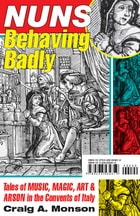
Nuns Behaving Badly
Tales of Music, Magic, Art, and Arson in the Convents of ItalyCraig A. Monson
University of Chicago Press, 2010
Witchcraft. Arson. Going AWOL. Some nuns in sixteenth- and seventeenth-century Italy strayed far from the paradigms of monastic life. Cloistered in convents, subjected to stifling hierarchy, repressed, and occasionally persecuted by their male superiors, these women circumvented authority in sometimes extraordinary ways. But tales of their transgressions have long been buried in the Vatican Secret Archive. That is, until now.
In Nuns Behaving Badly, Craig A. Monson resurrects forgotten tales and restores to life the long-silent voices of these cloistered heroines. Here we meet nuns who dared speak out about physical assault and sexual impropriety (some real, some imagined). Others were only guilty of misjudgment or defacing valuable artwork that offended their sensibilities. But what unites the women and their stories is the challenges they faced: these were women trying to find their way within the Catholicism of their day and through the strict limits it imposed on them. Monson introduces us to women who were occasionally desperate to flee cloistered life, as when an entire community conspired to torch their convent and be set free. But more often, he shows us nuns just trying to live their lives. When they were crossed—by powerful priests who claimed to know what was best for them—bad behavior could escalate from mere troublemaking to open confrontation.
In resurrecting these long-forgotten tales and trials, Monson also draws attention to the predicament of modern religious women, whose “misbehavior”—seeking ordination as priests or refusing to give up their endowments to pay for priestly wrongdoing in their own archdioceses—continues even today. The nuns of early modern Italy, Monson shows, set the standard for religious transgression in their own age—and beyond.
The Chronicle of Le Murate
Sister Giustina Niccolini
Iter Press, 2011
Writings on the Sisters of San Luca and Their Miraculous Madonna
Diodata Malvasia
Iter Press, 2015
The Bolognese nun Diodata Malvasia was presumed to have authored only one work, The Arrival and the Miraculous Workings of the Glorious Image of the Virgin (1617). In her recently discovered second manuscript chronicle, A Brief Discourse on What Occurred to the Most Reverend Sisters of the Joined Convents of San Mattia and San Luca (1575), her writing demonstrates active resistance to Tridentine convent reform. Together, Malvasia’s works read as the bookends to a lifelong crusade on behalf of her convent.