Results by title
38 books match the query 'Conversation'

A Starter's Guide for Academic Library Leaders
Advice in ConversationAmanda Clay Powers
American Library Association, 2019
The path towards leadership starts with you. But you don’t have to go it alone. For this book, the authors sat down with many of the library leaders they most admire for a series of conversations about the aspects of the job that they find the most fascinating (and challenging). Much like the chats you might have over coffee at a conference or with a mentor, these frank discussions will nourish you with nuts-and-bolts wisdom on a diverse range of academic library management issues. Among the topics and situations broached are
- balancing personal values against the common refrain “you don’t get to be who you want to be in positions like ours”;
- five questions to ask that reveal much about organizational culture and climate;
- creating a culture of change, including why a newly promoted director chose to make the most drastic changes in the first 100 days;
- forming a “dean team” to help frame responses with consideration to institutional culture;
- the value of demystifying the budget for the entire library staff;
- using tools such as a personal “learning journal” to fuel professional development;
- cultivating a personal network by setting up meetings at local libraries during conferences;
- the risks that result from jumping into a situation too fast and boxing yourself into a corner;
- lessons learned from failed initiatives;
- examples of navigating controversies, such as a director’s response to a WPA mural with a racist message; and
- managing facilities, with an example of how injecting a previously ignored library voice into a building project led to a tripling of the space.
Between these covers you’ll find guidance, ideas, and inspiration as you continue your leadership journey.

Anselm Kiefer in Conversation with Klaus Dermutz
Anselm Kiefer and Klaus Dermutz
Seagull Books, 2018
The only visual artist to have won the Peace Prize of the German Book Trade, Anselm Kiefer is a profoundly literary painter. In these conversations, Kiefer describes how the central materials of his art—lead, sand, water, fire, ashes, plants, clothing, oil paint, watercolor, and ink—influence the act of creation. No less decisive are his intellectual and artistic touchstones: the sixteenth-century Jewish mystic Isaac Luria, the German Romantic poet Novalis, Ingeborg Bachmann, Paul Celan, Martin Heidegger, Marcel Proust, Adalbert Stifter, the operas of Richard Wagner, the Catholic liturgy, and the innovative theater director and artist Tadeusz Kantor. Kiefer and Dermutz discuss all of these influential thinkers, as well as Kiefer’s own status as a controversial figure. His relentless examination of German history, the themes of guilt, suffering, communal memory, and the seductions of destruction have earned him equal amounts of criticism and praise. The conversations in this book offer a rare insight into the mind of a gifted creator, appealing to artists, critics, art historians, cultural journalists, and anyone interested in the visual arts and the literature and history of the twentieth century.
Arenas of Language Use
Herbert H. Clark
University of Chicago Press, 1993
According to Clark, in order for one person to understand another, there must be a "common ground" of knowledge between them. He shows how people infer this "common ground" from their past conversations, their immediate surroundings, and their shared cultural background. Clark also discusses the means by which speakers design their utterances for particular audiences and coordinate their use of language with other participants in a language arena. He argues that language use in conversation is a collaborative process, where speaker and listener work together to establish that the listener understands the speaker's meaning. Since people often use words to mean something quite different from the dictionary definitions of those words, Clark offers a realistic perspective on how speakers and listeners coordinate on the meanings of words.
This collection presents outstanding examples of Clark's pioneering work on the pragmatics of language use and it will interest psychologists, linguists, computer scientists, and philosophers.

Banking for a Better World
Nanno Kleiterp in Conversation with Marijn WiersmaNanno Kleiterp
Amsterdam University Press, 2017

Cinema Today
A Conversation with Thirty-nine Filmmakers from around the WorldOumano, Elena
Rutgers University Press, 2011
Can't spare the time from work or class? Travel expense too great? What? You can't even find such a collaborative event?
Then imagine curling up with a good book, maybe a shot of espresso in hand, and becoming engrossed in the exciting and informative conversation that Elena Oumano has ingeniously crafted from her personal and individual interviews with these artists. Straying far from the usual choppy question-and-answer format, Cinema Today saves you from plowing through another tedious read, in which the same topics and issues are directed to each subject, over and over-an experience that is like being trapped in a revolving door.
Oumano stops that revolving door by following a lively symposium-in-print format, with the filmmakers' words and thoughts grouped together under various key cinema topics. It is as though these experts are speaking to each other and you are their audience--collectively they reflect on and explore issues and concerns of modern filmmaking, from the practical to the aesthetic, including the process, cinematic rhythm and structure, and the many aspects of the media: business, the viewer, and cinema's place in society. Whether you are a movie lover, a serious student of cinema, or simply interested in how we communicate in today's global village through films that so profoundly affect the world, Cinema Today is for you.
Collaborating with Strangers
Facilitating Workshops in Libraries, Classes, and NonprofitsBess G. de Farber
American Library Association, 2017

Conversation and Community
Chat in a Virtual WorldLynn Cherny
CSLI, 1999
Conversation with Christ
Douglas Gwyn
QuakerPress, 2011
Conversation with Spinoza
A Cobweb NovelGoce Smilevski
Northwestern University Press, 2006
Smilevski's novel brings the thinker Spinoza and his inner life into conversation with the outer, all-too-real facts of his life and his day--from his connection to the Jewish community of Amsterdam, his excommunication in 1656, and the emergence of his philosophical system to his troubling feelings for his fourteen-year-old Latin teacher Clara Maria van den Enden and later his disciple Johannes Casearius. From this conversation there emerges a compelling and complex portrait of the life of an idea--and of a man who tries to live that idea.
Curriculum as Conversation
Transforming Traditions of Teaching and LearningArthur N. Applebee
University of Chicago Press, 1996
“Applebee's central point, the need to teach 'knowledge in context,' is absolutely crucial for the hopes of any reformed curriculum. His experience and knowledge give his voice an authority that makes many of the current proposals on both the left and right seem shallow by comparison.”—Gerald Graff, University of Chicago

David Mamet in Conversation
Leslie Kane, Editor
University of Michigan Press, 2001
Contemporary playwright David Mamet's thought-provoking plays and screenplays such as Wag the Dog, Glengarry Glen Ross (for which he won the Pulitzer Prize), and Oleanna have enjoyed popular and critical success in the past two decades. Among the most prolific and provocative of writers, Mamet frequently draws emotional responses from both audiences and critics. Mamet in Conversation collects interviews with the playwright that offer readers insight into his life in the theater, his artistic vision, and the evolution of his craft. The interviews help followers of his work better understand the sensibilities that have informed his work in drama, film, and prose over a twenty-five-year career. The conversations collected here--several of which appear in print for the first time--allow a glimpse inside Mamet's creative process, and into the recurring motifs that drive his work. The range of topics is impressive and includes the celebratory purpose of theater, the responsibility of the playwright, writing for Hollywood, the seduction of fame, the search for truth and the merchandising of it, and the decay of culture. The interviews shed light on the personal as well: Mamet's return to Judaism, his appreciation of Midwestern virtues, his love of rural Vermont, the problems of embattled virtue, and the challenge of aging. The book includes transcripts of Mamet's engagingly candid broadcast interviews with Jim Lehrer and Charlie Rose of PBS, published here for the first time.

Deuteronomy-Kings as Emerging Authoritative Books
A ConversationDiana V. Edelman
SBL Press, 2014
Explore how the past came to address the present and the future and why it became important for emerging Jewish identity.
Experts explore the themes and topics that made Deuteronomy and the Former Prophets appealing to ancient readers leading ultimately to those texts becoming authoritative for Persian and Hellenistic readers. This unique collection of essays focuses on what larger impact these texts might have had on primary and secondary audiences as part of emerging Torah. Contributors include Klaus-Peter Adam, Yairah Amit, Thomas M. Bolin, Philip R. Davies, Serge Frolov, Susanne Gilmayr-Bucher, E. Axel Knauf, Christoph Levin, James R. Linville, and Thomas Römer, and Diana V. Edelman.
Features:
- Essays focused on why texts became authoritative instead of when they were written or their historicity
- Two scholars examine each book providing a range of views
- Coverage of the socio-religious function of emerging Torah in the Persian and early Hellenistic periods
Dialogue, Dialectic and Conversation
A Social Perspective on the Function of WritingGregory Clark. Foreword by Robert J. Connors
Southern Illinois University Press, 1990
This book articulates an ethics for reading that places primary responsibility for the social influences of a text on the response of its readers.
We write and read as participants in a process through which we negotiate with others whom we must live or work with and with whom we share values, beliefs, and actions. Clark draws on current literary theory, rhetoric, philosophy, communication theory, and composition studies as he builds on this argument.
Because reading and writing are public actions that address and direct matters of shared belief, values, and action, reading and writing should be taught as public discourse. We should teach not writing or reading so much as the larger practice of public discourse—a discourse that sustains the many important communities of which students are and will be active members.
Edward Said
Continuing the ConversationEdited by Homi K. Bhabha and W. J. T. Mitchell
University of Chicago Press, 2005
The essays, imagining and recalling the cadences of Said's conversation, take various forms, including elaborations on his ideas, applications of his thought to new problems, and recollections of the indescribable electricity that made conversation with him intense and memorable. This lively, personal tone is a direct result of editors Homi Bhabha and W. J. T. Mitchell urging contributors to write in the spirit of a conversation interrupted, a call on hold, a letter waiting for a reply, a question hanging in the air. This is a work of immense imaginative and intellectual force and compelling candor, honoring Said's legacy as an activist intellectual.
This collection includes essays by Lila Abu-Lughod, Daniel Barenboim, Akeel Bilgrami, Paul Bové, Timothy Brennan, Noam Chomsky, Ranajit Guha, Harry Harootunian, Saree Makdisi, Aamir Mufti, Roger Owen, Gyan Prakash, Dan Rabinowitz, Jacqueline Rose, and Gayatri Spivak.
Framing Information Literacy (PIL#73) Volume Five
Scholarship as ConversationJanna L. Mattson
American Library Association, 0
Galateo
Or, The Rules of Polite BehaviorGiovanni Della Casa
University of Chicago Press, 2013
So begins Galateo, a treatise on polite behavior written by Giovanni Della Casa (1503–56) for the benefit of his nephew, a young Florentine destined for greatness.

Hope on Earth
A ConversationPaul R. Ehrlich and Michael Charles Tobias
University of Chicago Press, 2014
Both Ehrlich and Tobias argue that we are on the verge of environmental catastrophe, as the human population continues to grow without restraint and without significant attempts to deal with overconsumption and the vast depletion of resources and climate problems it creates. Though their views are sympathetic, they differ in their approach and in some key moral stances, giving rise to a heated and engaging dialogue that opens up dozens of new avenues of exploration. They both believe that the impact of a human society on its environment is the direct result of its population size, and through their dialogue they break down the complex social problems that are wrapped up in this idea and attempts to overcome it, hitting firmly upon many controversial topics such as circumcision, religion, reproduction, abortion, animal rights, diet, and gun control. For Ehrlich and Tobias, ethics involve not only how we treat other people directly, but how we treat them and other organisms indirectly through our effects on the environment. University of California, Berkeley professor John Harte joins the duo for part of the conversation, and his substantial expertise on energy and climate change adds a crucial perspective to the discussion of the impact of population on global warming.
This engaging and timely book invites readers into an intimate conversation with some of the most eminent voices in science as they offer a powerful and approachable argument that the ethical and scientific issues involved in solving our environmental crisis are deeply intertwined, while offering us an optimistic way forward. Hope on Earth is indeed a conversation we should all be having.

I Was More American than the Americans
Sylvère Lotringer in Conversation with Donatien GrauSylvère Lotringer and Donatien Grau
Diaphanes, 2021
In the mid-1970s, Sylvère Lotringer created Semiotext(e), a philosophical group that became a magazine and then a publishing house. Since its creation, Semio-text(e) has been a place of stimulating dialogue between artists and philosophers, and for the past fifty years, much of American artistic and intellectual life has depended on it. The model of the journal and the publishing house revolves around the notion of the collective, and Lotringer has rarely shared his personal journey: his existence as a hidden child during World War II; the liberating and then traumatic experience of the collective in the kibbutz; his Parisian activism in the 1960s; his time of wandering, that took him, by way of Istanbul, to the United States; and then, of course, his American years, the way he mingled his nightlife with the formal experimentation he invented with Semiotext(e) and with his classes. Since the early 2010s, Donatien Grau has developed the habit of visiting Lotringer during his trips to Los Angeles; some of their dialogs were published or held in public. This book is an entry into Lotringer's life, his friendships, his choices, and his admiration for some of the leading thinkers of our times. The conversations between Lotringer and Grau show bursts of life, traces of a journey, through texts and existence itself, with an unusual intensity.

Imagined Dialogues
Eastern European Literature in Conversation with American and English LiteratureGordana Crnkovic
Northwestern University Press, 1999
Interviews with American Composers
Barney Childs in ConversationBarney Childs. Edited by Virginia Anderson
University of Illinois Press, 2022
Virginia Anderson edits the first published collection of these conversations. She pairs each interview with a contextual essay by a contemporary expert that shows how the composer's discussion with Childs fits into his life and work. Together, the interviewees cover a broad range of ideas and concerns around topics like education, notation, developments in electronic music, changing demands on performers, and tonal music.
Innovative and revealing, Interviews with American Composers is an artistic and historical snapshot of American music at an important crossroads.
Islam and the West
A Conversation with Jacques DerridaMustapha Chérif
University of Chicago Press, 2008
Joining the Conversation
Dialogues by Renaissance WomenJanet Levarie Smarr
University of Michigan Press, 2005
Avoiding the male-authored model of competing orations, French and Italian women of the Renaissance framed their dialogues as informal conversations, as letters with friends that in turn became epistles to a wider audience, and even sometimes as dramas. No other study to date has provided thorough, comparative view of these works across French, Italian, and Latin. Smarr's comprehensive treatment relates these writings to classical, medieval, and Renaissance forms of dialogue, and to other genres including drama, lyric exchange, and humanist invective -- as well as to the real conversations in women's lives -- in order to show how women adapted existing models to their own needs and purposes.
Janet Levarie Smarr is Professor of Theatre and Italian Studies at the University of California, San Diego.
Literature Is a Voyage of Discovery
Tom Bishop in Conversation with Donatien GrauTom Bishop and Donatien Grau
Diaphanes, 2021
Tom Bishop has, for over sixty years, helped shape the literary, philosophical, cultural, artistic, and political conversation between Paris and New York. As professor and director of the Center for French Civilization and Culture at New York University, he made the Washington Square institution one of the great bridges between French innovation and a New York scene in full transformation. Bishop was close to Beckett, championed Robbe-Grillet in the United States, befriended Marguerite Duras and Hélène Cixous, and organized historic public encounters—such as the one between James Baldwin and Toni Morrison. He was also a scholar, a recognized specialist in the avant-garde, notably the Nouveau Roman and the Nouveau Théâtre.
In 2012, Bishop invited Donatien Grau to give a talk at NYU. This invitation led to conversations—many of which are presented in this book—and a friendship. Literature Is a Voyage of Discovery gathers their dialogues, retracing Bishop’s career, his own history, his departure from Vienna, his studies, his meetings, his choices, his conception of literature and life, his relationship to the political and economic world, and the way he helped define the profession of “curator” as it is practiced today, offering a thought-provoking look into one of the leading minds of our time.
Memory and Identity in Ancient Judaism and Early Christianity
A Conversation with Barry SchwartzTom Thatcher
SBL Press, 2014
Essential reading for scholars and students interested in sociology and biblical studies
In this collection scholars of biblical texts and rabbinics engage the work of Barry Schwartz, Professor Emeritus in the Department of Sociology at the University of Georgia. Schwartz provides an introductory essay on the study of collective memory. Articles that follow integrate his work into the study of early Jewish and Christian texts. The volume concludes with a response from Schwartz that continues this warm and fruitful dialogue between fields.
Features:
- Articles that integrate the study of collective memory and social psychology into religious studies
- Essays from Barry Schwartz
- Theories applied rather than left as abstract principles
ORDINARY PLEASURES
COUPLES, CONVERSATION, AND COMEDYKAY YOUNG
The Ohio State University Press, 2001
Paul and Scripture
Extending the ConversationChristopher D. Stanley
SBL Press, 2012

River of Light
A Conversation with KabirJohn Morgan
University of Alaska Press, 2014
River of Light: A Conversation with Kabir is centered in one man’s meditations and revelations while traveling on a river. John Morgan spent a week traveling the Copper River in Southcentral Alaska, and the resulting encounters form the heart of this book-length poem. The river’s shifting landscape enriches the poem’s meditative mood while currents shape the poem and the pacing of its lines. The mystic poet Kabir is Morgan’s internal guide and serves as a divine foil through quiet stretches that bring to mind questions about war and human nature. Artwork by distinguished Alaska artist Kesler Woodward is a sublime companion to the text.
A combination of adventurer’s tale and spiritual quest, River of Light: A Conversation with Kabir takes the reader on a soulful journey that is both deeply personal and profoundly universal.

Sarah's Seasons
An Amish Diary and ConversationMartha Moore Davis
University of Iowa Press, 1997
Sarah's brief daily notations, recorded on a calendar throughout 1976 and 1977, reveal an ongoing account of her seasonal routine. In many ways the straightforward simplicity of her writing is a reflection of her life near rural Kalona, Iowa, a life filled with what Martha Davis calls look-easy tasks undertaken without the conveniences of electricity, phones, or automobiles. For Sarah, diaries are a record. “A diary can settle a question, a disagreement,” she tells Martha. “You look back and see what took place. That's history.”
Through their conversations, Martha soon discovered she had more in common with Sarah than diary writing. Though Davis lived in the mainstream culture, an “English” person as the Amish say, like Sarah she grew up on a farm in rural Iowa during the 1950s and 1960s. Like Martha, Sarah had spent several years as a teacher.
In Sarah's Seasons Martha Davis shares their common experiences and common interests—gardening, quilting, and cooking. Alongside Sarah's diary, Martha presents their shared recipes and conversations as well as reflections on her own more modern existence. Because of her friendship with Sarah, the author found a new sense of belonging to and purpose in the mainstream world. In the end, Sarah's diary becomes for Martha a meditation on time and community.

Six Paintings from Papunya
A ConversationFred R. Myers and Terry Smith
Duke University Press, 2024
Storytelling and Conversation
Discourse in Deaf CommunitiesElizabeth A. Winston
Gallaudet University Press, 1999
In this intriguing book, renowned sociolinguistics experts explore the importance of discourse analysis, a process that examines patterns of language to understand how users build cooperative understanding in dialogues. It presents discourse analyses of sign languages native to Bali, Italy, England, and the United States.
Studies of internal context review the use of space in ASL to discuss space, how space in BSL is used to “package” complex narrative tasks, how signers choose linguistic tools to structure storytelling, and how affect, emphasis, and comment are added in text telephone conversations. Inquiries into external contexts observe the integration of deaf people and sign language into language communities in Bali, and the language mixing that occurs between deaf parents and their hearing children.
Both external and internal contexts are viewed together, first in an examination of applying internal ASL text styles to teaching written English to Deaf students and then in a consideration of the language choices of interpreters who must shift footing to manage the “interpreter’s paradox.” Storytelling and Conversation casts new light on discourse analysis, which will make it a welcome addition to the sociolinguistics canon.
Talk and Textual Production in Medieval England
Marisa Libbon
The Ohio State University Press, 2021
The Art of Teaching Speaking
Research and Pedagogy for the ESL/EFL ClassroomKeith S. Folse
University of Michigan Press, 2006
*Which tasks or activities really help build speaking fluency?
*What does the research show regarding speaking activities?
*What mistakes do ESL teachers often make in speaking activity design?
In this highly accessible and practical resource, Keith S. Folse provides a wealth of information to help ESL/EFL teachers design and use speaking tasks that will actually improve students' speaking fluency. The book presents and discusses the relevant research and assessment issues and includes case studies from twenty different settings and classrooms around the world so that readers learn from others about the problems and successes of using various speaking activities.
Teachers will find the chapters on Twenty Successful Activities and Ten Unsuccessful Activities particularly valuable. The successful activities are provided for classroom use and are reproducible. The book also contains five appendixes that explain what teachers need to know about vocabulary, pronunciation, and grammar and how they affect the teaching of speaking. Samples of successful lesson plans and a list of resources useful for teaching speaking are also included.
Keith S. Folse, Ph.D., is Coordinator, TESOL Programs, University of Central Florida (Orlando). He is the author of Vocabulary Myths (University of Michigan Press, 2004) and more than 35 second language textbooks, including texts on grammar, reading, speaking, listening, and writing.
The Chattering Mind
A Conceptual History of Everyday TalkSamuel McCormick
University of Chicago Press, 2020
From Plato’s contempt for “the madness of the multitude” to Kant’s lament for “the great unthinking mass,” the history of Western thought is riddled with disdain for ordinary collective life. But it was not until Kierkegaard developed the term chatter that this disdain began to focus on the ordinary communicative practices that sustain this form of human togetherness.
The Chattering Mind explores the intellectual tradition inaugurated by Kierkegaard’s work, tracing the conceptual history of everyday talk from his formative account of chatter to Heidegger’s recuperative discussion of “idle talk” to Lacan’s culminating treatment of “empty speech”—and ultimately into our digital present, where small talk on various social media platforms now yields big data for tech-savvy entrepreneurs.
In this sense, The Chattering Mind is less a history of ideas than a book in search of a usable past. It is a study of how the modern world became anxious about everyday talk, figured in terms of the intellectual elites who piqued this anxiety, and written with an eye toward recent dilemmas of digital communication and culture. By explaining how a quintessentially unproblematic form of human communication became a communication problem in itself, McCormick shows how its conceptual history is essential to our understanding of media and communication today.
The Converse of the Pen
Acts of Intimacy in the Eighteenth-Century Familiar LetterBruce Redford
University of Chicago Press, 1987
Redford examines six masters of the "talking letter": Lady Mary Wortley Montagu, William Cowper, Thomas Gray, Horace Walpole, James Boswell, and Samuel Johnson. All seek the paradoxical goal of artful spontaneity. Each exploits the distinctive resources of the eighteenth-century letter writer: a flexible conversational manner, a repertoire of literary and social allusion, a flair for dramatic impersonation. The voices of these letter writers "make distance, presence," in Samuel Richardson's phrase, by devising substitutes for gesture, vocal inflection, and physical context, turning each letter into a performance—an act. The resulting verbal constructs create a mysterious tension between the claims of fact and the possibilities of art. Redford recovers a neglected literary form and makes possible a deeper understanding of major eighteenth-century writers who devoted much of their talent and time to "the converse of the pen."
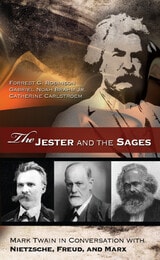
The Jester and the Sages
Mark Twain in Conversation with Nietzsche, Freud, and MarxForrest G. Robinson, Gabriel Noah Brahm, Jr., and Catherine Carlstroem
University of Missouri Press, 2011
During their lifetimes, Twain, Nietzsche, Freud, and Marx witnessed massive upheavals in Western constructions of religion, morality, history, political economy, and human nature. The foundations of reality had been shaken, and one did not need to be a philosopher—nor did one even need to read philosophy—to weigh in on what this all might mean. Drawing on a wide range of primary and secondary materials, the authors show that Twain was well attuned to debates of the time. Unlike his Continental contemporaries, however, he was not as systematic in developing his views.
Brahm and Robinson’s chapter on Nietzsche and Twain reveals their subjects’ common defiance of the moral and religious truisms of their time. Both desired freedom, resented the constraints of Christian civilization, and saw punishing guilt as the disease of modern man. Pervasive moral evasion and bland conformity were the principal end result, they believed.
In addition to a continuing focus on guilt, Robinson discovers in his chapter on Freud and Twain that the two men shared a lifelong fascination with the mysteries of the human mind. From the formative influence of childhood and repression, to dreams and the unconscious, the mind could free people or keep them in perpetual chains. The realm of the unconscious was of special interest to both men as it pertained to the creation of art.
In the final chapter, Carlstroem and Robinson explain that, despite significant differences in their views of human nature, history, and progress, Twain and Marx were both profoundly disturbed by economic and social injustice in the world. Of particular concern was the gulf that industrial capitalism opened between the privileged elite property owners and the vast class of property-less workers. Moralists impatient with conventional morality, Twain and Marx wanted to free ordinary people from the illusions that enslaved them.
Twain did not know the work's of Nietzsche, Freud, and Marx well, yet many of his thoughts cross those of his philosophical contemporaries. By focusing on the deeper aspects of Twain’s intellectual makeup, Robinson, Brahm, and Carlstroem supplement the traditional appreciation of the forces that drove Twain’s creativity and the dynamics of his humor.
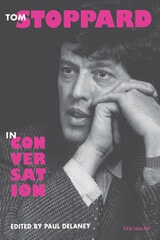
Tom Stoppard in Conversation
Paul Delaney, Editor
University of Michigan Press, 1994
This collection of interviews with British playwright Tom Stoppard, author of such well-known comedies as Travesties, Jumpers, and Rosencrantz and Guildenstern Are Dead, brings together for the first time Stoppard's most significant assessments of his own work.
A wide range of discussions are featured, from extensive conversations with the editors of Theatre Quarterly and Gambit to important interviews in lesser-known periodicals. The interviews include the playwright's unguarded comments to the daily press, from those of a dazzled young Stoppard the morning after the triumphant opening of Rosencrantz and Guildenstern to those of a veteran playwright still smarting from caustic reviews 36 hours after the opening of Hapgood. The interviews cover the full range of Stoppard's work, from his adaptations for the stage to his increasing involvement in film, and this volume makes many of them available for the first time. Also appearing for the first time in print are transcripts of radio interviews and an informal lecture by Stoppard called "The Event and the Text."
Tom Stoppard's conversations about his work shed light on questions of authorial intent and the creative process. Debates over interpretations of the plays will be enhanced by this record of Stoppard's own perceptions and insights. The collection also includes the most extensive bibliography and discography ever compiled of Stoppard's print interviews, broadcast interviews, and lectures.
Witty, illuminating, and informative, Tom Stoppard in Conversation will be of interest to scholars, students, directors, actors, and fans of Stoppard's work.
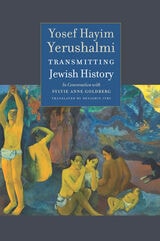
Transmitting Jewish History
Yosef Hayim Yerushalmi in Conversation with Sylvie Anne GoldbergYosef Hayim Yerushalmi and Sylvie Anne Goldberg
Brandeis University Press, 2021
Scholar Yosef Hayim Yerushalmi (1932–2009) possessed a stunning range of erudition in all eras of Jewish history, as well as in world history, classical literature, and European culture. What Yerushalmi also brought to his craft was a brilliant literary style, honed by his own voracious reading from early youth and his formative undergraduate studies. This series of interviews paints a revealing portrait of this giant of history, bringing together exceptional material on Yerushalmi’s personal and intellectual journeys that not only attests to the astonishing breakthrough of the issues of Jewish history into “general history,” but also offers profound insight into being Jewish in today's world.

What is la hispanidad?
A conversationBy Ilan Stavans and Iván Jaksić
University of Texas Press, 2011
Natives of the Iberian Peninsula and the twenty countries of Latin America, as well as their kinsfolk who've immigrated to the United States and around the world, share a common quality or identity characterized as la hispanidad. Or do they?
In this lively, provocative book, two distinguished intellectuals, a cultural critic and a historian, engage in a series of probing conversations in which they try to discern the nature of la hispanidad and debate whether any such shared identity binds the world's nearly half billion people who are "Hispanic." Their conversations range from La Reconquista and Spanish monarchs Ferdinand and Isabella, who united the Spanish nation while expelling its remaining Moors and Jews, to the fervor for el fútbol (soccer) that has swept much of Latin America today. Along the way, they discuss a series of intriguing topics, including the complicated relationship between Latin America and the United States, Spanish language and the uses of Spanglish, complexities of race and ethnicity, nineteenth-century struggles for nationhood and twentieth-century identity politics, and popular culture from literary novels to telenovelas. Woven throughout are the authors' own enlightening experiences of crossing borders and cultures in Mexico and Chile and the United States.
Sure to provoke animated conversations among its readers, What is la hispanidad? makes a convincing case that "our hispanidad is rooted in a changing tradition, flexible enough to persist beyond boundaries and circumstances. Let us not fix it with a definition, but allow it instead to travel, always."