Results by title
8 books match the query 'Conversation and phrase books'
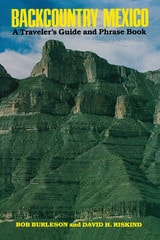
Backcountry Mexico
A Traveler’s Guide and Phrase BookBy Bob Burleson and David H. Riskind
University of Texas Press, 1986
<p>Going well beyond the usual tourist guidebook entries, <cite>Backcountry Mexico</cite> will help you hire a guide and burro, navigate rural roads and trails, and communicate with the friendly and, sometimes, unfriendly folks you are likely to meet in a rural setting.</p>
<p>In addition to English-Spanish and Spanish-English vocabulary lists containing both standard words and numerous terms relating to people, conditions, land, and situations not ordinarily encountered in tourists' lists, the authors have provided literally hundreds of helpful phrases and short conversations in easy-to-use sections arranged according to topics. Experienced unconventional travelers themselves, Burleson and Riskind have become experts in such subjects as "Eating and Staying Well on the Road, " "Camping in Mexico, " "Rural Mexican Village Life," and many more. Their experience, and the resultant wealth of language and cultural information contained in this guide, will help you to enjoy your trip ancd to better understand and appreciate the people and the land you visit.</p>
<p>Throughout the book, the language examples are interwoven with beautifully illustrated anecdotes about culture and lifeways, so that the traveler is equipped with practical knowledge as well as appropriate behavior and speech. Fascinating in its treatment of a culture that is little known and unique in its coverage of rural-style Mexican Spanish, <cite>Backcountry Mexico</cite> will prove invaluable to anyone who ventures forth into northern Mexico.</p>
Breaking Out of Beginner's Spanish
By Joseph J. Keenan
University of Texas Press, 2014
Many language books are boring—this one is not. Written by a native English speaker who learned Spanish the hard way—by trying to talk to Spanish-speaking people—it offers English speakers who have a basic knowledge of Spanish hundreds of tips for using the language more fluently and colloquially, with fewer obvious “gringo” errors.
Writing with humor, common sense, and a minimum of jargon, Joseph J. Keenan covers everything from pronunciation, verb usage, and common grammatical mistakes to the subtleties of addressing other people, “trickster” words that look alike in both languages, inadvertent obscenities, and intentional swearing. He guides readers through the set phrases and idiomatic expressions that pepper the native speaker’s conversation and provides a valuable introduction to the most widely used Spanish slang.
With this book, both students in school and adult learners who never want to see another classroom can rapidly improve their speaking ability. Breaking Out of Beginner’s Spanish will be an essential aid in passing the supreme language test—communicating fluently with native speakers.
Breaking Out of Beginner's Spanish
By Joseph J. Keenan
University of Texas Press, 1994
Many language books are boring—this one is not. Written by a native English speaker who learned Spanish the hard way—by trying to talk to Spanish-speaking people—it offers English speakers with a basic knowledge of Spanish hundreds of tips for using the language more fluently and colloquially, with fewer obvious "gringo" errors.
Writing with humor, common sense, and a minimum of jargon, Joseph Keenan covers everything from pronunciation, verb usage, and common grammatical mistakes to the subtleties of addressing other people, "trickster" words that look alike in both languages, inadvertent obscenities, and intentional swearing. He guides readers through the set phrases and idiomatic expressions that pepper the native speaker's conversation and provides a valuable introduction to the most widely used Spanish slang.
With this book, both students in school and adult learners who never want to see another classroom can rapidly improve their speaking ability. Breaking Out of Beginner's Spanish will be an essential aid in passing the supreme language test-communicating fluently with native speakers.
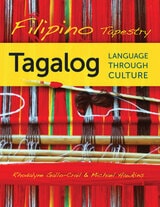
Filipino Tapestry
Tagalog Language through CultureRhodalyne Gallo-Crail
University of Wisconsin Press, 2012
An official language of the Philippines, Filipino is based on Tagalog, with elements of Spanish, English, and Chinese mixed in. The result is a rich, expressive language spoken in the Philippines and throughout the far-reaching Filipino diaspora.
Filipino Tapestry offers an innovative approach to learning language by emphasizing the critical intersection of language and culture. It provides activities and exercises that immerse beginning and intermediate students of Filipino in a variety of authentic situations to simulate an in-country experience. Starting with chapters on such topics as family, friends, and home, it then expands the student’s world in chapters prompting conversation about food, shopping, parties, and pastimes. Its later chapters push learners to discuss city and country life, cultural traditions, religion, history, and politics.
Features include:
• background chapters on phonology, sentence construction, and common expressions
• photos and cultural notes about chapter themes
• grammar, reading, listening, and speaking exercises
• glossaries of words and additional expressions
Maya for Travelers and Students
A Guide to Language and Culture in YucatanBy Gary Bevington
University of Texas Press, 1995
The Yucatan Peninsula draws many North American and European travelers each year to view the ruins of the pre-Columbian Classical Maya civilization and the abundant native flora and fauna. For these travelers, as well as armchair travelers and students, Gary Bevington has prepared the first general English-language introduction to Yucatec Maya, the native language of the people indigenous to the region.
Written in nontechnical terms for learners who have a basic knowledge of simple Mexican Spanish, the book presents easily understood, practical information for anyone who would like to communicate with the Maya in their native language. In addition to covering the pronunciation and grammar of Maya, Bevington includes invaluable tips on learning indigenous languages "in the field." Most helpful are his discussions of the cultural and material worlds of the Maya, accompanied by essential words and expressions for common objects and experiences. A Maya-English-Spanish glossary with extensive usage examples and an English-Maya glossary conclude the book.
Note: The supplemental audiocasette, Spoken Maya for Travelers and Students, is now available as a free download through the book's page on the University of Texas Press's website.
Signing Fun
American Sign Language Vocabulary, Phrases, Games, and ActivitiesPenny Warner
Gallaudet University Press, 2006
Here’s a great book for every young adult age 11 up, Signing Fun: American Sign Language Vocabulary, Phrases, Games, and Activities. Signing is visual, easy to learn, and fun to use. Author Penny Warner offers 441 useful signs on a variety of favorite topics: activities, animals, fashion, food, holidays, home, outdoors, parties, people, places, play, emotions, school, shopping, travel, plus extra fun signs for especially popular words. Each chapter includes practice sentences using everyday phrases to help new signers learn in a fun way.
Signing Fun provides dozens of entertaining games and activities, too, such as Alphabet Sign, Finger Fun Gesture Guess, Match Signs, Mime and Sign, Oppo-Sign, Picture Hand, Secret Sign, Sign-A-Gories, Signo Bingo, Snap and Sign, and Truth or Sign. It also features a list of tips on how to sign, including how to fingerspell, use numbers, and communicate with deaf people. Whimsical drawings clearly illustrate all of the signs, and a full index lists all of their English meanings for quick reference. Signing Fun is a terrific first book for learning sign while having a great time.
Speaking in Social Contexts
Communication for Life and Study in the U.S.Robyn Brinks Lockwood
University of Michigan Press, 2018
The text provides language to use for a variety of functions as they might related to life on a university campus: offering greetings and goodbyes, making introductions, giving opinions, agreeing and disagreeing, using the phone, offering assistance, asking for advice, accepting and declining invitations, giving and receiving compliments, complaining, giving congratulations, expressing condolences, and making small talk. Users are also taught to think beyond the words and to interpret intonation and stress (how things sound).
Each of the 10 units includes discussion prompts, language lessons, practice activities, get acquainted tasks (interacting with native speakers), and analysis opportunities (what did they discover and what can they apply?).
The Eater's Guide to Chinese Characters
James D. McCawley
University of Chicago Press, 1984
With this guide in hand, English speakers hold the key to a world of tantalizing—and otherwise unavailable—Chinese dishes.