Results by title
4 books match the query 'Conversion to Christianity'
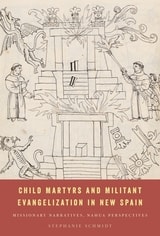
Child Martyrs and Militant Evangelization in New Spain
Missionary Narratives, Nahua PerspectivesStephanie Schmidt
University of Texas Press, 2025
Examines the many iterations of a story of child martyrdom in colonial Mexico.
A cornerstone of the evangelization of early New Spain was the conversion of Nahua boys, especially the children of elites. They were to be emissaries between Nahua society and foreign missionaries, hastening the transmission of the gospel. Under the tutelage of Franciscan friars, the boys also learned to act with militant zeal. They sermonized and smashed sacred objects. Some went so far as to kill a Nahua religious leader. For three boys from Tlaxcala, the reprisals were just as deadly.
In Child Martyrs and Militant Evangelization in New Spain, Stephanie Schmidt sheds light on a rare manuscript about Nahua child converts who were killed for acts of zealotry during the late 1520s. This is the Nahuatl version of an account by an early missionary-friar, Toribio de Benavente Motolinía. To this day, Catholics venerate the slain boys as Christian martyrs who suffered for their piety. Yet Franciscan accounts of the boys’ sacrifice were influenced by ulterior motives, as the friars sought to deflect attention from their missteps in New Spain. Illuminating Nahua perspectives on this story and period, Schmidt leaves no doubt as to who drove this violence as she dramatically expands the knowledgebase available to students of colonial Latin America.
Figures of Conversion
“The Jewish Question” and English National IdentityMichael Ragussis
Duke University Press, 1995
—Daniel Defoe, The Farther Adventures of Robinson Crusoe (1719)
When the hero of Defoe’s novel listens skeptically to this anecdote related by a French Roman Catholic priest, he little suspects that in less than a century the conversion of the Jews would become nothing short of a national project—not in France but in England. In this book, Michael Ragussis explores the phenomenon of Jewish conversion—the subject of popular enthusiasm, public scandal, national debate, and dubbed "the English madness" by its critics—in Protestant England from the 1790s through the 1870s.
Moving beyond the familiar catalog of anti-Semitic stereotypes, Ragussis analyzes the rhetoric of conversion as it was reinvented by the English in sermons, stories for the young, histories of the Jews, memoirs by Jewish converts, and popular novels. Alongside these texts and the countertexts produced by English Jews, he situates such writers as Edgeworth, Scott, Disraeli, Arnold, Trollope, and Eliot within the debate over conversion and related issues of race, gender, and nation-formation. His work reveals how a powerful group of emergent cultural projects—including a revisionist tradition of the novel, the new science of ethnology, and the rewriting of European history—redefined English national identity in response to the ideology of conversion, the history of the Jews, and "the Jewish question."
Figures of Conversion offers an entirely new way of regarding Jewish identity in nineteenth-century British culture and will be of importance not only to literary scholars but also to scholars of Judaic and religious studies, history, and cultural studies.
Parables of Coercion
Conversion and Knowledge at the End of Islamic SpainSeth Kimmel
University of Chicago Press, 2015
In its careful examination of how Spanish authors transformed the history of scholarship through debate about forced religious conversion, Parables of Coercion makes us rethink what we mean by tolerance and intolerance, and shows that debates about forced conversion and assimilation were also disputes over the methods and practices that demarcated one scholarly discipline from another.
The Mortara Case and St. Thomas Aquinas's Defense of Jewish Parental Authority
with Original Documents from the Mortara Case: <i>Pro-memoria, Syllabus, Brevi cenni</i>Matthew Tapie
Catholic University of America Press, 2024