Results by title
22 books match the query 'Cooperation'

After Bipolarity
The Vanishing Threat, Theories of Cooperation and the Future of the Atlantic AllianceFred Chernoff, Editor
University of Michigan Press, 1995

Arctic Politics
Conflict and Cooperation in the Circumpolar NorthOran R. Young
Dartmouth College Press, 1992

Beyond Self-Interest
Edited by Jane J. Mansbridge
University of Chicago Press, 1990
In Beyond Self-Interest, leading social scientists argue for a view of individuals behavior and social organization that takes into account the powerful motivations of duty, love, and malevolence. Economists who go beyond "economic man," psychologists who go beyond stimulus-response, evolutionary biologists who go beyond the "selfish gene," and political scientists who go beyond the quest for power come together in this provocative and important manifesto.
The essays trace, from the ancient Greeks to the present, the use of self-interest to explain political life. They investigate the differences between self-interest and the motivations of duty and love, showing how these motivations affect behavior in "prisoners' dilemma" interactions. They generate evolutionary models that explain how altruistic motivations escape extinction.
They suggest ways to model within one individual the separate motivations of public spirit and self-interest, investigate public spirit and self-interest, investigate public spirit in citizen and legislative behavior, and demonstrate that the view of democracy in existing Constitutional interpretations is not based on self-interest. They advance both human evil and mothering as alternatives to self-interest, this last in a penetrating feminist critique of the "contract" model of human interaction.

Coethnicity
Diversity and the Dilemmas of Collective ActionJames Habyarimana
Russell Sage Foundation, 2009

Collaborating with Strangers
Facilitating Workshops in Libraries, Classes, and NonprofitsBess G. de Farber
American Library Association, 2017
Competition and Cooperation
Conversations with Nobelists about Economics and Political ScienceJames Alt
Russell Sage Foundation, 1999

Cooperation and Collective Action
Archaeological PerspectivesDavid M. Carballo
University Press of Colorado, 2013
Disentangling the motivations and institutions that foster group cooperation among competitive individuals remains one of the few great conundrums within evolutionary theory. The breadth and material focus of archaeology provide a much needed complement to existing research on cooperation and collective action, which thus far has relied largely on game-theoretic modeling, surveys of college students from affluent countries, brief ethnographic experiments, and limited historic cases. In Cooperation and Collective Action, diverse case studies address the evolution of the emergence of norms, institutions, and symbols of complex societies through the last 10,000 years. This book is an important contribution to the literature on cooperation in human societies that will appeal to archaeologists and other scholars interested in cooperation research.

Cooperation and Community
Economy and Society in OaxacaBy Jeffrey H. Cohen
University of Texas Press, 2000
In the villages and small towns of Oaxaca, Mexico, as in much of rural Latin America, cooperation among neighbors is essential for personal and community survival. It can take many forms, from godparenting to sponsoring fiestas, holding civic offices, or exchanging agricultural or other kinds of labor. This book examines the ways in which the people of Santa Ana del Valle practice these traditional cooperative and reciprocal relationships and also invent new relationships to respond to global forces of social and economic change at work within their community.
Based on fieldwork he conducted in this Zapotec-speaking community between 1992 and 1996, Jeffrey Cohen describes continuities in the Santañeros' practices of cooperation, as well as changes resulting from transnational migration, tourism, increasing educational opportunities, and improved communications. His nuanced portrayal of the benefits and burdens of cooperation is buttressed by the words of many villagers who explain why and how they participate-or not-in reciprocal family and community networks. This rich ethnographic material offers a working definition of community created in and through cooperative relationships.

Cooperation with Evil
Thomistic Tools of AnalysisKevin L. Flannery, SJ
Catholic University of America Press, 2019

Elite Oral History Discourse
A Study of Cooperation and CoherenceEva M. McMahan
University of Alabama Press, 1989
Over the past thirty years, oral history has found increasing favor among social scientists and humanists, with scholars “rediscovering” the oral interview as a valuable method for obtaining information about the daily realities and historical consciousness of people, their histories, and their culture. One primary issue is the question of how the communicative performances of the interviewer and narrator jointly influence the interview. Using methods of conversation/discourse analysis, the author describes the collaborative processes that enable interviewers and narrators to interact successfully in the interview context.

Environmental Challenges in the MENA Region
The Long Road from Conflict to CooperationHamid Pouran and Hassan Hakimian
Gingko, 2019
Although the region’s fragile environmental state has increasingly preoccupied policymakers in individual countries, there is currently insufficient attention paid to coordinating collaborative action to recognise and address problems relating to its environmental sustainability and climatic change. In the absence of a positive agenda for tackling these issues, recurrent environmental setbacks and rapid depletion of the region’s natural resources continue to pose a major threat to the long-term economic, political, and social stability of the region.
Despite the urgency of these challenges, there is little research dedicated to studying MENA’s environmental sustainability. Environmental Challenges in the MENA Region: The Long Road from Conflict to Cooperation draws from the proceedings of a seminal international conference on the subject at SOAS in October 2016, which was held as a celebration of the SOAS Centenary. This led to a collective contribution by experts and policy-makers concerned with the state of the MENA region’s environmental predicament with the aim of addressing these problems in a constructive and forward-looking approach.
The chapters in this book are predicated upon two critical premises. First, expertise and awareness from a wide range of disciplines is required to understand and address environmental challenges. And, second, to have a real chance of success, MENA countries need to confront these problems as their common threats and to see them as an opportunity for regional cooperation and policy coordination. This book provides the results of an interdisciplinary effort to address the various dimensions of the region’s environmental challenges from across the region and disciplines.
How Humans Cooperate
Confronting the Challenges of Collective ActionRichard E. Blanton
University Press of Colorado, 2016
In How Humans Cooperate, Richard E. Blanton and Lane F. Fargher take a new approach to investigating human cooperation, developed from the vantage point of an "anthropological imagination." Drawing on the discipline’s broad and holistic understanding of humans in biological, social, and cultural dimensions and across a wide range of temporal and cultural variation, the authors unite psychological and institutional approaches by demonstrating the interplay of institution building and cognitive abilities of the human brain.
Blanton and Fargher develop an approach that is strongly empirical, historically deep, and more synthetic than other research designs, using findings from fields as diverse as neurobiology, primatology, ethnography, history, art history, and archaeology. While much current research on collective action pertains to local-scale cooperation, How Humans Cooperate puts existing theories to the test at larger scales in markets, states, and cities throughout the Old and New Worlds.
This innovative book extends collective action theory beyond Western history and into a broadly cross-cultural dimension, places cooperation in the context of large and complex human societies, and demonstrates the interplay of collective action and aspects of human cognitive ability. By extending the scope and content of collective action theory, the authors find a fruitful new path to understanding human cooperation.

Negotiating Economic Development
Identity Formation and Collective Action in BelizeLaurie Kroshus Medina
University of Arizona Press, 2004
Peer to Peer
The Commons ManifestoMichel Bauwens, Vasilis Kostakis and Alex Pazaitis
University of Westminster Press, 2019
Not since Marx identified the manufacturing plants of Manchester as the blueprint for the new capitalist society has there been a more profound transformation of the fundamentals of our social life. As capitalism faces a series of structural crises, a new social, political and economic dynamic is emerging: peer to peer.
What is peer to peer? Why is it essential for building a commons-centric future? How could this happen? These are the questions this book tries to answer. Peer to peer is a type of social relations in human networks, as well as a technological infrastructure that makes the generalization and scaling up of such relations possible. Thus, peer to peer enables a new mode of production and creates the potential for a transition to a commons-oriented economy.

Postcapitalist Countrysides
From Commoning to Community Wealth BuildingEdited by Nick Gallent, Menelaos Gkartzios, Mark Scott, and Andrew Purves
University College London, 2025
Postcapitalist Countrysides exposes the entrenched inequalities that capitalism has imposed on rural communities and charts a path toward more just and sustainable futures. Built upon case studies from around the world, the book critiques the failures of privatization and market-driven development while showcasing alternative economic models that reclaim land and wealth for the many, not the few.
Through analyses of land reform and community wealth building, contributors depict how local initiatives can reshape rural economies and empower communities when reinforced by structural change. From challenging exploitative land ownership to confronting the encroachment of platform capitalism, this volume engages with urgent global crises while offering tangible strategies for transformation. Postcapitalist Countrysides presents a bold vision for rural life beyond capitalism—one rooted in collective prosperity and resilience.

Solidarity Cities
Confronting Racial Capitalism, Mapping TransformationMaliha Safri
University of Minnesota Press, 2025
Mapping the transformative effects of America’s urban solidarity economies
Solidarity economies, characterized by diverse practices of cooperation and mutual support, have long played pivotal but largely invisible roles in fostering shared survival and envisioning alternatives to racial capitalism globally and in the United States. This book maps the thriving existence of these cooperative networks in three differently sized American cities, highlighting their commitment to cooperation, democracy, and inclusion and demonstrating the desire—and the pressing need—to establish alternative foundations for social and economic justice.
Collectively authored by four social scientists, Solidarity Cities analyzes the deeply entrenched racial and economic divides from which cooperative networks emerge as they work to provide unmet basic needs, including food security, affordable housing, access to fair credit, and employment opportunities. Examining entities such as community gardens, credit unions, cooperatives, and other forms of economic solidarity, the authors highlight how relatively small yet vital interventions into public life can expand into broader movements that help bolster the overall well-being of their surrounding communities.
Bringing together insights from geography, political economy, and political science with mapping and spatial analysis methodologies, surveys, and in-depth interviews, Solidarity Cities illuminates the extensive footprints of solidarity economies and the roles they play in communities. The authors show how these initiatives act as bulwarks against gentrification, exploitation, and economic exclusion, helping readers see them as part of the past, present, and future of more livable and just cities.
Retail e-book files for this title are screen-reader friendly with images accompanied by short alt text and/or extended descriptions.

South-South
The Architecture of Non-Alignment and CooperationEdited by Amit Srivastava, Vladimir Kulic, and Peter Scriver
National University of Singapore Press, 2027
Recovers the untold history of how the Global South cooperated to construct its own modernity.
During the era of decolonization, architecture began to travel along unprecedented paths. Newly independent nations in the Global South did not only build within their own borders; they built with one another, exchanging designs, experts, materials, and entire construction technologies across Africa, Asia, and Latin America. Exchanges operated through a range of formal frameworks, from the Non-Aligned Movement to the Afro-Asian Housing Organization, but also through a dense weave of professional and personal networks, connecting Bandung and Cairo to Kampala, Colombo, and Havana.
South-South considers architecture as a form of “worldmaking,” by which postcolonial nations imagined and materialized alternatives to both colonial legacies and Cold War binaries. Organized around the lenses of staging, cooperation, and mobilities, the contributions attend as much to lofty solidarities as to pragmatic necessities and persistent Northern dependencies, all of which shaped architecture on the ground. The result reframes modern architectural history, not as a story of influence flowing south, but of lateral exchange among so-called peripheries, an unfinished project whose stakes have only grown as the Global South reasserts itself today.

T?he Commons
Economic Alternatives in the Digital AgeVangelis Papadimitropoulos
University of Westminster Press, 2020
This book explores the potential creation of a broader collaborative economy through commons-based peer production (P2P) and the emergent role of information and communication technologies (ICTs). The book seeks to critically engage in the political discussion of commons-based peer production, which can be classified into three basic arguments: the liberal, the reformist and the anti-capitalist. This book categorises the liberal argument as being in favour of the coexistence of the commons with the market and the state. Reformists, on the other hand, advocate for the gradual adjustment of the state and of capitalism to the commons, while anti-capitalists situate the commons against capitalism and the state. By discussing these three viewpoints, the book contributes to contemporary debates concerning the future of commons-based peer production.
Further, the author argues that for the commons to become a fully operational mode of peer production, it needs to reach critical mass arguing that the liberal argument underestimates the reformist insight that technology has the potential to decentralise production, thereby forcing capitalism to transition to post-capitalism. Surveying the three main strands of commons-based peer production, this book makes the case for a post-capitalist commons-orientated transition that moves beyond neoliberalism.

The Long Détente
Changing Concepts of Security and Cooperation in Europe, 1950s–1980sPoul Villaume
Central European University Press, 2017

The Roots of Cooperation
Constructing Interstate Alliances in Ancient GreeceNicholas D. Cross
University of Michigan Press, 2026
Nicholas D. Cross’s The Roots of Cooperation reinterprets how the Greeks conceived, enacted, and displayed their alliances, offering a socially grounded understanding of interstate relations in antiquity. Following the international relations model of constructivism, Cross emphasizes the social features of Greek alliances including words used to articulate agreements, ceremonial acts they performed during the formation process, and the symbols they employed to illustrate how the alliances contributed to the creation of shared goals, ideas, and identities. The study covers the proposals for alliances, the articulation of alliance treaties, the ratification of alliances by means of religious ceremonies, the public display of the agreements in visual media, and the implications of terminated alliances. While alliances had political and military objectives, the Greeks represented them as collective and consensual achievements. Relying as much on epigraphic and numismatic evidence as on the literary record, this study recontextualizes interstate activity by analyzing how contemporaries imagined and depicted their formal interstate agreements. The Roots of Cooperation offers fresh insights that go beyond just alliances and can deepen our understanding of interstate relations, broadly speaking, in the ancient world.
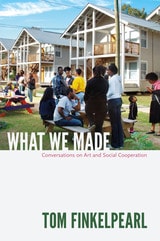
What We Made
Conversations on Art and Social CooperationTom Finkelpearl
Duke University Press, 2013
Interviewees. Naomi Beckwith, Claire Bishop, Tania Bruguera, Brett Cook, Teddy Cruz, Jay Dykeman, Wendy Ewald, Sondra Farganis, Harrell Fletcher, David Henry, Gregg Horowitz, Grant Kester, Mierle Laderman Ukeles, Pedro Lasch, Rick Lowe, Daniel Martinez, Lee Mingwei, Jonah Peretti, Ernesto Pujol, Evan Roth, Ethan Seltzer, and Mark Stern
Works Councils
Consultation, Representation, and Cooperation in Industrial RelationsEdited by Joel Rogers and Wolfgang Streeck
University of Chicago Press, 1995
Works councils—institutionalized bodies for representative communication between an employer and employees in a single workplace—are rare in the Anglo-American world, but are well-established in other industrialized countries. The contributors to this volume survey the history, structure, and functions of works councils in the Netherlands, Germany, France, Spain, Sweden, Italy, Poland, Canada, and the United States. Special attention is paid to the relations between works councils and unions and collective bargaining, works councils and management, and the role and interest of governments in works councils. On the basis of extensive comparative data from other Western countries, the book demonstrates powerfully that well-designed works councils may be more effective than labor unions at solving management-labor problems.