Results by title
3 books match the query 'Correctional institutions'
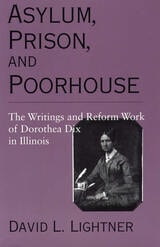
Asylum, Prison, and Poorhouse
The Writings and Reform Work of Dorothea Dix in IllinoisDavid L. Lightner
Southern Illinois University Press, 1999
This illustrated collection of annotated newspaper articles and memorials by Dorothea Dix provides a forum for the great mid-nineteenth-century humanitarian and reformer to speak for herself.
Dorothea Lynde Dix (1802–87) was perhaps the most famous and admired woman in America for much of the nineteenth century. Beginning in the early 1840s, she launched a personal crusade to persuade the various states to provide humane care and effective treatment for the mentally ill by funding specialized hospitals for that purpose. The appalling conditions endured by most mentally ill inmates in prisons, jails, and poorhouses led her to take an active interest also in prison reform and in efforts to ameliorate poverty.
In 1846–47 Dix brought her crusade to Illinois. She presented two lengthy memorials to the legislature, the first describing conditions at the state penitentiary at Alton and the second discussing the sufferings of the insane and urging the establishment of a state hospital for their care. She also wrote a series of newspaper articles detailing conditions in the jails and poorhouses of many Illinois communities.
These long-forgotten documents, which appear in unabridged form in this book, contain a wealth of information on the living conditions of some of the most unfortunate inhabitants of Illinois. In his preface, David L. Lightner describes some of the vivid images that emerge from Dorothea Dix's descriptions of social conditions in Illinois a century and a half ago: "A helpless maniac confined throughout the bitter cold of winter to a dark and filthy pit. Prison inmates chained in hallways and cellars because no more men can be squeezed into the dank and airless cells. Aged paupers auctioned off by county officers to whoever will maintain them at the lowest cost."
Lightner provides an introduction to every document, placing each memorial and newspaper article in its proper social and historical context. He also furnishes detailed notes, making these documents readily accessible to readers a century and a half later. In his final chapter, Lightner assesses both the immediate and the continuing impact of Dix's work.
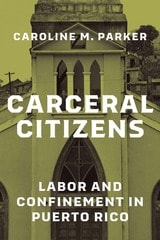
Carceral Citizens
Labor and Confinement in Puerto RicoCaroline M. Parker
University of Chicago Press, 2024
In Carceral Citizens, anthropologist Caroline M. Parker offers an ethnographic portrait of therapeutic communities in Puerto Rico, the oldest colony in the Americas. As nonprofits nested within the carceral state, therapeutic communities serve as reeducation and recovery centers for the mostly male drug offenders who serve out their sentences engaged in manual labor and prayer. The most surprising aspect of these centers, however, is that their “graduates” often remain long after the completion of their term, working as self-appointed peer counselors in a mixture of volunteer and low-wage positions.
Parker seeks to explain this dynamic by showing how, in these therapeutic communities, criminalized men find new and meaningful ways of living in the shadow of the prison. Through their participation in the day-to-day functioning of the centers, they discover and cultivate alternative forms of belonging, livelihood, and citizenship, despite living within the restrictions of the carceral state. Situating her study against the backdrop of Puerto Rico’s colonial history, and with findings that extend across Latin America, Parker challenges common assumptions about confinement, labor, and rehabilitation. By delving into lives shaped by the convergence of imperialism, the carceral state, and self-help, she offers a fresh understanding of the transformations of labor and social life brought about by mass incarceration.

Japanese Corrections
Managing Convicted Offenders in an Orderly SocietyElmer H. Johnson
Southern Illinois University Press, 1996
In his analysis of the current Japanese corrections system, internationally respected criminologist Elmer H. Johnson focuses on three basic questions: What are the characteristics of the major programmatic elements? How do various personnel carry out their programmatic responsibilities? Why are the various duties and activities carried out in a particular way?
Johnson points out that compared with the United States, where prison populations are huge and often violent, Japan incarcerates relatively few criminals. In 1989, for example, Japan locked up only 34 out of every 100,000 citizens while the United States imprisoned people at a rate of 271 per 100,000. Examining the cultural differences leading to this disparity, Johnson notes that in Japan prosecutors are reluctant to refer defendants for trial and the courts often suspend sentences for convicted felons.
In Japan, two bureaus—the Correction Bureau and the Rehabilitation Bureau—administer all Japanese correctional activities. Placing these bureaus in the organizational scheme of the Ministry of Justice, Johnson traces the history, describes the organizational ideologies, and outlines the special features of each.
A central feature of the Japanese penal system is the industrial prison, a concept that met such fierce opposition in the United States that it lost almost all access to the free market by the 1940s. Johnson traces the history of the industrial prison, noting particularly that the industrial operations in adult institutions explain in part why there is almost no violence and why few try to escape. Juvenile institutions enjoy similar success; even though they produce no industrial products, the juvenile training schools emphasize education, vocational training, and counseling.
Japanese correctional officers rely heavily on the community and on unsalaried volunteer probation officers for supervision of probationers and parolees. Although Japanese courts regard probationary supervision as too punitive for most convicted defendants and return many to the community without supervision, the probation caseload is weighty. Johnson describes the responsibilities and operations of the Regional Parole Boards. He also discusses the aid hostels (halfway houses) that are primarily operated by private organizations and that serve released or paroled prisoners.
Johnson sums up by noting that both the Correction Bureau and the Rehabilitation Bureau depend on the overall operations of police, prosecutors, and judges. More broadly, he asserts, both bureaus are creatures of Japanese society and culture. The assets and disadvantages of the bureaus reflect society’s reluctance to sentence defendants to prison and, to a lesser extent, the reluctance to place them on probationary supervision.