Results by title
2 books match the query 'Cosmology in art'

The Fold
From Your Body to the CosmosLaura U. Marks
Duke University Press, 2024
In The Fold, Laura U. Marks offers a practical philosophy and aesthetic theory for living in an infinitely connected cosmos. Drawing on the theories of Leibniz, Glissant, Deleuze, and theoretical physicist David Bohm—who each conceive of the universe as being folded in on itself in myriad ways—Marks contends that the folds of the cosmos are entirely constituted of living beings. From humans to sandwiches to software to stars, every entity is alive and occupies its own private enclosure inside the cosmos. Through analyses of fiction, documentary and experimental movies, interactive media, and everyday situations, Marks outlines embodied methods for detecting and augmenting the connections between each living entity and the cosmos. She shows that by affectively mediating with the ever-shifting folded relations within the cosmos, it is possible to build “soul-assemblages” that challenge information capitalism, colonialism, and other power structures and develop new connections with the infinite. With this guide for living within the enfolded and unfolding cosmos, Marks teaches readers to richly apprehend the world and to trace the processes of becoming that are immanent within the fold.
[more]
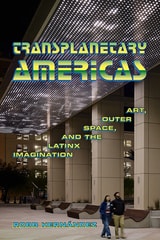
Transplanetary Americas
Art, Outer Space, and the Latinx ImaginationRobb Hernández
Duke University Press, 2026
In Transplanetary Americas, Robb Hernández launches a propulsive pathway for Latinx cultural studies by exploring how the modern space race has driven artists to look upward and attune to expressions derived from the solar system and beyond. By advancing a theoretical and methodological framework he calls transplanetary relationality, Hernández shows how artists’ ascendant attentions unhinge Latinidades from their terrestrial bindings in an aerial pursuit of being with Earth and with other planets. Speculation, science, and technology fuel creative activities referencing the cosmos, taking Latinx art history into unexpected territory. Science fiction B-movie aesthetics empowers political statements of the third kind. NASA’s Apollo program sparks muralist imaginings about other planetary vistas. Private aerospace companies are prompting new generations of artist-activists to defend both land and sky. By showcasing visionaries who frustrate categories of time and place, Hernández’s investigation transcends the typical limits of border studies via a vertical scale, proving that the color of space is not only black but brown.
[more]