Results by title
7 books match the query 'Cost effectiveness'

Building Tall
My Life and the Invention of Construction ManagementJohn L. Tishman and Tom Shachtman
University of Michigan Press, 2011
"John Tishman is a true pioneer in the Construction Management industry. Through his CM leadership, some of America's most well-known buildings have been brought to successful completion."
---Bruce D'Agostino, president and chief executive, Construction Management Association of America
"Building Tall will provide readers with insights into John Tishman's career as a visionary engineer, landmark builder, and great businessman. Responsible for some of the construction world's most magnificent projects, John is one of the preeminent alumni in the history of Michigan Engineering. His perspectives have helped me throughout my time as dean, and his impact will influence generations of Construction Management professionals and students."
---David C. Munson, Jr., Robert J. Vlasic Dean of Engineering, University of Michigan
In this memoir, University of Michigan graduate John L. Tishman recounts the experiences and rationale that led him to create the entirely new profession now recognized and practiced as Construction Management. It evolved from his work as the construction lead of the "owner/builder" firm Tishman Realty and Construction, and his personal role as hands-on Construction Manager in the building of an astonishing array of what were at the time the world's tallest and most complex projects. These include
- The world's first three 100-story towers---the original "twin towers" of the World Trade Center in Manhattan and the Hancock Tower in Chicago.
- The Epcot Center at Disney World.
- The Renaissance Center in Detroit.
- New York's Madison Square Garden.
Tishman interweaves the stories behind the construction of these and many other important buildings and projects with personal reminiscences of his dealings with Henry Ford, Jr., Disney's Michael Eisner, casino magnate Steve Wynn, and many others into a practical history of the field of Construction Management, which he pioneered.
This book will be of interest not only to a general public interested in the stories and personalities behind many of the most iconic construction projects of the post–World War II period in the United States but to students of engineering and architecture and members of the new field of Construction Management.
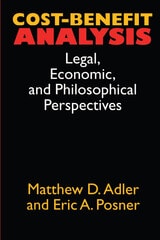
Cost-Benefit Analysis
Economic, Philosophical, and Legal PerspectivesEdited by Matthew D. Adler and Eric A. Posner
University of Chicago Press, 2001
This new scholarly debate includes not only economists, but also contributors from philosophy, cognitive psychology, legal studies, and public policy who can further illuminate the justification and moral implications of this method and specify alternative measures.
These articles originally appeared in the Journal of Legal Studies.
Contributors:
- Matthew D. Adler - Gary S. Becker
- John Broome - Robert H. Frank
- Robert W. Hahn - Lewis A. Kornhauser
- Martha C. Nussbaum - Eric A. Posner
- Richard A. Posner - Henry S. Richardson
- Amartya Sen - Cass R. Sunstein
- W. Kip Viscusi
Least Cost Analysis of Social Landscapes
Archaeological Case StudiesDevin A. White
University of Utah Press, 2012
A growing number of archaeologists are applying Geographic Information Science (GIS) technologies to their research problems and questions. Advances in GIS and its use across disciplines allows for collaboration and enables archaeologists to ask ever more sophisticated questions and develop increasingly elaborate models on numerous aspects of past human behavior. Least cost analysis (LCA) is one such avenue of inquiry. While least cost studies are not new to the social sciences in general, LCA is relatively new to archaeology; until now, there has been no systematic exploration of its use within the field.
This edited volume presents a series of case studies illustrating the intersection of archaeology and LCA modeling at the practical, methodological, and theoretical levels. Designed to be a guidebook for archaeologists interested in using LCA in their own research, it presents a wide cross-section of practical examples for both novices and experts. The contributors to the volume showcase the richness and diversity of LCA’s application to archaeological questions, demonstrate that even simple applications can be used to explore sophisticated research questions, and highlight the challenges that come with injecting geospatial technologies into the archaeological research process.
Measuring the Gains from Medical Research
An Economic ApproachEdited by Kevin M. Murphy and Robert H. Topel
University of Chicago Press, 2003
From an economic perspective, they find, the answer is a resounding "yes": in fact, considering the extraordinary value of improvements to health, we may even be spending too little on medical research. The evidence these papers present and the conclusions they reach are both surprising and convincing: that growth in longevity since 1950 has been as valuable as growth in all other forms of consumption combined; that medical advances producing 10% reductions in mortality from cancer and heart disease alone would add roughly $10 trillion-a year's GDP-to the national wealth; or that the average new drug approved by the FDA yields benefits worth many times its cost of development.
The papers in this book are packed with these and many other surprising revelations, their sophisticated analysis persuasively demonstrating the massive economic benefits we can gain from investments in medical research. For anyone concerned about the cost and the value of such research-from policy makers to health care professionals and economists-this will be a landmark book.
Medical Care Output and Productivity
Edited by David M. Cutler and Ernst R. Berndt
University of Chicago Press, 2001
This volume takes aim at that problem, while taking stock of where we are in our attempts to solve it. Much of this analysis focuses on the capacity to measure the value of technological change and other health care innovations. A key finding suggests that growth in health care spending has coincided with an increase in products and services that together reduce mortality rates and promote additional health gains. Concerns over the apparent increase in unit prices of medical care may thus understate positive impacts on consumer welfare. When appropriately adjusted for such quality improvements, health care prices may actually have fallen. Provocative and compelling, this volume not only clarifies one of the more nebulous issues in health care analysis, but in so doing addresses an area of pressing public policy concern.

Purchasing Population Health
Paying for ResultsDavid A. Kindig
University of Michigan Press, 1997

Valuing Health for Policy
An Economic ApproachEdited by George Tolley, Donald Kenkel, and Robert Fabian
University of Chicago Press, 1994