Results by title
4 books match the query 'Cotton growing'

Black Bodies, White Gold
Art, Cotton, and Commerce in the Atlantic WorldAnna Arabindan-Kesson
Duke University Press, 2021
In Black Bodies, White Gold Anna Arabindan-Kesson uses cotton, a commodity central to the slave trade and colonialism, as a focus for new interpretations of the way art, commerce, and colonialism were intertwined in the nineteenth-century Atlantic world. In doing so, Arabindan-Kesson models an art historical approach that makes the histories of the Black diaspora central to nineteenth-century cultural production. She traces the emergence of a speculative vision that informs perceptions of Blackness in which artistic renderings of cotton—as both commodity and material—became inexorably tied to the monetary value of Black bodies. From the production and representation of “negro cloth”—the textile worn by enslaved plantation workers—to depictions of Black sharecroppers in photographs and paintings, Arabindan-Kesson demonstrates that visuality was the mechanism through which Blackness and cotton became equated as resources for extraction. In addition to interrogating the work of nineteenth-century artists, she engages with contemporary artists such as Hank Willis Thomas, Lubaina Himid, and Yinka Shonibare CBE RA, who contend with the commercial and imperial processes shaping constructions of Blackness and meanings of labor.
[more]

Cultivating Knowledge
Biotechnology, Sustainability, and the Human Cost of Cotton Capitalism in IndiaAndrew Flachs
University of Arizona Press, 2019
A single seed is more than just the promise of a plant. In rural south India, seeds represent diverging paths toward a sustainable livelihood. Development programs and global agribusiness promote genetically modified seeds and organic certification as a path toward more sustainable cotton production, but these solutions mask a complex web of economic, social, political, and ecological issues that may have consequences as dire as death.
In Cultivating Knowledge anthropologist Andrew Flachs shows how rural farmers come to plant genetically modified or certified organic cotton, sometimes during moments of agrarian crisis. Interweaving ethnographic detail, discussions of ecological knowledge, and deep history, Flachs uncovers the unintended consequences of new technologies, which offer great benefits to some—but at others’ expense. Flachs shows that farmers do not make simple cost-benefit analyses when evaluating new technologies and options. Their evaluation of development is a complex and shifting calculation of social meaning, performance, economics, and personal aspiration. Only by understanding this complicated nexus can we begin to understand sustainable agriculture.
By comparing the experiences of farmers engaged with these mutually exclusive visions for the future of agriculture, Cultivating Knowledge investigates the human responses to global agrarian change. It illuminates the local impact of global changes: the slow, persistent dangers of pesticides, inequalities in rural life, the aspirations of people who grow fibers sent around the world, the place of ecological knowledge in modern agriculture, and even the complex threat of suicide. It all begins with a seed.
[more]

The Old South Frontier
Cotton Plantations and the Formation of Arkansas Society, 1819–1861Donald P. Mcneilly
University of Arkansas Press, 2000
In this deeply researched and well-written study, Donald P. McNeilly examines how moderately wealthy planters and sons of planters immigrated into the virtually empty lands of Arkansas, seeking their fortune and to establish themselves as the leaders of a new planter aristocracy west of the Mississippi River. These men, sometimes alone, sometimes with family, and usually with slaves, sought the best land possible, cleared it, planted their crops, and erected crude houses and other buildings. Life was difficult for these would-be leaders of society and their families, and especially hard for the slaves who toiled to create fields in which they labored to produce a crop. McNeilly argues that by the time of Arkansas's statehood in 1836, planters and large farmers had secured a hold over their frontier home, and that between 1840 and the Civil War, planters solidified their hold on politics, economics, and society in Arkansas. The author takes a topical approach to the subject, with chapters on migration, slavery, non-planter whites, politics, and the secession crisis of 1860–1861. McNeilly offers a first-rate analysis of the creation of a white, cotton-based society in Arkansas, shedding light not only on the southern frontier, but also on the established Old South before the Civil War.
[more]
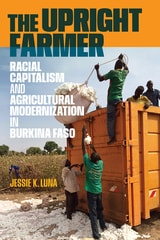
The Upright Farmer
Racial Capitalism and Agricultural Modernization in Burkina FasoJessie K. Luna
Duke University Press, 2026
Debates over African agricultural development have been deeply polarized between those who see capitalism and modern technology as saving African farmers and those who see those forces as destroying them. The Upright Farmer reframes this debate through a flagship case of agricultural modernization: the cotton sector of Burkina Faso, where farmers have rapidly adopted pesticides and genetically modified seeds. This process has produced inequality, debt, and social and ecological harm, yet many farmers embrace these technologies. Through rich, multi-sited ethnographic data, Jessie K. Luna untangles this puzzle by arguing that the material and ideological dynamics of colonial capitalist expansion have been interwoven with racialized hierarchies. The lens of racial capitalism reveals how agricultural modernization creates and justifies structural inequalities. At the same time, people throughout this system, from farmers to extension agents to scientists, actively navigate what W. E. B. Du Bois called “the global color line,” using agricultural technologies as pathways for status and tools of resistance. Invoking Thomas Sankara’s anticolonial vision of Burkina Faso as “the land of upright people,” Luna reveals how Burkinabè strive to stand upright as modern subjects, even as they participate in a process that compounds ecological and social splintering.
[more]