Results by title
10 books match the query 'Cotton trade'

Black Bodies, White Gold
Art, Cotton, and Commerce in the Atlantic WorldAnna Arabindan-Kesson
Duke University Press, 2021
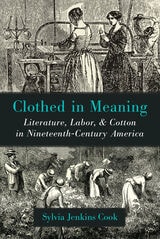
Clothed in Meaning
Literature, Labor, and Cotton in Nineteenth-Century AmericaSylvia Jenkins Cook
University of Michigan Press, 2020
Cloth and clothing provide potent tropes not only for physical but also for intellectual forms of self-expression. Drawing on sources ranging from fugitive slave narratives, newspapers, manifestos, and mill workers’ magazines to fiction, poetry, and autobiographies, Clothed in Meaning examines the significant part played by mill workers and formerly enslaved people, many of whom still worked picking cotton, in this revolution of literary self-expression. They created a new literature from their palpable daily intimacy with cotton, cloth, and clothing, as well as from their encounters with grimly innovative modes of work. In the materials of their labor they discovered vivid tropes for formulating their ideas and an exotic and expert language for articulating them. The harsh conditions of their work helped foster in their writing a trenchant irony toward the demeaning reduction of human beings to “hands” whose minds were unworthy of interest. Ultimately, Clothed in Meaning provides an essential examination of the intimate connections between oppression and luxury as recorded in the many different voices of nineteenth-century labor.
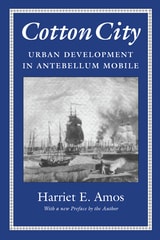
Cotton City
Urban Development in Antebellum MobileHarriet E. Amos Doss
University of Alabama Press, 2001
The exploration of the North-South relationship and the growth of of antebellum Mobile.
Cotton City offers a compelling exploration of Mobile, Alabama’s transformation into a thriving urban center during the antebellum period. Historian Harriet E. Amos examines how economic ambition, civic planning, and the cotton trade shaped the city’s development between 1819 and 1861. Through detailed archival research, Amos reveals how Mobile’s leaders sought to modernize infrastructure, expand commerce, and assert the city’s regional importance—all while navigating the tensions of slavery, class, and Southern identity.
This richly contextualized study highlights the interplay between urban growth and the broader forces of the Southern economy, making Cotton City a vital contribution to the histories of the American South, urbanization, and antebellum society.

Fair to Middlin'
The Antebellum Cotton Trade of the Apalachicola/Chattahoochee River ValleyLynn Willoughby
University of Alabama Press, 2009
This study focuses on the port of Apalachicola, Florida and the business men who lived the trade, flourishing amongst the poor conditions of transportation, communication, money, and banking. Cotton businessmen located along the waterway and on the coast neatly divided the labour necessary to market the region's major source of income.
Early regional economics revolved around and grew from the rivers that served as the primary form of transportation, and each patchwork of economy in the antebellum South relied on a different river system and its major transportation artery. Few people truly understand and realize how important cotton was to the world's economy, and no other American export came close to the importance of cotton. This power and success allowed the South to function self-sufficiently, eliminating the need to rely on other regions for goods. It was not until the introduction of the railroad system that these individual river economies blurred and faded into one another, gradually uniting to one integrated national economy.
Global Rivalries
Standards Wars and the Transnational Cotton TradeAmy A. Quark
University of Chicago Press, 2013
Nowhere is the conflict over rule setting more evident than in the simmering “standards wars” over the rules that define quality and enable the adjudication of disputes. In Global Rivalries, Amy A. Quark explores the questions of how rules are made, who makes them, and how they are enforced, using the lens of cotton—a simple commodity that has become a poignant symbol of both the crisis of Western rule making power and the potential for powerful new rivals to supplant it. Quark traces the strategies for influencing rule making processes employed not only by national governments but also by transnational corporations, fiber scientists, and trade associations from around the globe. Quark analyzes the efficacy of their approaches and the implications for more marginal actors in the cotton trade, including producers in West Africa.
Hanging by a Thread
Cotton, Globalization, and Poverty in AfricaWilliam G. Moseley
Ohio University Press, 2008
The textile industry was one of the first manufacturing activities to become organized globally, as mechanized production in Europe used cotton from the various colonies. Africa, the least developed of the world’s major regions, is now increasingly engaged in the production of this crop for the global market, and debates about the pros and cons of this trend have intensified.
Hanging by a Thread: Cotton, Globalization, and Poverty in Africa illuminates the connections between Africa and the global economy. The editors offer a compelling set of linked studies that detail one aspect of the globalization process in Africa, the cotton commodity chain.
From global policy debates, to impacts on the natural environment, to the economic and social implications of this process, Hanging by a Thread explores cotton production in the postcolonial period from different disciplinary perspectives and in a range of national contexts. This approach makes the globalization process palpable by detailing how changes at the macroeconomic level play out on the ground in the world’s poorest region. Hanging by a Thread offers new insights on the region in a global context and provides a critical perspective on current and future development policy for Africa.
Contributors: Thomas J. Bassett, Jim Bingen, Duncan Boughton, Brian M. Dowd, Marnus Gouse, Leslie C. Gray, Dolores Koenig, Scott M. Lacy, William G. Moseley, Colin Poulton, Bhavani Shankar, Corinne Siaens, Colin Thirtle, David Tschirley, and Quentin Wodon.
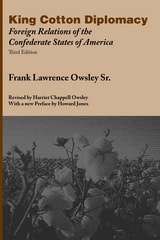
King Cotton Diplomacy
Foreign Relations of the Confederate States of AmericaFrank L. Owsley Sr., revised by Harriet Chappell Owsley, and with a new Preface by Howard Jones
University of Alabama Press, 2008
The exhaustive, definitive study of Southern attempts to gain international support for the Confederacy by leveraging the cotton supply for European intervention during the Civil War. Using previously untapped sources from Britain and France, along with documents from the Confederacy’s state department, Frank Owsley’s King Cotton Diplomacy is the first archival-based study of Confederate diplomacy.
Peasants on Plantations
Subaltern Strategies of Labor and Resistance in the Pisco Valley, PeruVincent Peloso
Duke University Press, 1999
Grounded in the theoretical perspectives of subaltern studies and drawing on an extremely complete archive of landed estates that includes detailed regular reports by plantation managers on all aspects of farming life, Peasants on Plantations reveals the intricate ways peasants, managers, and owners manipulated each other to benefit their own interests. As Peloso demonstrates, rather than a simple case of domination of the peasants by the owners, both parties realized that negotiation was the key to successful growth, often with the result that peasants cooperated with plantation growth strategies in order to participate in a market economy. Long-term contracts gave tenants and sharecroppers many opportunities to make farming choices, to assert claims on the land, compete among themselves, and participate in plantation expansion. At the same time, owners strove to keep the peasants in debt and well aware of who maintained ultimate control.
Peasants on Plantations offers a largely untold view of the monumental struggle between planters and peasants that was fundamental in shaping the agrarian history of Peru. It will interest those engaged in Latin American studies, anthropology, and peasant and agrarian studies.
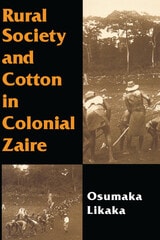
Rural Society and Cotton in Colonial Zaire
Osumaka Likaka
University of Wisconsin Press, 1997
As local plots of food crops grown by individual households gave way to commercial fields of cotton, a whole host of social, economic, and environmental changes followed. Likaka reveals how food shortages and competition for labor were endemic, forests were cleared, social stratification increased, married women lost their traditional control of agricultural production, and communities became impoverished while local chiefs enlarged their power and prosperity.
Likaka documents how the cotton regime promoted its cause through agricultural exhibits, cotton festivals, films, and plays, as well as by raising producer prices and decreasing tax rates. He also shows how the peasant laborers in turn resisted regimented agricultural production by migrating, fleeing the farms for the bush, or sabotaging plantings by surreptitiously boiling cotton seeds. Small farmers who had received appallingly low prices from the cotton companies resisted by stealing back their cotton by night from the warehouses, to resell it in the morning. Likaka draws on interviews with more than fifty informants in Zaire and Belgium and reviews an impressive array of archival materials, from court records to comic books. In uncovering the tumultuous economic and social consequences of the cotton regime and by emphasizing its effects on social institutions, Likaka enriches historical understanding of African agriculture and development.
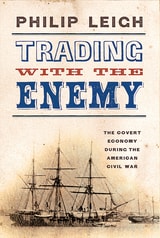
Trading with the Enemy
The Covert Economy During the American Civil WarPhilip Leigh
Westholme Publishing, 2022
While Confederate blockade runners famously carried the seaborne trade for the South during the American Civil War, the amount of Southern cotton exported to Europe was only half of that shipped illicitly to the North. Most went to New England textile mills where business “was better than ever,” according to textile mogul Amos Lawrence. Rhode Island senator William Sprague, a mill owner and son-in-law to Treasury Secretary Salmon P. Chase, was a member of a partnership supplying weapons to the Confederacy in exchange for cotton. The trade in contraband was not confined to New England. Union General William T. Sherman claimed Confederates were supplied with weapons from Cincinnati, while General Ulysses S. Grant captured Rebel cavalry armed with carbines purchased in Union-occupied Memphis. During the last months of the war, supplies entering the Union-controlled port of Norfolk, Virginia, were one of the principal factors enabling Robert E. Lee’s Confederate army to avoid starvation. Indeed, many of the supplies that passed through the Union blockade into the Confederacy originated in Northern states, instead of Europe as is commonly supposed. Merchants were not the only ones who profited; Union officers General Benjamin Butler and Admiral David Dixon Porter benefited from this black market. President Lincoln admitted that numerous military leaders and public officials were involved, but refused to stop the trade.
In Trading with the Enemy: The Covert Economy During the American Civil War, New York Times Disunion contributor Philip Leigh recounts the little-known story of clandestine commerce between the North and South. Cotton was so important to the Northern economy that Yankees began growing it on the captured Sea Islands of South Carolina. Soon the neutral port of Matamoras, Mexico, became a major trading center, where nearly all the munitions shipped to the port—much of it from Northern armories—went to the Confederacy. After the fall of New Orleans and Vicksburg, a frenzy of contraband-for-cotton swept across the vast trans-Mississippi Confederacy, with Northerners sometimes buying the cotton directly from the Confederate government. A fascinating study, Trading with the Enemy adds another layer to our understanding of the Civil War.