Results by title
7 books match the query 'Counseling of'
Cognitive Behavioral Therapy for Christians with Depression
A Practical Tool-Based PrimerMichelle Pearce
Templeton Press, 2016
For anyone in the helping profession, whether as mental health professional or religious leader, this question is bound to arise. Many mental health professionals feel uncomfortable discussing religion. In contrast, many religious leaders feel uncomfortable referring their congregants to professionals who do not know their faith or intent to engage with it.
And yet Michelle Pearce, PhD, assistant professor and clinical psychologist at the Center for Integrative Medicine at the University of Maryland, argues that if religion is essential to a client, religion will be a part of psychotherapy, whether it is discussed or not. Clients cannot check their values at the door more than the professionals who treat them.
To Pearce, the question isn’t really, “does religion belong?” but rather, “how can mental health professionals help their religious clients engage with and use their faith as a healing resource in psychotherapy?”
Cognitive Behavioral Therapy for Christian Clientswith Depression is the answer to that question, as the book’s purpose is to educate mental health professionals and pastoral counselors about religion’s role in therapy, as well as equip them to discuss religious issues and use evidence-based, religiously-integrated tools with Christian clients experiencing depression.
In this book, readers will find the following resources in an easy-to-use format:
- An overview of the scientific benefits of integrating clients’ religious beliefs and practices in psychotherapy
- An organizing therapeutic approach for doing Christian CBT
- Seven tools specific to Christian CBT to treat depression
- Suggested dialogue for therapists to introduce concepts and tools
- Skill-building activity worksheets for clients
- Clinical examples of Christian CBT and the seven tools in action
Cognitive Behavioral Therapy for Christian Clients with Depression is a practical guide for mental health professionals and pastoral counselors who want to learn how to use Christian-specific CBT tools to treat depression in their Christian clients.
Healing Invisible Wounds
Paths to Hope and Recovery in a Violent WorldRichard F. Mollica
Vanderbilt University Press, 2006
Here is how Neil Boothby, Director of the Program on Forced Migration and Health at the Mailman School of Public Health, Columbia University, describes the book:
"Mollica provides a wealth of ethnographic and clinical evidence that suggests the human capacity to heal is innate--that the 'survival instinct' extends beyond the physical to include the psychological as well. He enables us to see how recovery from 'traumatic life events' needs to be viewed primarily as a 'mystery' to be listened to and explored, rather than solely as a 'problem' to be identified and solved. Healing involves a quest for meaning--with all of its emotional, cultural, religious, spiritual and existential attendants--even when bio-chemical reactions are also operative."
Healing Invisible Wounds reveals how trauma survivors, through the telling of their stories, teach all of us how to deal with the tragic events of everyday life. Mollica's important discovery that humiliation--an instrument of violence that also leads to anger and despair--can be transformed through his therapeutic project into solace and redemption is a remarkable new contribution to survivors and clinicians.
This book reveals how in every society we have to move away from viewing trauma survivors as "broken people" and "outcasts" to seeing them as courageous people actively contributing to larger social goals. When violence occurs, there is damage not only to individuals but to entire societies, and to the world. Through the journey of self-healing that survivors make, they enable the rest of us not only as individuals but as entire communities to recover from injury in a violent world.
Helping Children Live With Death and Loss
Dinah Seibert, Judy C. Drolet, and Joyce V. Fetro. Illustrations by Christine I. Stetter
Southern Illinois University Press, 2003
Helping Children Live with Death and Loss is a practical guide for parents, caregivers, teachers, clergy, funeral directors, and other adults who may interact with young children between the ages of two and ten. Utilizing a developmental approach that is critical for understanding the unique characteristics and needs among children under ten, the volume is enhanced by an accessible style and format, numerous illustrations, and the positive attitude that make it possible for any reader to comprehend and apply the concepts when discussing death and loss with young children.
The scope of concepts ranges from adult self-assessment to knowledge of children’s developmental stages in learning. Building on that foundation, the book provides four basic content areas for teaching, supplies sample questions and answers, and suggests strategies for teaching general death education as well as strategies for responding to a current death or loss. The resource concludes with print and internet sources for adults and children. Helping Children Live with Death and Loss also aids adults and children in improving their communication and coping skills, which are critical for managing loss and preparing for a healthier future.

International Students And Academic Libraries Initiatives
Pamela Jackson
Assoc of College & Research Libraries, 2011
International Students and Academic Libraries
Initiatives for SuccessPamela A. Jackson
Assoc of College & Research Libraries, 2011
When Boys Become Parents
Adolescent Fatherhood in AmericaMark S. Kiselica
Rutgers University Press, 2011
In this informative book, Mark S. Kiselica draws on his many years of counseling teenage fathers to offer a compassionate look at the difficult life circumstances and the complicated hardships these young men experience. He dispels many of the myths surrounding teenage fatherhood and shows that, contrary to popular belief, these young men are often emotionally and physically involved in relationships with their partner and their child. But without support and guidance from adults, these relationships often deteriorate in the first year of the child-'s life. Kiselica offers advice for how professionals and policy makers can assist these young men and improve services for them.
When Boys Become Parents provides a moving portrait of teenage fathers to any reader who wants to understand and help these young men to become more competent and loving parents during their journey to adulthood.
White Man's Water
The Politics of Sobriety in a Native American CommunityErica Prussing
University of Arizona Press, 2011
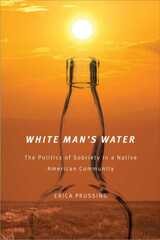
Erica Prussing provides the first in-depth assessment of the politics of Native sobriety by focusing on the Northern Cheyenne community in southeastern Montana, where for many decades the federally funded health care system has relied on the Twelve Step program of Alcoholics Anonymous. White Man’s Water provides a thoughtful and careful analysis of Cheyenne views of sobriety and the politics that surround the selective appeal of Twelve Step approaches despite wide-ranging local critiques. Narratives from participants in these programs debunk long-standing stereotypes about ”Indian drinking” and offer insight into the diversity of experiences with alcohol that actually occur among Native North Americans.
This critical ethnography employs vivid accounts of the Northern Cheyenne people to depict how problems with alcohol are culturally constructed, showing how differences in age, gender, and other social features can affect involvement with both drinking and sobriety. These testimonies reveal the key role that gender plays in how Twelve Step program participants engage in a selective and creative process of appropriation at Northern Cheyenne, adapting the program to accommodate local cultural priorities and spiritual resources. The testimonies also illuminate community reactions to these adaptations, inspiring deeper inquiry into how federally funded health services are provided on the reservation.
This book will appeal to readers with an interest in Native studies, ethnography, women’s studies, and medical anthropology. With its critical consideration of how cultural context shapes drinking and sobriety, White Man’s Water offers a multivocal perspective on alcohol’s impact on health and the cultural complexities of sobriety.