Results by title

3 books match the query 'Counter-Reformation'

cover of Innovation in the Italian Counter-Reformation

Innovation in the Italian Counter-Reformation

Shannon McHugh

University of Delaware Press, 2011

The enduring "black legend" of the Italian Counter-Reformation, which has held sway in both scholarly and popular culture, maintains that the Council of Trent ushered in a cultural dark age in Italy, snuffing out the spectacular creative production of the Renaissance. As a result, the decades following Trent have been mostly overlooked in Italian literary studies, in particular. The thirteen essays of Innovation in the Italian Counter-Reformation present a radical reconsideration of literary production in post-Tridentine Italy. With particular attention to the much-maligned tradition of spiritual literature, the volume’s contributors weave literary analysis together with religion, theater, art, music, science, and gender to demonstrate that the literature of this period not only merits study but is positively innovative. Contributors include such renowned critics as Virginia Cox and Amedeo Quondam, two of the leading scholars on the Italian Counter-Reformation.

Published by University of Delaware Press. Distributed worldwide by Rutgers University Press.
 
[more]
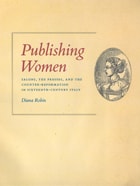
cover of Publishing Women: Salons, the Presses, and the Counter-Reformation in Sixteenth-Century Italy

Publishing Women

Salons, the Presses, and the Counter-Reformation in Sixteenth-Century Italy

Diana Robin

University of Chicago Press, 2007

Even the most comprehensive Renaissance histories have neglected the vibrant groups of women writers that emerged in cities across Italy during the mid-1500s—and the thriving network of printers, publishers, and agents that specialized in producing and selling their books. In Publishing Women, Diana Robin finally brings to life this story of women’s cultural and intellectual leadership in early modern Italy, illuminating the factors behind—and the significance of—their sudden dominance.

Focusing on the collective publication process, Robin portrays communities in Naples, Venice, Rome, Siena, and Florence, where women engaged in activities that ranged from establishing literary salons to promoting religious reform. Her innovative cultural history considers the significant roles these women played in tandem with men, rather than separated from them. In doing so, it collapses the borders between women’s history, Renaissance and Reformation studies, and book history to evoke a historical moment that catapulted women’s writings and women-sponsored books into the public sphere for the first time anywhere in Europe.
[more]
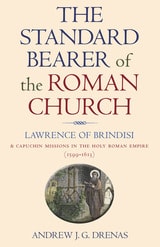
cover of The Standard Bearer of the Roman Church: Lawrence of Brindisi and Capuchin Missions in the Holy Roman Empire (1599-1613)

The Standard Bearer of the Roman Church

Lawrence of Brindisi and Capuchin Missions in the Holy Roman Empire (1599-1613)

Andrew J.G. Drenas

Catholic University of America Press, 2018

The Standard Bearer of the Roman Church examines the missionary work of the early modern Capuchin friar, and doctor of the Church, Lawrence of Brindisi. Renowned in his own day as a preacher, Bible scholar, missionary, chaplain, and diplomat, as well as vicar general of his order, Lawrence led the first organized, papally-commissioned Capuchin mission among the non-Catholics of Bohemia in the Holy Roman Empire from 1599 to 1602. He returned again under papal mandate, from 1606 to 1613. Andrew Drenas analyzes Lawrence’s evangelistic and polemical strategies in central Europe in order to shed light on some of the ways the Capuchins labored in religiously divided territories to confirm Catholics in their faith and to win over heretics. The introduction explains, principally, the book’s purpose and the historiographical background. After providing a brief biographical sketch of Lawrence’s life followed by details of his afterlife, Drenas examines Lawrence’s leading role in establishing the Capuchins’ new Commissariate of Bohemia-Austria-Styria in 1600, and specifically its first three friaries in Prague, Vienna, and Graz. From there the volume moves on to treat his preaching against heresy, followed by a focus on how Lawrence, while in Prague, involved himself directly in theological disputations with two different Lutheran preachers. The first dispute, with Polycarp Leyser, took place in July 1607, and dealt with good works and justification. The second, with a Lutheran whose identity remains unknown, and which occurred in August 1610, concerned Catholic veneration of the Virgin Mary. This is followed by an analysis of the Lutheranismi hypotyposis, or The Express Image of Lutheranism, Lawrence’s literary refutation of Lutheranism following additional contact with Polycarp Leyser in 1607. Finally, Drenas considers briefly the effectiveness of Lawrence’s apostolate and closes with a review of the book as a whole.
[more]