Results by title
5 books match the query 'Coup d'état, 1973'

Battling for Hearts and Minds
Memory Struggles in Pinochet's Chile, 1973–1988Steve J. Stern
Duke University Press, 2006
In the 1970s, Chilean dissidents were lonely “voices in the wilderness” insisting that state terror and its victims be recognized and remembered. By the 1980s, the dissent had spread, catalyzing a mass movement of individuals who revived public dialogue by taking to the streets, creating alternative media, and demanding democracy and human rights. Despite long odds and discouraging defeats, people of conscience—victims of the dictatorship, priests, youth, women, workers, and others—overcame fear and succeeded in creating truthful public memories of state atrocities. Recounting both their efforts and those of the regime’s supporters to win the battle for Chileans’ hearts and minds, Stern shows how profoundly the struggle to create memories, to tell history, matters.
Battling for Hearts and Minds is the second volume in the trilogy The Memory Box of Pinochet’s Chile. The third book will examine Chileans’ efforts to achieve democracy while reckoning with Pinochet’s legacy.
Latent Memory
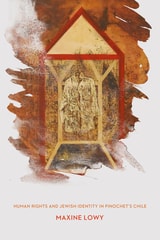
Human Rights and Jewish Identity in ChileMaxine Lowy
University of Wisconsin Press, 2022
Maxine Lowy draws upon hundreds of first-person testimonials and archival resources to explore Chilean Jewish identity in the wake of Pinochet's coup, exposing the complex and sometimes contradictory development of collective traumatic memory and political sensibilities in an oppressive new context. Latent Memory points to processes of community gestures of moral reparation and signals the pathways to justice and healing associated with Shoah and the Jewish experience. Lowy asks how individuals and institutions may overcome fear, indifference, and convenience to take a stand even under intense political duress, posing questions applicable to any nation emerging from state repression.
Reckoning with Pinochet
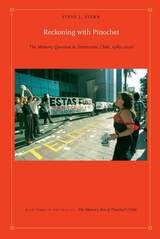
The Memory Question in Democratic Chile, 1989–2006Steve J. Stern
Duke University Press, 2010
Stern’s analysis integrates policymaking by elites, grassroots efforts by human rights victims and activists, and inside accounts of the truth commissions and courts where top-down and bottom-up initiatives met. Interpreting solemn presidential speeches, raucous street protests, interviews, journalism, humor, cinema, and other sources, he describes the slow, imperfect, but surprisingly forceful advance of efforts to revive democratic values through public memory struggles, despite the power still wielded by the military and a conservative social base including the investor class. Over time, resourceful civil-society activists and select state actors won hard-fought, if limited, gains. As a result, Chileans were able to face the unwelcome past more honestly, launch the world’s first truth commission to examine torture, ensnare high-level perpetrators in the web of criminal justice, and build a public culture of human rights. Stern provides an important conceptualization of collective memory in the wake of national trauma in this magisterial work of history.
Remembering Pinochet's Chile
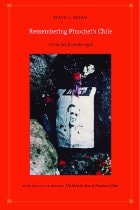
On the Eve of London 1998Steve J. Stern
Duke University Press, 2004
“A thoughtful, nuanced study of how Chileans remember the traumatic 1973 coup by Augusto Pinochet against Salvador Allende and the nearly two decades of military government that followed. . . . In light of the recent revelations of American human rights abuses of Iraqi prisoners, [Stern’s] insights into the legacies of torture and abuse in the Chilean prisons of the 1970s certainly have contemporary significance for any society that undergoes a national trauma.”—Publishers Weekly
“This outstanding work of scholarship sets a benchmark in the history of state terror, trauma, and memory in Latin America.”—Thomas Miller Klubock, American Historical Review
“This is a book of uncommon depth and introspection. . . . Steve J. Stern has not only advanced the memory of the horrors of the military dictatorship; he has assured the place of Pinochet’s legacy of atrocity in our collective conscience.”—Peter Kornbluh, author of The Pinochet File: A Declassified Dossier on Atrocity and Accountability
“Steve J. Stern’s book elegantly recounts the conflicted recent history of Chile. He has found a deft solution to the knotty problem of evenhandedness in representing points of view so divergent they defy even the most careful attempts to portray the facts of the Pinochet period. He weaves a tapestry of memory in which narratives of horror and rupture commingle with the sincere perceptions of Chileans who remember Pinochet’s rule as salvation. The facts are there, but more important is the understanding we gain by knowing how ordinary Chileans—Pinochet’s supporters and his victims—work through their unresolved past.”—John Dinges, author of The Condor Years: How Pinochet and His Allies Brought Terrorism to Three Continents
When a Flower Is Reborn
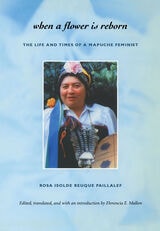
The Life and Times of a Mapuche FeministRosa Isolde Reuque Paillalef, Edited, translated, and with an introduction by Florencia E. Mallon
Duke University Press, 2002
A leading activist during the Pinochet dictatorship, Reuque—a woman, a Catholic, and a Christian Democrat—often felt like an outsider within the male-dominated, leftist Mapuche movement. This sense of herself as both participant and observer allows for Reuque’s trenchant, yet empathetic, critique of the Mapuche ethnic movement and of the policies regarding indigenous people implemented by Chile’s post-authoritarian government. After the 1990 transition to democratic rule, Reuque collaborated with the government in the creation of the Indigenous Development Corporation (CONADI) and the passage of the Indigenous Law of 1993. At the same time, her deepening critiques of sexism in Chilean society in general, and the Mapuche movement in particular, inspired her to found the first Mapuche feminist organization and participate in the 1996 International Women’s Conference in Beijing. Critical of the democratic government’s inability to effectively address indigenous demands, Reuque reflects on the history of Mapuche activism, including its disarray in the early 1990s and resurgence toward the end of the decade, and relates her hopes for the future.
An important reinvention of the testimonial genre for Latin America’s post-authoritarian, post-revolutionary era, When a Flower Is Reborn will appeal to those interested in Latin America, race and ethnicity, indigenous people’s movements, women and gender, and oral history and ethnography.