Results by title
16 books match the query 'Court'

AMBASSADORIAL DIARIES
THE COURT OF ST. JAMES'S 1918-1921JULIA DAVIS
West Virginia University Press, 1993
John W. Davis (1873-1955) was the most important national politician to call West Virginia home. Nominated for president by the Democratic Party in 1924, Davis lost to the incumbent Calvin Coolidge. This diary is an engaging day-by-day account of Davis's service as U.S. ambassador to England at a pivotal point in modern history. The recent World War and Russian Revolution, the new thirst for oil, the old strife in Ireland, and the final days of the Wilson presidency fill this diary with enduring significance. Davis also offers a look at the personalities which shaped the post-war world and describes the pageantry and social life of America's most coveted ambassadorial assignment.

Court of Last Resort
Mental Illness and the LawCarol A. B. Warren
University of Chicago Press, 1982
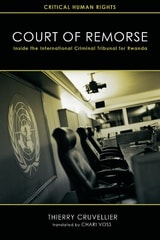
Court of Remorse
Inside the International Criminal Tribunal for RwandaThierry Cruvellier
University of Wisconsin Press, 2010
Fascinated by the Tribunal’s rich complexities, journalist Thierry Cruvellier came back day after day to watch the proceedings, spending more time there than any other outside observer. Gradually he gained the confidence of the victims, defendants, lawyers, and judges. Drawing on interviews with these protagonists and his close observations of their interactions, Cruvellier takes readers inside the courtroom to witness the motivations, mechanisms, and manipulations of justice as it unfolded on the stage of high-stakes, global politics. It is this ground-level view that makes his account so valuable—and so absorbing. A must-read for those who want to understand the dynamics of international criminal tribunals, Court of Remorse reveals both the possibilities and the challenges of prosecuting human rights violations.
Best Books for General Audiences, selected by the American Association for School Libraries and the Public Library Association
Best Books for High Schools, selected by the American Association for School Libraries
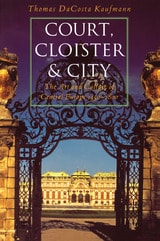
Court, Cloister, and City
The Art and Culture of Central Europe, 1450-1800Thomas DaCosta Kaufmann
University of Chicago Press, 1995
"Kaufmann throws considerable light on one of the more neglected and least understood periods in art history."—Philadelphia Inquirer
"A wonderful book which does justice both to a formal analysis of the art and to an explanation of broader political and economic forces at work."—Virginia Quarterly Review
"Important and stimulating, Kaufmann's study examines the cultural legacy of a region too little known and understood."—Choice
"Peaks of the creative heritage which [Kaufmann] describes reserve their message—and their surprises—for those who visit them in situ. But invest in Kaufmann's volume before you go."—R. J. W. Evans, New York Review of Books
Courting the Community
Legitimacy and Punishment in a Community CourtChristine Zozula
Temple University Press, 2019
Community Courts are designed to handle a city’s low-level offenses and quality-of-life crimes, such as littering, loitering, or public drunkenness. Court advocates maintain that these largely victimless crimes jeopardize the well-being of residents, businesses, and visitors. Whereas traditional courts might dismiss such cases or administer a small fine, community courts aim to meaningfully punish offenders to avoid disorder escalating to apocalyptic decline.
Courting the Community is a fascinating ethnography that goes behind the scenes to explore how quality-of-life discourses are translated into court practices that marry therapeutic and rehabilitative ideas. Christine Zozula shows how residents and businesses participate in meting out justice—such as through community service, treatment, or other sanctions—making it more emotional, less detached, and more legitimate in the eyes of stakeholders. She also examines both “impact panels,” in which offenders, residents, and business owners meet to discuss how quality-of-life crimes negatively impact the neighborhood, as well as strategic neighborhood outreach efforts to update residents on cases and gauge their concerns.
Zozula’s nuanced investigation of community courts can lead us to a deeper understanding of punishment and rehabilitation and, by extension, the current state of the American court system.
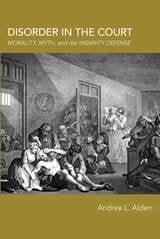
Disorder in the Court
Morality, Myth, and the Insanity DefenseAndrea L. Alden
University of Alabama Press, 2018
The first book-length rhetorical history and analysis of the legal and moral questions behind the insanity defense.
The insanity defense is considered one of the most controversial, most misunderstood, and least straightforward subjects in the American legal system. Disorder in the Court: Morality, Myth, and the Insanity Defense traces the US legal standards for the insanity defense as they have evolved from 1843, when they were first codified in England, to 1984, when the US government attempted to revise them through the Insanity Defense Reform Act. Throughout this period “insanity” existed primarily as a legal term rather than a medical one; yet the testimony of psychiatric experts is required in cases in which an insanity defense is raised.
The adjudication of such cases by courtroom practice is caught between two different but overlapping discourses, the legal and the medical, both of which have historically sought to assert and maintain firm disciplinary boundaries. Both expert and lay audiences have struggled to understand and apply commonplace definitions of sanity, and the portrayal of the insanity defense in popular culture has only served to further frustrate such understandings.
Andrea L. Alden argues that the problems with understanding the insanity defense are, at their foundation, rhetorical. The legal concept of what constitutes insanity and, therefore, an abdication of responsibility for one’s actions does not map neatly onto the mental health professions’ understandings of mental illness and how that affects an individual’s ability to understand or control his or her actions. Additionally, there are multiple layers of persuasion involved in any effort to convince a judge, jury—or a public, for that matter—that a defendant is or is not responsible for his or her actions at a particular moment in time.
Alden examines landmark court cases such as the trial of Daniel McNaughtan, Durham v. United States, and the trial of John Hinckley Jr. that signal the major shifts in the legal definitions of the insanity defense. Combining archival, textual, and rhetorical analysis, Alden offers a close reading of texts including trial transcripts, appellate court opinions, and relevant medical literature from the time period. She contextualizes these analyses through popular texts—for example, newspaper articles and editorials—showing that while all societies have maintained some version of mental illness as a mitigating factor in their penal systems, the insanity defense has always been fraught with controversy.
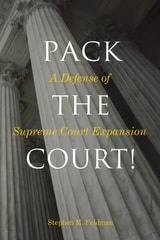
Pack the Court!
A Defense of Supreme Court ExpansionStephen M. Feldman
Temple University Press, 2021
The United States Supreme Court has numbered nine justices for the past 150 years. But that number is not fixed. With the Democrats controlling the House and Senate during the Biden presidency, they could add justices to the Supreme Court. But would court packing destroy the Court as an apolitical judicial institution? This is the crucial question Stephen Feldman addresses in his provocative book, Pack the Court! He uses a historical, analytical, and political argument to justify court-packing in general and Democratic court-packing more specifically.
Republicans and Democrats alike profess to worry that court-packing will destroy the legitimacy of the Supreme Court as a judicial institution by injecting politics into a purely legal adjudicative process. But as Feldman’s insightful book shows, law and politics are forever connected in judicial interpretation and decision making. Pack the Court! insists that court packing is not the threat to the Supreme Court’s institutional legitimacy that many fear. Given this, Feldman argues that Democrats should pack the Court while they have the opportunity. Doing so might even strengthen the American people’s faith in the Court.
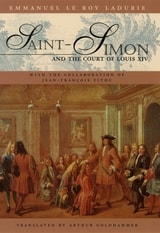
Saint-Simon and the Court of Louis XIV
Emmanuel Le Roy Ladurie
University of Chicago Press, 2001
Saint-Simon and the Court of Louis XIV, expertly translated by Arthur Goldhammer, is a historical essay about court life, built with the wide range of tools Ladurie so expertly employs: ethnography, history, literary criticism, and historiography. Ladurie recreates a world in which man is most definitely born unequal, a world circumscribed entirely by purity of bloodline, which nonetheless directly preceded the birth of democratic thought and political action. Locked into a virtual caste system, courtiers formed within their ranks cabals, factions, and groups bonded by common ideological principles in order to survive the political order of the court. Thus Saint-Simon and the Court of Louis XIV is not only about Saint-Simon's place in this constellation but also the constellation itself and how understanding it forces us to a reevaluation of political life in France during the Old Regime.
Including a biographical sketch of Saint-Simon and more than 30 illustrations of court life and its members, Saint-Simon and the Court of Louis XIV will delight those interested in French history as well as instruct those interested in political history.

Star Chamber Matters
The Court and Its RecordsEdited by Natalie Mears and Krista Kesselring
University of London Press, 2021
Star Chamber Matters details some of the fascinating, tragic, and startling cases brought before the Star Chamber, an English court that sat at the Royal Palace of Westminster from the late fifteenth century to the mid-seventeenth century. Through close examination of the breadth and depth of cases brought before the court in its day, readers will experience the trials and tribulations of life, love, and death in Tudor Britain. These cases touch on changing gender roles, shifting religious views, and more. Star Chamber Matters witnesses the birth of English common and civil law as we know it today.
Statutes in Court
The History and Theory of Statutory InterpretationWilliam D. Popkin
Duke University Press, 1999
Popkin begins by discussing the British origins of statutory interpretation in this country. He then maps the evolving conceptions of the judicial role in the United States from Revolutionary times through the twentieth century before presenting his “ordinary judging” theory—one that asks the judge to use modest judicial discretion to assist the legislature in implementing good government. Claiming that theory cannot account for everything a judge does when determining statutory meaning or writing an opinion, Popkin shows how judges who strive to be conscientious in interpreting the law are often hampered by the lack of both a framework in which to fit their approach and a well-understood common vocabulary to explain what they do. Statutes in Court fills that gap.
This work will be valuable to anyone concerned about the judicial role in the interpretation of laws—from judiciary officials and law professors to legal historians and political scientists.
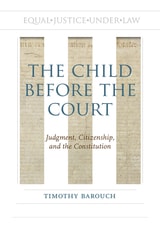
The Child before the Court
Judgment, Citizenship, and the ConstitutionTimothy Barouch
University of Alabama Press, 2021
A study that challenges our notions about citizenship and judgment by considering the place of children in historical and contemporary legal discourse.
Many of the most controversial political issues of our time focus on the actions and well-being of children such as Greta Thunberg’s climate movement; youth activists standing up for racial justice, safe schools, and an equitable economy; and the furor over separating migrant children from their families. When do we treat children as competent citizens, when do we treat them as dependents in need of protection, and why?
The Child before the Court: Judgment, Citizenship, and the Constitution provides answers to these foundational questions. It analyzes landmark US Supreme Court cases involving children’s free speech and due process rights and argues that our ideas about civic and legal judgment are deeply contested concepts instead of simple character traits. These cases serve as analytic touchstones for these problems, and the Court’s opinions seemingly articulate clear rules through a pragmatic balancing of interests.
Timothy Barouch shows how these cases continually reshape constitutional thought, breaking from a vocabulary of wardship and recasting the child as a liberal individual. He analyzes these legal opinions as judicial novelizations and focuses on their rhetorical markers: the range of tropes, idioms, figures, and arguments that emerge across nearly two centuries of jurisprudence in this important but oft-neglected area. The careful and subtle readings of these cases demonstrate how judicial representations of the child provide key resources for thinking about the child as citizen and, more broadly, citizenship itself. It serves as a bold call to think through the relationship between the liberal individual and the problem of civic judgment as it manifests in public culture in a wide array of contexts at a time when liberal democracy is under siege.
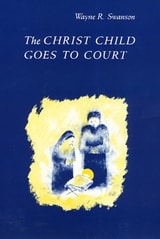
The Christ Child Goes to Court
Wayne R. Swanson
Temple University Press, 1992
In December 1981, when the American Civil Liberties Union challenged the Nativity scene in the Christmas display put on by the city of Pawtucket, Rhode Island, an emotional controversy erupted. Two federal courts disallowed the crèche because its religious impact in the taxpayer-supported display overstepped the constitutional boundary between church and state. In March 1984, the United States Supreme Court by a 5-4 vote in Lynch V. Donnelly overruled the lower courts, deciding that in the predominantly secular context of Pawtucket’s display, the purpose and effect of the Nativity scene was not to promote religion, but only to acknowledge the spirit of the holiday season. The Christ Child Goes to Court traces the judicial history of a case that lasted more than two years and explores its implications for future issues concerning the relationship between religion and government.
Wayne R. Swanson describes how this compelling constitutional issue polarized public opinion in Rhode Island and generated "unimaginable vilification" of the Roman Catholic judge who first ordered the crèche removed. He reports the reactions of local citizens, which echoed the national debate on this issue. By carefully documenting the case’s trek through the judiciary, Swanson illustrates the workings of the judicial process in the United States, the political nature of the courts, and how their interpretation of the Constitution helps to shape the development of public policy.
An important conclusion of this critical examination of the courts’ approach to a controversial church-state question is that judicial decisions are usually interim in nature and often lead to imperfect solutions. Lynch V. Donnelly did not solve the problems posed by government-supported Nativity scenes or other religious symbols. The controversy lives on and the courts continue to struggle with one of the most difficult First Amendment problems.
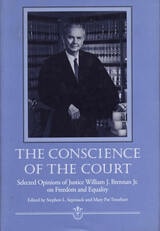
The Conscience of the Court
Selected Opinions of Justice William J. Brennan Jr. on Freedom and EqualityEdited by Stephen L. Sepinuck and Mary Pat Treuthart
Southern Illinois University Press, 1999
The Conscience of the Court celebrates the work of Justice William J. Brennan Jr., who served on the United States Supreme Court for thirty-four years (1956–1990).
Stephen L. Sepinuck and Mary Pat Treuthart introduce and present selected judicial opinions written by Justice Brennan on issues involving personal freedom, civil liberties, and equality. Brennan is ranked by many as the best writer ever to have served on the Supreme Court, and his written opinions depict real people, often in desperate, emotional situations. Remarkable for their clarity of analysis, for their eloquence, and for their forcefulness and persuasiveness, his opinions demonstrate that judicial thought need not be a proprietary enclave of lawyers or the intellectual elite.
The extended excerpts selected by Sepinuck and Treuthart highlight Brennan's approach to judicial decision making. Concerned always with how each decision would actually affect people's lives, Brennan possessed a rare quality of empathy. In Brennan, the editors note, "people and groups who lacked influence in society—Communists and flag burners, children and foreigners, criminal defendants and racial minorities"—found a champion they could count on "to listen to their causes and judge them unmoved by the passions of the politically powerful."
In their introduction to each opinion, the editors provide background facts, discuss how the excerpted opinion transformed the law or otherwise fit into the realm of constitutional jurisprudence, and delve into Justice Brennan's judicial philosophy, his method of constitutional interpretation, and the language he used.
The Court of Comedy
Wilfred E. Major
The Ohio State University Press, 2013
The Cult Of The Court
John Brigham
Temple University Press, 1991
In recent years widespread attention has been focused on decisions handed down by the Supreme Court that grapple with passionate issues: integration, school prayer, abortion, affirmative action. The appointment of new justices is a highly charged political event although the Court is supposed to be "above" politics. Amidst the bicentennial celebration of the Constitution and almost daily reports of major confrontations awaiting the highest court’s judicial review, John Brigham presents a fresh and innovative examination of the U.S. Supreme Court as the final arbiter of constitutional interpretation.
Drawing on philosophy and anthropology, The Cult of the Court offers a social scientific investigation of an institution whose authority has come to be taken for granted. The author emphasizes that the Court is an institution and that its authority is founded less in the claim of legal expertise than in hierarchical finality—the assertion of political will, not of legal judgment. He shows how the Court has supplanted the Constitution as the authority in our political world and that what makes legal "sense" is affected by these factors of institutionalization, bureaucratization, and court-dominated constitutionalism.

When Women Rule the Court
Gender, Race, and Japanese American BasketballWillms, Nicole
Rutgers University Press, 2017
For nearly one hundred years, basketball has been an important part of Japanese American life. Women’s basketball holds a special place in the contemporary scene of highly organized and expansive Japanese American leagues in California, in part because these leagues have produced numerous talented female players. Using data from interviews and observations, Nicole Willms explores the interplay of social forces and community dynamics that have shaped this unique context of female athletic empowerment. As Japanese American women have excelled in mainstream basketball, they have emerged as local stars who have passed on the torch by becoming role models and building networks for others.