Results by title
5 books match the query 'Courtroom'
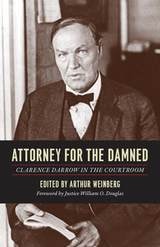
Attorney for the Damned
Clarence Darrow in the CourtroomClarence Darrow
University of Chicago Press, 2012
A famous defender of the underdog, the oppressed, and the powerless, Clarence Darrow (1857–1938) is one of the true legends of the American legal system. His cases were many and various, but all were marked by his unequivocal sense of justice, as well as his penchant for representing infamous and unpopular clients, such as the Chicago thrill killers Leopold and Loeb; Ossian Sweet, the African American doctor charged with murder after fighting off a violent, white mob in Detroit; and John T. Scopes, the teacher on trial in the famous Scopes Monkey Trial.
Published for the first time in 1957, Attorney for the Damned collects Darrow’s most influential summations and supplements them with scene-setting explanations and comprehensive notes by Arthur Weinberg. Darrow confronts issues that remain relevant over half a century after his death: First Amendment rights, capital punishment, and the separation of church and state. With an insightful forward by Justice William O. Douglas, this volume serves as a powerful reminder of Darrow’s relevance today.
Published for the first time in 1957, Attorney for the Damned collects Darrow’s most influential summations and supplements them with scene-setting explanations and comprehensive notes by Arthur Weinberg. Darrow confronts issues that remain relevant over half a century after his death: First Amendment rights, capital punishment, and the separation of church and state. With an insightful forward by Justice William O. Douglas, this volume serves as a powerful reminder of Darrow’s relevance today.
[more]

Battered Women In The Courtroom
The Power of Judicial ResponsesUniversity Press of New England, 1999
[more]
Experiencing Other Minds in the Courtroom
Neal Feigenson
University of Chicago Press, 2016
Sometimes the outcome of a lawsuit depends upon sensations known only to the person who experiences them, such as the buzzing sound heard by a plaintiff who suffers from tinnitus after an accident. Lawyers, litigants, and expert witnesses are now seeking to re-create these sensations in the courtroom, using digital technologies to simulate litigants’ subjective experiences and thus to help jurors know—not merely know about—what it is like to be inside a litigant’s mind. But with this novel type of evidence comes a host of questions: Can anyone really know what it is like to have another person’s sensory experiences? Why should courts allow jurors to see or hear these simulations? And how might this evidence alter the ways in which judges and jurors do justice?
In Experiencing Other Minds in the Courtroom, Neal Feigenson turns the courtroom into a forum for exploring the profound philosophical, psychological, and legal ramifications of our efforts to know what other people’s conscious experiences are truly like. Drawing on disciplines ranging from cognitive psychology to psychophysics to media studies, Feigenson harnesses real examples of digitally simulated subjective perceptions to explain how the epistemological value of this evidence is affected by who creates it, how it is made, and how it is presented. Through his close scrutiny of the different kinds of simulations and the different knowledge claims they make, Feigenson is able to suggest best practices for how we might responsibly incorporate such evidence into the courtroom.
In Experiencing Other Minds in the Courtroom, Neal Feigenson turns the courtroom into a forum for exploring the profound philosophical, psychological, and legal ramifications of our efforts to know what other people’s conscious experiences are truly like. Drawing on disciplines ranging from cognitive psychology to psychophysics to media studies, Feigenson harnesses real examples of digitally simulated subjective perceptions to explain how the epistemological value of this evidence is affected by who creates it, how it is made, and how it is presented. Through his close scrutiny of the different kinds of simulations and the different knowledge claims they make, Feigenson is able to suggest best practices for how we might responsibly incorporate such evidence into the courtroom.
[more]
Reproducing Rape
Domination through Talk in the CourtroomGregory M. Matoesian
University of Chicago Press, 1993
This book offers new insight into one of the most disturbing social problems of modern societies: rape. Using tape recordings of actual trials, Gregory M. Matoesian looks at the social construction of rape trials and at how a woman's experience of violation can be transformed in the courtroom into an act of routine, consensual sex.
Matoesian examines the language of the courtroom, focusing on how defense lawyers interpret and classify rape in a way that makes the victim's experience appear as a normal sexual encounter. He analyzes the language that defense attorneys use in cross-examination to argue that courtroom talk can shape the victim's testimony to fit male standards of legitimate sexual practice. On this view, cross-examination is an adversarial war of words through which lawyers manipulate reality and perpetuate the patriarchal domination of women.
Reproducing Rape will interest students and professionals in law, criminology, sociology, feminist theory, linguistics, and anthropology.
[more]
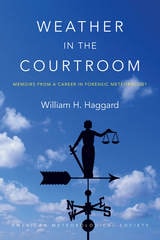
Weather in the Courtroom
Memoirs from a Career in Forensic MeteorologyWilliam H. Haggard
American Meteorological Society, 2016
As director of the National Oceanic and Atmospheric Administration’s National Climatic Data Center in the late 1960s and early ’70s, William H. Haggard witnessed an explosion in the number of requests from attorneys needing weather data for their cases. But while the Center offered data certified by the Department of Commerce that could be submitted as evidence in a court of law, government meteorologists could not be released from work to interpret this data in the courtroom. In their place, pioneering forensic meteorologists stepped in to serve as expert witnesses.
For a society enthralled by courtroom drama, forensics, and natural disasters, Weather in the Courtroom is a perfect storm: an exciting inside scoop on legendary court cases where the weather may—or may not—have played a crucial role. Haggard explores both the meteorological facts and human stories of a variety of high-profile cases among the hundreds in which, after retiring from the government, he served as an expert witness. Were the disappearance of Alaskan Congressman Nick Begich’s plane on October 16, 1972; the collapse of Tampa Bay’s Skyway Bridge on May 9, 1980; and the crash of Delta Flight 191 in Dallas/Fort Worth on August 2, 1985, natural or human-caused disasters? Haggard’s recounting of these and other litigations reveals just how critical the interpretation of weather and climate data in the courtroom is to our understanding of what happened—and who, if anyone, is at fault.
For a society enthralled by courtroom drama, forensics, and natural disasters, Weather in the Courtroom is a perfect storm: an exciting inside scoop on legendary court cases where the weather may—or may not—have played a crucial role. Haggard explores both the meteorological facts and human stories of a variety of high-profile cases among the hundreds in which, after retiring from the government, he served as an expert witness. Were the disappearance of Alaskan Congressman Nick Begich’s plane on October 16, 1972; the collapse of Tampa Bay’s Skyway Bridge on May 9, 1980; and the crash of Delta Flight 191 in Dallas/Fort Worth on August 2, 1985, natural or human-caused disasters? Haggard’s recounting of these and other litigations reveals just how critical the interpretation of weather and climate data in the courtroom is to our understanding of what happened—and who, if anyone, is at fault.
[more]