Results by title
3 books match the query 'Couvares, Francis G.'
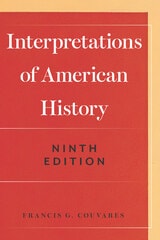
Interpretations of American History
Francis G. Couvares
University of Massachusetts Press, 2025
Without a doubt, the teaching of American history has changed since George Billias and Gerald Grob first issued Interpretations of American History, a comprehensive introduction to the major debates and schools of thought within the field of American history. For this ninth edition, Francis G. Couvares has thoroughly updated the text to include both developments in scholarly debate and changes in the format. He has consolidated two chapters on the revolutionary era into one, and he has also merged formerly separate chapters on profit and commerce in the trading of human beings and the complex and resilient culture that enslaved people sustained. Additionally, he has written a completely new chapter on environmental history and updated the final chapters of the text to include recent scholarship that connects the history of the Civil Rights Movement to the Black Lives Matter Movement; scholarship that discusses intersectionality within feminism, and recent work on political realignment and fragmentation.
In a major revision to the format, Couvares has omitted excerpts of scholarly articles. However, for curious students or research assignments, he includes ample current references. Further, this updated edition anticipates electronic reading of discrete chapters rather than the entire book, and each chapter stands alone well enough to be assigned individually.

Movie Censorship and American Culture
Francis G. Couvares
University of Massachusetts Press, 2006
From the earliest days of public outrage over “indecent” nickelodeon shows, Americans have worried about the power of the movies. The eleven essays in this book examine nearly a century of struggle over cinematic representations of sex, crime, violence, religion, race, and ethnicity, revealing that the effort to regulate the screen has reflected deep social and cultural schisms.
In addition to the editor, contributors include Daniel Czitrom, Marybeth Hamilton, Garth Jowett, Charles Lyons, Richard Maltby, Charles Musser, Alison M. Parker, Charlene Regester, Ruth Vasey, and Stephen Vaughn. Together they make it clear that censoring the movies is more than just a reflex against "indecency," however defined. Whether censorship protects the vulnerable or suppresses the creative, it is part of a broader culture war that breaks out recurrently as Americans try to come to terms with the market, the state, and the plural society in which they live.
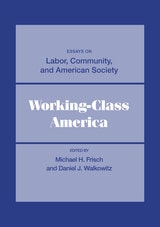
Working-Class America
Essays on Labor, Community, and American SocietyEdited by Michael H. Frisch and Daniel J. Walkowitz
University of Illinois Press, 1983