Results by title
5 books match the query 'Covenant'
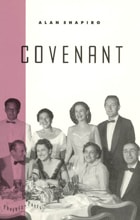
Covenant
Alan Shapiro
University of Chicago Press, 1991
"At forty-years-old and already the author of four superbly written books of poems, Shapiro has produced a work of such authority and originality that he has permanently enlarged my hopes and expectations for contemporary poetry. His risk-loving swiftness of perception and his affinity for stories that up-end convention and taboo have enabled him to reclaim, for poets of my generation, areas of feeling and linguistic virtuosity that originated with William Carlos Williams, Elizabeth Bishop, J. V. Cunningham, and Ivor Winters. It is hard for me to see how an ideal anthologist of the future will be able to include their names without gratefully including his."—Tom Sleigh, Boston Phoenix
Covenant of Blood
Circumcision and Gender in Rabbinic JudaismLawrence A. Hoffman
University of Chicago Press, 1995
In the rabbinic system, Hoffman argues, circumcision was neither a birth ritual nor the beginning of the human life cycle, but a rite of covenantal initiation into a male "life line." Although the evolution of the rite was shaped by rabbinic debates with early Christianity, the Rabbis shared with the church a view of blood as providing salvation. Hoffman examines the particular significance of circumcision blood, which, in addition to its salvific role, contrasted with menstrual blood to symbolize the gender dichotomy within the rabbinic system. His analysis of the Rabbis' views of circumcision and menstrual blood sheds light on the marginalization of women in rabbinic law. Differentiating official mores about gender from actual practice, Hoffman surveys women's spirituality within rabbinic society and examines the roles mothers played in their sons' circumcisions until the medieval period, when they were finally excluded.
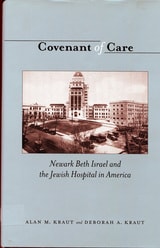
Covenant of Care
Newark Beth Israel and the Jewish Hospital in AmericaKraut, Alan M
Rutgers University Press, 2006
Where were you born? Were you born at the Beth? Many thousands of Americans-Jewish and non-Jewish-were born at a hospital bearing the Star of David and named Beth Israel, Mount Sinai, or Montefiore. In the United States, health care has been bound closely to the religious impulse. Newark Beth Israel Hospital is a distinguished modern medical institution in New Jersey whose history opens a window on American health care, the immigrant experience, and urban life. Alan M. and Deborah A. Kraut tell the story of this important institution, illuminating the broader history of voluntary nonprofit hospitals created under religious auspices initially to serve poor immigrant communities. Like so many Jewish hospitals in the early half of the twentieth century, "the Beth" cared not only for its own community's poor and underprivileged, a responsibility grounded in the Jewish traditions of tzedakah ("justice") and tikkun olam ("to heal the world"), but for all Newarkers.
Since it first opened its doors in 1902, the Beth has been an engine of social change. Jewish women activists and immigrant physicians founded an institution with a nonsectarian admissions policy and a welcome mat for physicians and nurses seeking opportunity denied them by anti-Semitism elsewhere. Research, too, flourished at the Beth. Here dedicated medical detectives did path-breaking research on the Rh blood factor and pacemaker development. When economic shortfalls and the Great Depression threatened the Beth's existence, philanthropic contributions from prominent Newark Jews such as Louis Bamberger and Felix Fuld, the efforts of women volunteers, and, later, income from well-insured patients saved the institution that had become the pride of the Jewish community.
The Krauts tell the Beth Israel story against the backdrop of twentieth-century medical progress, Newark's tumultuous history, and the broader social and demographic changes altering the landscape of American cities. Today, the United States, in the midst of another great wave of immigration, once again faces the question of how to provide newcomers with culturally sensitive and economically accessible medical care. Covenant of Care will inform and inspire all those working to meet these demands, offering a compelling look at the creative ways that voluntary hospitals navigated similar challenges throughout the twentieth century.
Covenant of Justice
Prayers, Poems, and Meditations from Women of Reform JudaismWomen of Reform Judaism
Central Conference of American Rabbis, 2025
Copublished with Women of Reform Judaism

Family, Law, and Community
Supporting the CovenantMargaret F. Brinig
University of Chicago Press, 2010
In the wake of vast social and economic changes, the nuclear family has lost its dominance, both as an ideal and in practice. Some welcome this shift, while others see civilization itself in peril—but few move beyond ideology to develop a nuanced understanding of how families function in society. In this provocative book, Margaret F. Brinig draws on research from a variety of disciplines to offer a distinctive study of family dynamics and social policy.
Concentrating on legal reform, Brinig examines a range of subjects, including cohabitation, custody, grandparent visitation, and domestic violence. She concludes that conventional legal reforms and the social programs they engender ignore social capital: the trust and support given to families by a community. Traditional families generate much more social capital than nontraditional ones, Brinig concludes, which leads to clear rewards for the children. Firmly grounded in empirical research, Family, Law, and Community argues that family policy can only be effective if it is guided by an understanding of the importance of social capital and the advantages held by families that accrue it.