Results by title
5 books match the query 'Coyote'
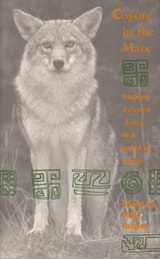
Coyote In The Maze
Peter Quigley
University of Utah Press, 1999
The works of Edward Abbey have been well known to general readers since the 1960’s. This volume, the first comprehensive collection of literary criticism devoted to the entire challenging corpus of Abbey’s fiction and nonfiction, couldn’t be more timely or significant.
From the perspective of his scholarly critics in Western American literature and environmental studies Ed Abbey is, in a word, problematic. As Peter Quigley, volume editor, comments, "The title of this collection refers to a number of references within Abbey’s work. The maze is a place of myriad canyons, of wonder, and a place where the desperadoes in The Monkey Wrench Gang could lose the authorities. The coyote refers to the slippery figure in Native American myth, a figure, known to Abbey, that always eluded definition an could slip out of every trap set to catch him." In this long-awaited anthology, eighteen intrepid scholars have chosen to ignore the coyote’s reputation, tracking Abbey in one masterful and illuminating essay after another through the canyons of anarchist politics, philosophy, feminist literary criticism, post-structuralism, and rhetoric, as well as nature and environmental theory and activism.
Coyote Stories
Edited by William Bright
University of Chicago Press Journals, 1978
Coyote Stories II
Edited by Martha B. Kendall
University of Chicago Press Journals, 1980
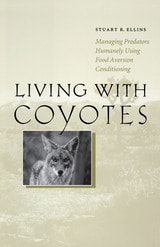
Living with Coyotes
Managing Predators Humanely Using Food Aversion ConditioningBy Stuart R. Ellins
University of Texas Press, 2005
The coyote may well be North America's most adaptable large predator. While humans have depleted or eliminated most other native predators, the coyote has defied all attempts to exterminate it, simultaneously expanding its range from coast to coast and from wilderness to urban areas. As a result, coyotes are becoming the focus of increasing controversy and emotion for people across the continent— from livestock growers who would like to eradicate coyotes to conservationists who would protect them at any cost.
In this thoughtful, well-argued, and timely book, Stuart Ellins makes the case that lethal methods of coyote management do not work and that people need to adopt a more humane way of coexisting with coyotes. Interweaving scientific data about coyote behavior and natural history with decades of field experience, he shows how endlessly adaptive coyotes are and how attempts to kill them off have only strengthened the species through natural selection. He then explains the process of taste aversion conditioning—which he has successfully employed—to stop coyotes from killing domestic livestock and pets. Writing frankly as an advocate of this effective and humane method of controlling coyotes, he asks, "Why are we mired in the use of archaic, inefficient, unsophisticated, and barbaric methods of wildlife management in this age of reason and high technology? This question must be addressed while there is still a wildlife to manage."
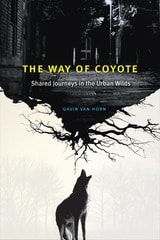
The Way of Coyote
Shared Journeys in the Urban WildsGavin Van Horn
University of Chicago Press, 2018
A hiking trail through majestic mountains. A raw, unpeopled wilderness stretching as far as the eye can see. These are the settings we associate with our most famous books about nature. But Gavin Van Horn isn’t most nature writers. He lives and works not in some perfectly remote cabin in the woods but in a city—a big city. And that city has offered him something even more valuable than solitude: a window onto the surprising attractiveness of cities to animals. What was once in his mind essentially a nature-free blank slate turns out to actually be a bustling place where millions of wild things roam. He came to realize that our own paths are crisscrossed by the tracks and flyways of endangered black-crowned night herons, Cooper’s hawks, brown bats, coyotes, opossums, white-tailed deer, and many others who thread their lives ably through our own.
With The Way of Coyote, Gavin Van Horn reveals the stupendous diversity of species that can flourish in urban landscapes like Chicago. That isn’t to say city living is without its challenges. Chicago has been altered dramatically over a relatively short timespan—its soils covered by concrete, its wetlands drained and refilled, its river diverted and made to flow in the opposite direction. The stories in The Way of Coyote occasionally lament lost abundance, but they also point toward incredible adaptability and resilience, such as that displayed by beavers plying the waters of human-constructed canals or peregrine falcons raising their young atop towering skyscrapers. Van Horn populates his stories with a remarkable range of urban wildlife and probes the philosophical and religious dimensions of what it means to coexist, drawing frequently from the wisdom of three unconventional guides—wildlife ecologist Aldo Leopold, Taoist philosopher Lao Tzu, and the North American trickster figure Coyote. Ultimately, Van Horn sees vast potential for a more vibrant collective of ecological citizens as we take our cues from landscapes past and present.
Part urban nature travelogue, part philosophical reflection on the role wildlife can play in waking us to a shared sense of place and fate, The Way of Coyote is a deeply personal journey that questions how we might best reconcile our own needs with the needs of other creatures in our shared urban habitats.