Results by title
4 books match the query 'Crafts'
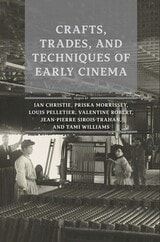
Crafts, Trades, and Techniques of Early Cinema
Ian Christie, Priska Morrissey, Louis Pelletier, Valentine Robert, Jean-Pierre Sirois-Trahan, and Tami Williams
Michigan Publishing Services, 2024
These proceedings of the 16th conference of the international society for the study of early cinema Domitor includes 26 studies and numerous rarely seen figures dealing with the often overlooked history of the crafts, trades and techniques of early cinema. By examining material culture and the institutionalization of practices into trades during the late 19th and early 20th centuries, this new investigation into the skills and the techniques that defined the cinema in its early decades aims to foster a better understanding of the medium in its varied industrial and professional aspects. The art and gestures of craftspersons—including performers, camera operators, editors, directors, designers, engineers, projectionists, programmers, and critics—, like those of the factory or laboratory workers, are considered for their emerging specificity, as well as in relation to existing cultural, material and technological forms. This book shows how the industrialization of cinema, the professionalization of workers, and the standardization of techniques led to the creation (or at times, subversion) of norms, and consequently legitimized certain skills, crafts and techniques at the expense of others.
The intermedial approaches deployed in this collection bring into focus the influence of multiple professional worlds and cultural practices on the nascent film medium, as well as the necessary adaptations and transformations required by the latter. This circulatory dynamic concerns people and practices, studied in a non-diffusionist approach taking into account transcultural interactions. Chapters examine the mechanisms of professionalization and identity-building as they relate to professions such as filmmaker or colorist, as well as to more unexpected occupations such as accountant, censor, or chemical engineer.
The notion of technique is broadly defined. Several of the volume’s chapters deal with cameras or special effects, as well as with new historical investigation into mysterious technical devices such as shutters, cue systems or working samples. Going beyond this preoccupation with materiality, the collected studies also approach technique as a human and cultural activity, and thus as a set of gestures, crafts, and expertise. The book more specifically opens up a reflection on the skills of screen performers and on the training that brought the institutionalization of body techniques and film acting. The book further illustrates to an unprecedented extent that the first film workers were frequently women.
Several chapters are dedicated to the unconventional careers of specific film workers, with particular attention being given to the diversity and complexity of professional trajectories. Indeed, this book demonstrates that the invention of cinema was deeply enmeshed with the rise of international networks, which resulted in the standardization of technical practices within corporate and national contexts being ultimately shaped by globalization.
[more]
Marginalism and Discontinuity
Tools for the Crafts of Knowledge and DecisionMartin H. Krieger
Russell Sage Foundation, 1989
Marginalism and Discontinuity is an account of the culture of models employed in the natural and social sciences, showing how such models are instruments for getting hold of the world, tools for the crafts of knowing and deciding. Like other tools, these models are interpretable cultural objects, objects that embody traditional themes of smoothness and discontinuity, exchange and incommensurability, parts and wholes. Martin Krieger interprets the calculus and neoclassical economics, for example, as tools for adding up a smoothed world, a world of marginal changes identified by those tools. In contrast, other models suggest that economies might be sticky and ratchety or perverted and fetishistic. There are as well models that posit discontinuity or discreteness. In every city, for example, some location has been marked as distinctive and optimal; around this created differentiation, a city center and a city periphery eventually develop. Sometimes more than one model is applicable—the possibility of doom may be seen both as the consequence of a series of mundane events and as a transcendent moment. We might model big decisions or entrepreneurial endeavors as sums of several marginal decisions, or as sudden, marked transitions, changes of state like freezing or religious conversion. Once we take models and theory as tools, we find that analogy is destiny. Our experiences make sense because of the analogies or tools used to interpret them, and our intellectual disciplines are justified and made meaningful through the employment of characteristic toolkits—a physicist's toolkit, for example, is equipped with a certain set of mathematical and rhetorical models. Marginalism and Discontinuity offers a provocative and wide-ranging consideration of the technologies by which we attempt to apprehend the world. It will appeal to social and natural scientists, mathematicians and philosophers, and thoughtful educators, policymakers, and planners.
[more]
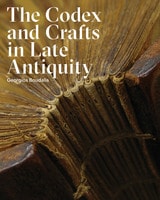
The Codex and Crafts in Late Antiquity
Georgios Boudalis
Bard Graduate Center, 2018
The transition from roll to codex as the standard format of the book is one of the most culturally significant innovations of Late Antiquity. The Codex and Crafts in Late Antiquity examines surviving evidence in order to better understand how this transition took place. Placing the codex into the general cultural, religious, and technological context of Late Antiquity, the book examines the major types of codices—the wooden tablet codex, the single-quire codex and the multi-quire codex—in all their structural, technical, and decorative features. Georgios Boudalis argues that the codex was not an ingenious invention but rather an innovation that evolved using techniques already widely employed by artisans and craftspeople in the creation of everyday items such as socks, shoes, and baskets, revealing that the codex was a fascinating, yet practical, development.
[more]
The Expert Witness in Islamic Courts
Medicine and Crafts in the Service of LawRon Shaham
University of Chicago Press, 2010
Islam’s tense relationship with modernity is one of the most crucial issues of our time. Within Islamic legal systems, with their traditional preference for eyewitness testimony, this struggle has played a significant role in attitudes toward expert witnesses. Utilizing a uniquely comparative approach, Ron Shaham here examines the evolution of the role of such witnesses in a number of Arab countries from the premodern period to the present.
Shaham begins with a history of expert testimony in medieval Islamic culture, analyzing the different roles played by male experts, especially physicians and architects, and females, particularly midwives. From there, he focuses on the case of Egypt, tracing the country’s reform of its traditional legal system along European lines beginning in the late nineteenth century. Returning to a broader perspective, Shaham draws on a variety of legal and historical sources to place the phenomenon of expert testimony in cultural context. A truly comprehensive resource, The Expert Witness in Islamic Courts will be sought out by a broad spectrum of scholars working in history, religion, gender studies, and law.
Shaham begins with a history of expert testimony in medieval Islamic culture, analyzing the different roles played by male experts, especially physicians and architects, and females, particularly midwives. From there, he focuses on the case of Egypt, tracing the country’s reform of its traditional legal system along European lines beginning in the late nineteenth century. Returning to a broader perspective, Shaham draws on a variety of legal and historical sources to place the phenomenon of expert testimony in cultural context. A truly comprehensive resource, The Expert Witness in Islamic Courts will be sought out by a broad spectrum of scholars working in history, religion, gender studies, and law.
[more]