Results by title
5 books match the query 'Crawford, Margo Natalie'
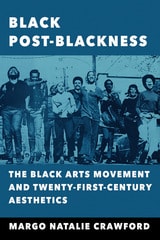
Black Post-Blackness
The Black Arts Movement and Twenty-First-Century AestheticsMargo Natalie Crawford
University of Illinois Press, 2017
A 2008 cover of The New Yorker featured a much-discussed Black Power parody of Michelle and Barack Obama. The image put a spotlight on how easy it is to flatten the Black Power movement as we imagine new types of blackness. Margo Natalie Crawford argues that we have misread the Black Arts Movement's call for blackness. We have failed to see the movement's anticipation of the "new black" and "post-black." Black Post-Blackness compares the black avant-garde of the 1960s and 1970s Black Arts Movement with the most innovative spins of twenty-first century black aesthetics. Crawford zooms in on the 1970s second wave of the Black Arts Movement and shows the connections between this final wave of the Black Arts movement and the early years of twenty-first century black aesthetics. She uncovers the circle of black post-blackness that pivots on the power of anticipation, abstraction, mixed media, the global South, satire, public interiority, and the fantastic.
[more]
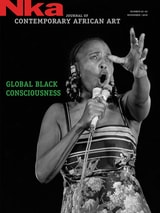
Global Black Consciousness
Natalie Natalie Crawford and Salah M. Hassan, special issue editors
Duke University Press, 2018
Contributors to this issue of Nka complicate the key paradigms that have shaped the theories and cultural productions of the African diaspora by offering a critical and nuanced analysis of global black consciousness. Literary scholars, historians, visual art critics, and diaspora theorists explore the confluence between theories of African diaspora and theories of decolonization. They examine the intersections of visual art, literature, film, and other cultural productions alongside the crosscurrents that shaped the transnational flow of black consciousness. The contributors revisit major black and Pan-African intellectual movements and festivals in the 1960s and 1970s, including the Dakar Festival of World Negro Arts held in Dakar in 1966, the Pan-African Cultural Festival in 1969 in Algiers, and FESTAC 1977 in Lagos, Nigeria. Throughout this issue, the contributors examine both the problem and promise of mobilizing “blackness” as a unifying concept.
Contributors: Hisham Aidi, Souleymane Bachir Diagne, Ahmed Bedjaoui, Margo Natalie Crawford, Romi Crawford, Lydie Diakhaté, Manthia Diawara, Amanda Gilvin, Salah M. Hassan, Shannen Hill, Tsitsi Jaji, Barbara Murray, Zita Nunes, Ugochukwu-Smooth C. Nzewi, Richard J. Powell, Holiday Powers, Shana L. Redmond, Penny M. Von Eschen, Dagmawi Woubshet
Contributors: Hisham Aidi, Souleymane Bachir Diagne, Ahmed Bedjaoui, Margo Natalie Crawford, Romi Crawford, Lydie Diakhaté, Manthia Diawara, Amanda Gilvin, Salah M. Hassan, Shannen Hill, Tsitsi Jaji, Barbara Murray, Zita Nunes, Ugochukwu-Smooth C. Nzewi, Richard J. Powell, Holiday Powers, Shana L. Redmond, Penny M. Von Eschen, Dagmawi Woubshet
[more]
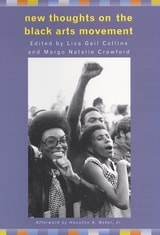
New Thoughts on the Black Arts Movement
Edited by Lisa Gail Collins and Margo Natalie Crawford
Rutgers University Press, 2006
During the 1960s and 1970s, a cadre of poets, playwrights, visual artists, musicians, and other visionaries came together to create a renaissance in African American literature and art. This charged chapter in the history of African American culture—which came to be known as the Black Arts Movement—has remained largely neglected by subsequent generations of critics. New Thoughts on the Black Arts Movement includes essays that reexamine well-known figures such as Amiri Baraka, Larry Neal, Gwendolyn Brooks, Sonia Sanchez, Betye Saar, Jeff Donaldson, and Haki Madhubuti. In addition, the anthology expands the scope of the movement by offering essays that explore the racial and sexual politics of the era, links with other period cultural movements, the arts in prison, the role of Black colleges and universities, gender politics and the rise of feminism, color fetishism, photography, music, and more. An invigorating look at a movement that has long begged for reexamination, this collection lucidly interprets the complex debates that surround this tumultuous era and demonstrates that the celebration of this movement need not be separated from its critique.
[more]
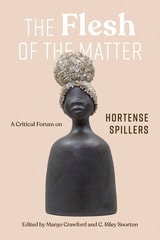
The Flesh of the Matter
A Critical Forum on Hortense SpillersEdited by Margo Natalie Crawford and C. Riley Snorton
Vanderbilt University Press, 2024
PROSE Awards Category Winner—Media and Cultural Studies, 2025
Hortense Spillers is one of the most important literary critics and Black feminist scholars of the last fifty years. Her 1987 scholarly article “Mama’s Baby, Papa’s Maybe: An American Grammar Book” is one of the most-cited essays in African American literary studies.
Edited by Margo Natalie Crawford and C. Riley Snorton, The Flesh of the Matter: A Critical Forum on Hortense Spillers is the first collection to take up directly how Spillers’s writing on literature, culture, and theory have been signal posts to the varied and universal threads of Black thought, as well as countless other areas of the academy. Interspersed with archival fragments from Spillers’s papers kept at the Pembroke Center for Feminist Thought at Brown University, the fourteen essays in this collection demonstrate a fidelity to the ways of reading Spillers has taught us, the nomenclature of enslavement keyed into the American lexicon, and the ways that history permeates our cultural boundaries today.
[more]
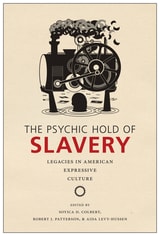
The Psychic Hold of Slavery
Legacies in American Expressive CultureSoyica Diggs Colbert, Robert J. Patterson, and Aida Levy-Hussen
Rutgers University Press, 2016
What would it mean to “get over slavery”? Is such a thing possible? Is it even desirable? Should we perceive the psychic hold of slavery as a set of mental manacles that hold us back from imagining a postracist America? Or could the psychic hold of slavery be understood as a tool, helping us get a grip on the systemic racial inequalities and restricted liberties that persist in the present day?
Featuring original essays from an array of established and emerging scholars in the interdisciplinary field of African American studies, The Psychic Hold of Slavery offers a nuanced dialogue upon these questions. With a painful awareness that our understanding of the past informs our understanding of the present—and vice versa—the contributors place slavery’s historical legacies in conversation with twenty-first-century manifestations of antiblack violence, dehumanization, and social death.
Through an exploration of film, drama, fiction, performance art, graphic novels, and philosophical discourse, this volume considers how artists grapple with questions of representation, as they ask whether slavery can ever be accurately depicted, trace the scars that slavery has left on a traumatized body politic, or debate how to best convey that black lives matter. The Psychic Hold of Slavery thus raises provocative questions about how we behold the historically distinct event of African diasporic enslavement and how we might hold off the transhistorical force of antiblack domination.
[more]