Results by title
10 books match the query 'Credit'
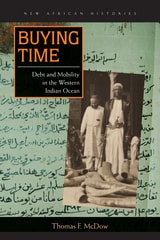
Buying Time
Debt and Mobility in the Western Indian OceanThomas F. McDow
Ohio University Press, 2018
In Buying Time, Thomas F. McDow synthesizes Indian Ocean, Middle Eastern, and East African studies as well as economic and social history to explain how, in the nineteenth century, credit, mobility, and kinship knit together a vast interconnected Indian Ocean region. That vibrant and enormously influential swath extended from the desert fringes of Arabia to Zanzibar and the Swahili coast and on to the Congo River watershed.
In the half century before European colonization, Africans and Arabs from coasts and hinterlands used newfound sources of credit to seek out opportunities, establish new outposts in distant places, and maintain families in a rapidly changing economy. They used temporizing strategies to escape drought in Oman, join ivory caravans in the African interior, and build new settlements.
The key to McDow’s analysis is a previously unstudied trove of Arabic business deeds that show complex variations on the financial transactions that underwrote the trade economy across the region. The documents list names, genealogies, statuses, and clan names of a wide variety of people—Africans, Indians, and Arabs; men and women; free and slave—who bought, sold, and mortgaged property. Through unprecedented use of these sources, McDow moves the historical analysis of the Indian Ocean beyond connected port cities to reveal the roles of previously invisible people.
Cosmologies of Credit
Transnational Mobility and the Politics of Destination in ChinaJulie Y. Chu
Duke University Press, 2010
Credit Markets for the Poor
Patrick Bolton
Russell Sage Foundation, 2005
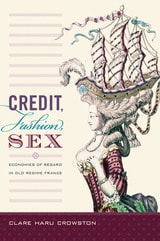
Credit, Fashion, Sex
Economies of Regard in Old Regime FranceClare Haru Crowston
Duke University Press, 2013
Credit economies constituted "economies of regard" in which reputation depended on embodied performances of credibility. Crowston explores the role of fashionable appearances and sexual desire in leveraging credit and reconstructs women's vigorous participation in its gray markets. The scandalous relationship between Queen Marie Antoinette and fashion merchant Rose Bertin epitomizes the vertical loyalties and deep social divides of the credit regime and its increasingly urgent political stakes.
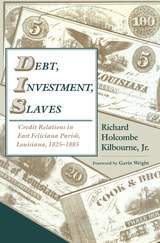
Debt, Investment, Slaves
Credit Relations in East Feliciana Parish, Louisiana, 1825-1885Richard Holcombe Kilbourne
University of Alabama Press, 2013
For his landmark Debt, Investment, Slaves, Louisiana attorney Richard Holcombe Kilbourne Jr. performed a thorough survey of parish mortgage records and other manuscripts to create a rich map of antebellum credit relationships in the region. He demonstrates that most credit relationships, collateralized and uncollateralized, were grounded in slave property and not, as a contemporary reader would assume, land or other forms of wealth. Antebellum slavery was thus not only an arrangement of labor, but also an arrangement of finance and economics that shaped all of Southern life and politics. For this reason, defeat in the Civil War and emancipation not only freed enslaved people to work and earn wages, it occasioned a monumental credit implosion from which the Southern economy did not recover for the remainder of the nineteenth century.
To understand the antebellum South, it is necessary to set aside assumptions shared by modern Americans about the nature of borrowing, lending, banking, and investing. Kilbourne's seminal work reminds readers of the absence of banks outside of major cities like Charleston, New Orleans, and Mobile. He explains the defined and ad hoc roles that regional banks, intermediary lenders, and flexible agents ("factors") played in the absence of a robust banking system. He persuasively shows that this network of borrowers and lenders was based to an extent not well understood today on bondage. He then demonstrates how this fragile and improvised financial system had no ability to respond to the shocks and disruptions of war.
Setting out to write a book of local history, Kilbourne achieved an enduring work that illuminated aspects of Southern life that are indispensable to understanding American history.
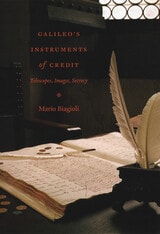
Galileo's Instruments of Credit
Telescopes, Images, SecrecyMario Biagioli
University of Chicago Press, 2006
Galileo's Instruments of Credit proposes radical new interpretations of several key episodes of Galileo's career, including his early telescopic discoveries of 1610, the dispute over sunspots, and the conflict with the Holy Office over the relationship between Copernicanism and Scripture. Galileo's tactics during this time shifted as rapidly as his circumstances, argues Mario Biagioli, and the pace of these changes forced him to respond swiftly to the opportunities and risks posed by unforeseen inventions, further discoveries, and the interventions of his opponents.
Focusing on the aspects of Galileo's scientific life that extend beyond the framework of court culture and patronage, Biagioli offers a revisionist account of the different systems of exchanges, communication, and credibility at work in various phases of Galileo's career. Galileo's Instruments of Credit will find grateful readers among scholars of science studies, historical epistemology, visual studies, Galilean science, and late Renaissance astronomy.
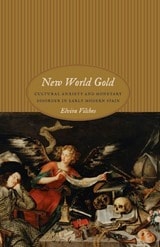
New World Gold
Cultural Anxiety and Monetary Disorder in Early Modern SpainElvira Vilches
University of Chicago Press, 2010
The discovery of the New World was initially a cause for celebration. But the vast amounts of gold that Columbus and other explorers claimed from these lands altered Spanish society. The influx of such wealth contributed to the expansion of the Spanish empire, but also it raised doubts and insecurities about the meaning and function of money, the ideals of court and civility, and the structure of commerce and credit. New World Gold shows that, far from being a stabilizing force, the flow of gold from the Americas created anxieties among Spaniards and shaped a host of distinct behaviors, cultural practices, and intellectual pursuits on both sides of the Atlantic.
Elvira Vilches examines economic treatises, stories of travel and conquest, moralist writings, fiction, poetry, and drama to reveal that New World gold ultimately became a problematic source of power that destabilized Spain’s sense of trust, truth, and worth. These cultural anxieties, she argues, rendered the discovery of gold paradoxically disastrous for Spanish society. Combining economic thought, social history, and literary theory in trans-Atlantic contexts, New World Gold unveils the dark side of Spain’s Golden Age.
Priceless Markets
The Political Economy of Credit in Paris, 1660-1870Philip T. Hoffman, Gilles Postel-Vinay, and Jean-Laurent Rosenthal
University of Chicago Press, 2000
The implications for historians and economists are substantial. The role of notaries operating in Paris that Priceless Markets uncovers has never before been recognized. In the wake of this pathbreaking new study, historians will also have to rethink the origins of the French Revolution. As the authors show, the crisis of 1787-88 did not simply ignite revolt; it was intimately bound up in an economic struggle that reached far back into the eighteenth century, and continued well into the 1800s.

The Credit Crunch
Housing Bubbles, Globalisation and the Worldwide Economic CrisisGraham Turner
Pluto Press, 2008
This book argues that the current financial turmoil signals a crisis in globalisation that will directly challenge the free market economic model.
Graham Turner shows that the housing bubbles in the West were deliberately created to mask the damage inflicted by companies shifting production abroad in an attempt to boost profits. As these bubbles burst, economic growth in many developed countries will inevitably tumble. The Japanese crisis of the 1990s shows that banks and governments may struggle to contain the fallout. The problem has not been limited to the US, UK and Europe: housing bubbles have become endemic across wide swathes of emerging market economies. As the West slides, these countries will see an implosion of their credit bubbles too, shaking their faith in the free market.
Turner is an experienced and successful economic forecaster, whose opinions are sought by large international banks and top financial journalists. Drawing from his first hand experience of the Japanese property crash of the 1990s, he presents his analysis in a clear and persuasive style, showing that the end of housing market growth spells disaster for neoliberal globalisation.
The World of Credit in Colonial Massachusetts
James Richards and His Daybook, 1692-1711James E. Wadsworth
University of Massachusetts Press, 2017
For years, James Richards, a prosperous and typical colonial farmer, tracked nearly five thousand transactions, involving more than six hundred individuals and stretching from Charlestown to Barnstable. Richards and his neighbors were bound together in a heterogeneous economy, reliant on networks of credit, barter, and sometimes cash. Richards practiced mixed husbandry farming, shipped goods by cart and by sloop, and produced and sold malt, salt, wool, and timber. The day book also reveals significant social details of Richards and his household, including his diverse trading partners, his extensive family connections, an Indian slave girl, and a well-dressed female servant. Available in both print and electronic editions, fully transcribed, annotated, and introduced by the editor, this record of economic life reinforces and challenges our understanding of colonial America.