Results by title
8 books match the query 'Cree Indians'
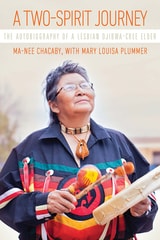
A Two-Spirit Journey
The Autobiography of a Lesbian Ojibwa-Cree ElderMa-Nee Chacaby
University of Manitoba Press, 2016
[more]
Cree Legends and Narratives from the West Coast of James Bay
Simeon Scott
University of Manitoba Press, 1995
This is the first major body of annotated texts in James Bay Cree, and a unique documentation of Swampy and Moose Cree (Western James Bay) usage of the 1950s and 1960s. Conversations and interviews with 16 different speakers include: legends, reminiscences, historical narratives, stories and conversations, as well as descriptions of technology. The book includes a detailed pronunciation guide, notes on Cree terms, informants' comments, dialect variations, and descriptions of cultural values and customs. The introduction describes and compares the various genres in traditional and popular culture. Cree and English, with full glosssary.
[more]
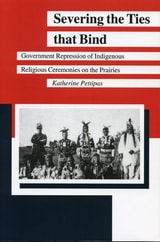
Severing the Ties that Bind
Government Repression of Indigenous Religious Ceremonies on the PrairiesKatherine Pettipas
University of Manitoba Press, 1994
Religious ceremonies were an inseparable part of Aboriginal traditional life, reinforcing social, economic, and political values. However, missionaries and government officials with ethnocentric attitudes of cultural superiority decreed that Native dances and ceremonies were immoral or un-Christian and an impediment to the integration of the Native population into Canadian society. Beginning in 1885, the Department of Indian Affairs implemented a series of amendments to the Canadian Indian Act, designed to eliminate traditional forms of religious expression and customs, such as the Sun Dance, the Midewiwin, the Sweat Lodge, and giveaway ceremonies.However, the amendments were only partially effective. Aboriginal resistance to the laws took many forms; community leaders challenged the legitimacy of the terms and the manner in which the regulations were implemented, and they altered their ceremonies, the times and locations, the practices, in an attempt both to avoid detection and to placate the agents who enforced the law.Katherine Pettipas views the amendments as part of official support for the destruction of indigenous cultural systems. She presents a critical analysis of the administrative policies and considers the effects of government suppression of traditional religious activities on the whole spectrum of Aboriginal life, focussing on the experiences of the Plains Cree from the mid-1880s to 1951, when the regulations pertaining to religious practices were removed from the Act. She shows how the destructive effects of the legislation are still felt in Aboriginal communities today, and offers insight into current issues of Aboriginal spirituality, including access to and use of religious objects held in museum repositories, protection of sacred lands and sites, and the right to indigenous religious practices in prison.
[more]

Stored in the Bones
Safeguarding Indigenous Living HeritagesAgnieszka Pawłowska-Mainville
University of Manitoba Press, 2023
[more]
Stories of the House People
Told by Peter Vandall and Joe DouquetteFreda Ahenakew
University of Manitoba Press, 1987
[more]
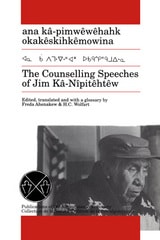
The Counselling Speeches of Jim Ka-Nipitehtew
Freda Ahenakew
University of Manitoba Press, 1998
A monolingual Cree speaker from Onion Lake, Saskatchewan, Jim Ka-Nipitehtew was a highly respected orator. His discourses have great force and authority, and no speeches of similar scope or depth have ever been published in their original form. He speaks of his concerns for young people, and of the proper performances of rituals, and gives an account of the signing of Treaty Six. These are superb examples of authentic spoken Cree texts. They are presented in syllabics, with Roman orthography and English translation on facing pages, and a glossary.
[more]
The Cree Language is Our Identity
The La Ronge lectures of Sarah WhitecalfSarah Whitecalf
University of Manitoba Press, 1983
[more]
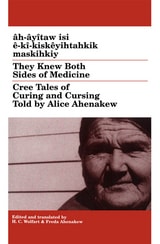
They Knew Both Sides of Medicine
Cree Tales of Curing and Cursing Told by Alice AhenakewH.C. Wolfart
University of Manitoba Press, 2000
Born in 1912, Alice Ahenakew was brought up in a traditional Cree community in north-central Saskatchewan. As a young woman, she married Andrew Ahenakew, a member of the prominent Saskatchewan family, who later became an Anglican clergyman and a prominent healer. Alice Ahenakew's personal reminiscences include stories of her childhood, courtship and marriage, as well as an account of the 1928 influenza epidemic an encounters with a windigo. The centrepiece of this book is the fascinating account of Andrew Ahenakewís bear vision, through which he received healing powers. Written in original Cree text with a full English translation, They Knew both Sides of Medicine also includes an introduction discussing the historical background of the narrative and its style and rhetorical structure, as well as a complete Cree-English glossary.
[more]