Results by title
3 books match the query 'Cresswell, Tim'

In Place/Out of Place
Geography, Ideology, and TransgressionTim Cresswell
University of Minnesota Press, 1996
In Place/Out of Place was first published in 1996. Minnesota Archive Editions uses digital technology to make long-unavailable books once again accessible, and are published unaltered from the original University of Minnesota Press editions.
What is the relationship between place and behavior? In this fascinating volume, Tim Cresswell examines this question via "transgressive acts" that are judged as inappropriate not only because they are committed by marginalized groups but also because of where they occur.
In Place/Out of Place seeks to illustrate the ways in which the idea of geographical deviance is used as an ideological tool to maintain an established order. Cresswell looks at graffiti in New York City, the attempts by various "hippie" groups to hold a free festival at Stonehenge during the summer solstices of 1984–86, and the Greenham Common Women's Peace Camp in Berkshire, England. In each of the cases described, the groups involved were designated as out of place both by the media and by politicians, whose descriptions included an array of images such as dirt, disease, madness, and foreignness.
Cresswell argues that space and place are key factors in the definition of deviance and, conversely, that space and place are used to construct notions of order and propriety. In addition, whereas ideological concepts being expressed about what is good, just, and appropriate often are delineated geographically, the transgression of these delineations reveals the normally hidden relationships between place and ideology-in other words, the "out-of-place" serves to highlight and define the "in-place." By looking at the transgressions of the marginalized, Cresswell argues, we can gain a novel perspective on the "normal" and "taken-for-granted" expectations of everyday life. The book concludes with a consideration of the possibility of a "politics of transgression," arguing for a link between the challenging of spatial boundaries and the possibility of social transformation.
Tim Cresswell is currently lecturer in geography at the University of Wales.
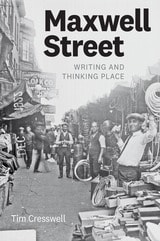
Maxwell Street
Writing and Thinking PlaceTim Cresswell
University of Chicago Press, 2019
In Maxwell Street, Cresswell advocates approaching the study of place as an “assemblage” of things, meanings, and practices. He models this innovative approach through a montage format that exposes the different types of texts—primary, secondary, and photographic sources—that have attempted to capture the essence of the area. Cresswell studies his historical sources just as he explores the different elements of Maxwell Street—exposing them layer by layer. Brilliantly interweaving words and images, Maxwell Street sheds light on a historic Chicago neighborhood and offers a new model for how to write about place that will interest anyone in the fields of geography, urban studies, or cultural history.
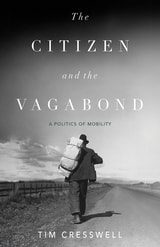
The Citizen and the Vagabond
A Politics of MobilityTim Cresswell
University of Minnesota Press, 2026
An expansive treatise on the power relations that govern our movement
The Citizen and the Vagabond develops a theoretical approach to the study of mobility and its relationship to the production, maintenance, and transformation of social and cultural hierarchies. Expanding upon his foundational work on the subject, Tim Cresswell examines human movement from around the globe to better understand the various forms of inequality and injustice that shape our lives.
Establishing a framework for movement in terms of rhythm, speed, routes, and friction, Cresswell extends these themes to address the Covid-19 pandemic and subsequent lockdowns, exploring what this turbulent period reveals to us about the politics of mobility. He demonstrates that while flexibility and ease of movement are typically considered markers of personal freedom, increased mobility brings with it new modes of control and surveillance. As he investigates the hierarchies and embodied experiences that emerge amid these tensions, Cresswell employs two figures: the citizen, whose mobility within and across borders is expected and accepted, and the vagabond, whose perpetual mobility is deemed suspect and in need of ordering.
In conversation with the work of theorists such as Mimi Sheller, Zygmunt Bauman, Paul Virilio, Henri Lefebvre, Ivan Illich, and Anna Tsing, Cresswell reaches beyond geography to incorporate insights from the humanities and social sciences. An interdisciplinary intervention into the study of mobility and citizenship, The Citizen and the Vagabond provides a new set of coordinates from which to grasp the shifting dynamics of movement and power.
Retail e-book files for this title are screen-reader friendly with images accompanied by short alt text and/or extended descriptions.