Results by title
3 books match the query 'Crete (Greece)'
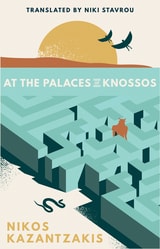
At the Palaces of Knossos
Nikos Kazantzakis
Ohio University Press, 2025
A captivating retelling—newly translated—of the rise and fall of the Minoan civilization interwoven with some of ancient Greece’s most enduring myths
At the Palaces of Knossos is a vivid reimagining of ancient Crete, blending history and mythology into an epic tale of heroism, love, and destiny. Set against the grandeur of the Minoan court, the novel brings to life the legendary stories of Theseus, the Minotaur, Ariadne, Daedalus, and Icarus.
The story follows Theseus, the prince of Athens, who arrives in Crete as part of the annual tribute of young Athenians sent to feed the monstrous Minotaur. Determined to end this brutal cycle, he infiltrates the labyrinthine palace of Knossos, where he crosses paths with Princess Ariadne. Struggling between loyalty to her people and her love for the courageous stranger, Ariadne risks everything to help Theseus in his quest.
Through the eyes of palace attendants, acrobats, and the inventor Daedalus and his son Icarus, Kazantzakis transports readers into the splendor of Minoan culture—its sacred rituals, breathtaking bull-leaping ceremonies, and vibrant city life. But as Theseus prepares to face his destiny, a tragic chain of events unfolds, leading to heartbreak, betrayal, and the downfall of a once-mighty civilization.
Rich with philosophical depth and lyrical prose, At the Palaces of Knossos is more than a mythological retelling—it is a meditation on power, freedom, and the eternal struggle between fate and human will. Perfect for fans of historical fiction and Greek mythology, this novel offers a compelling journey into one of the ancient world’s most fascinating eras.
Imports and Immigrants
Near Eastern Contacts with Iron Age CreteGail L. Hoffman
University of Michigan Press, 1998
Drawing together all the evidence and arguments for Near Eastern immigrants in Crete, Hoffman demonstrates there are basic problems with the accepted interpretations. Evidence of continued technical expertise casts doubt on the necessity of reintroduction, while careful scrutiny of the evidence supporting immigrant craftsmen reveals many inadequacies in the currently accepted analyses.
Imports and Immigrants identifies the need for reassessing all dimensions of the question of artistic relationships between ancient Greece and other regions of the Aegean basin and suggests new avenues of inquiry in this important debate. The volume also reassesses arguments made for the presence of Near Eastern immigrants in Crete. This book includes a catalogue indispensable for future work on these issues and illustrations of most of the known imports to Crete.
Gail L. Hoffman is Associate Professor of Greek Art and Archaeology, Department of Classics, Yale University.
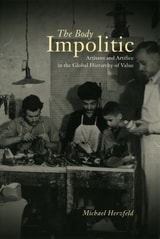
The Body Impolitic
Artisans and Artifice in the Global Hierarchy of ValueMichael Herzfeld
University of Chicago Press, 2003
Michael Herzfeld takes us inside a rich variety of small-town Cretan artisans' workshops to show how apprentices are systematically thwarted into learning by stealth and guile. This harsh training reinforces a stereotype of artisans as rude and uncultured. Moreover, the same stereotypes that marginalize artisans locally also operate to marginalize Cretans within the Greek nation and Greece itself within the international community. What Herzfeld identifies as "the global hierarchy of value" thus frames the nation's ancient monuments and traditional handicrafts as evidence of incurable "backwardness."
Herzfeld's sensitive observations offer an intimately grounded way of understanding the effects of globalization and of one of its most visible offshoots, the heritage industry, on the lives of ordinary people in many parts of the world today.