Results by title
8 books match the query 'Criminal liability'

Bad Acts and Guilty Minds
Conundrums of the Criminal LawLeo Katz
University of Chicago Press, 1987
"Bad Acts and Guilty Minds . . . revives the mind, it challenges superficial analyses, it reminds us that underlying the vast body of statutory and case law, there is a rationale founded in basic notions of fairness and reason. . . . It will help lawyers to better serve their clients and the society that permits attorneys to hang out their shingles."—Edward N. Costikyan, New York Times Book Review
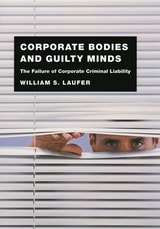
Corporate Bodies and Guilty Minds
The Failure of Corporate Criminal LiabilityWilliam S. Laufer
University of Chicago Press, 2006
In this timely work, William S. Laufer argues that even with recent legal reforms, corporate criminal law continues to be ineffective. As evidence, Laufer considers the failure of courts and legislatures to fashion liability rules that fairly attribute blame for organizations. He analyzes the games that corporations play to deflect criminal responsibility. And he also demonstrates how the exchange of cooperation for prosecutorial leniency and amnesty belies true law enforcement. But none of these factors, according to Laufer, trumps the fact that there is no single constituency or interest group that strongly and consistently advocates the importance and priority of corporate criminal liability. In the absence of a new standard of corporate liability, the power of regulators to keep corporate abuses in check will remain insufficient.
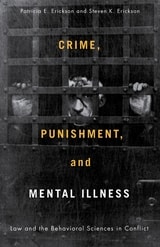
Crime, Punishment, and Mental Illness
Law and the Behavioral Sciences in ConflictErickson, Patricia
Rutgers University Press, 2008
In Crime, Punishment, and Mental Illness, Patricia E. Erickson and Steven K. Erickson explore how societal beliefs about free will and moral responsibility have shaped current policies and they identify the differences among the goals, ethos, and actions of the legal and health care systems. Drawing on high-profile cases, the authors provide a critical analysis of topics, including legal standards for competency, insanity versus mental illness, sex offenders, psychologically disturbed juveniles, the injury and death rates of mentally ill prisoners due to the inappropriate use of force, the high level of suicide, and the release of mentally ill individuals from jails and prisons who have received little or no treatment.

Drinkers, Drivers, and Bartenders
Balancing Private Choices and Public AccountabilityFrank A. Sloan, Emily M. Stout, Kathryn Whetten-Goldstein, and Lan Liang
University of Chicago Press, 2000
Extraordinary in scope and exacting in detail, Drinkers, Drivers, and Bartenders: Balancing Private Choices and Public Accountability links alcohol problems, deterrence, and serving practices in a way no other work has been able to do and is certain to become a crucial reference point for researchers and policymakers alike.
More Than Victims
Battered Women, the Syndrome Society, and the LawDonald Alexander Downs
University of Chicago Press, 1996
"More Than Victims is a powerful step in the right direction. Women as well as men need to be protected from violence, and women, in particular, require better understanding of their sometimes oppressive situations. But they also need to be able to participate fully in the discourse of politics and citizenship. Downs offers a solution that helps to make both possible."—Teresa Godwin Phelps, Review of Politics
"Downs has written an important book on a subject that deserves more of our attention."— Susan Mezey, Law and Politics Book Review
"Comprehensive and compelling. [Downs] demonstrates a masterful grasp of the complex legal and philosophical issues implicated in domestic violence cases."—Annette DeMichele, New York Law Journal
Negotiating Responsibility in the Criminal Justice System
Edited by Jack Kamerman. Foreword by Gilbert Geis
Southern Illinois University Press, 1998
With this collection of essays, Jack Kamerman presents the first sustained examination of one of the underpinnings of the operation of the criminal justice system: the issue of responsibility for actions and, as a consequence, the issue of accountability.
Unique in the breadth of its approach, this volume examines the issue of responsibility from the perspectives of criminal justice professionals, sociologists, philosophers, and public administrators from four countries. Attacking the problem on various levels, the essayists look first at the assumptions made by criminal justice institutions regarding offender responsibility, then turn to the views of offenders on the causes of their own actions and to the consequences of offenders either to accept or deny responsibility.
These scholars also examine the social and psychological circumstances under which people in general accept or deny responsibility for what they do, thus providing the basis for understanding the process of social distance as a major precondition for people to commit atrocities without seeing themselves as responsible. Understanding the circumstances under which people either distance themselves from or embrace responsibility enables criminologists to make grounded recommendations for reordering responsibility in the criminal justice system and, more generally, for restoring a sense of responsibility to organizations, occupations, and society.
Aside from Kamerman, the contributors are William C. Collins, Charles Fethe, Gilbert Geis, Robert J. Kelly, Alison Liebling, Jess Maghan, Mark Harrison Moore, Paul Neurath, John Rakis, William Rentzmann, and José E. Sánchez.

Patty's Got a Gun
Patricia Hearst in 1970s AmericaWilliam Graebner
University of Chicago Press, 2008

Youth on Trial
A Developmental Perspective on Juvenile JusticeEdited by Thomas Grisso and Robert G. Schwartz
University of Chicago Press, 2003