Results by title
7 books match the query 'Criminal provisions'
A Century of Repression
The Espionage Act and Freedom of the PressRalph Engelman and Carey Shenkman
University of Illinois Press, 2022
Blood on Their Hands
How Greedy Companies, Inept Bureaucracy, and Bad Science Killed Thousands of HemophiliacsWeinberg, Eric
Rutgers University Press, 2017
Blood on Their Hands is an inspiring, firsthand account of the legal battles fought on behalf of hemophiliacs who were unwittingly infected with tainted blood. As part of the team behind the key class action litigation filed by the infected, young New Jersey lawyer Eric Weinberg was faced with a daunting task: to prove the negligence of a powerful, well-connected global industry worth billions. Weinberg and journalist Donna Shaw tell the dramatic story of how idealistic attorneys and their heroic, mortally-ill clients fought to achieve justice and prevent further infections. A stunning exposé of one of the American medical system’s most shameful debacles, Blood on Their Hands is a rousing reminder that, through perseverance, the victims of corporate greed can sometimes achieve great victory.
Corporate Bodies and Guilty Minds
The Failure of Corporate Criminal LiabilityWilliam S. Laufer
University of Chicago Press, 2006
In this timely work, William S. Laufer argues that even with recent legal reforms, corporate criminal law continues to be ineffective. As evidence, Laufer considers the failure of courts and legislatures to fashion liability rules that fairly attribute blame for organizations. He analyzes the games that corporations play to deflect criminal responsibility. And he also demonstrates how the exchange of cooperation for prosecutorial leniency and amnesty belies true law enforcement. But none of these factors, according to Laufer, trumps the fact that there is no single constituency or interest group that strongly and consistently advocates the importance and priority of corporate criminal liability. In the absence of a new standard of corporate liability, the power of regulators to keep corporate abuses in check will remain insufficient.
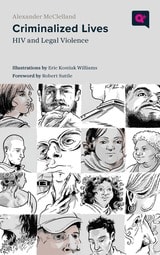
Criminalized Lives
HIV and Legal ViolenceAlexander McClelland
Rutgers University Press, 2024
Canada has been known as a hot spot for HIV criminalization where the act of not disclosing one’s HIV-positive status to sex partners has historically been regarded as a serious criminal offence. Criminalized Lives describes how this approach has disproportionately harmed the poor, Black and Indigenous people, gay men, and women in Canada. In this book, people who have been criminally accused of not disclosing their HIV-positive status, detail the many complexities of disclosure, and the violence that results from being criminalized.
Accompanied by portraits from artist Eric Kostiuk Williams, the profiles examine whether the criminal legal system is really prepared to handle the nuances and ethical dilemmas faced everyday by people living with HIV. By offering personal stories of people who have faced criminalization first-hand, Alexander McClelland questions common assumptions about HIV, the role of punishment, and the violence that results from the criminal legal system’s legacy of categorizing people as either victims or perpetrators.
Note: A regrettable error appears on page 22. The number 240 should be 206 when referring to the number of people prosecuted in relation to allegations of HIV nondisclosure. This will be fixed in future reprints.
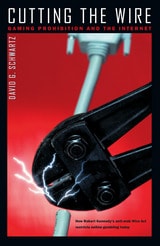
Cutting The Wire
Gaming Prohibition And The InternetDavid G. Schwartz
University of Nevada Press, 2005
The story of the Wire Act and how Robert Kennedy’s crusade against the Mob is creating a new generation of Internet gaming outlaws.
Gambling has been part of American life since long before the existence of the nation, but Americans have always been ambivalent about it. What David Schwartz calls the “pell-mell history of legal gaming in the United States” is a testament to our paradoxical desire both to gamble and to control gambling. It is in this context that Schwartz examines the history of the Wire Act, passed in 1961 as part of Attorney General Robert F. Kennedy’s crusade against organized crime and given new life in recent efforts to control Internet gambling. Cutting the Wire presents the story of how this law first developed, how it helped fight a war against organized crime, and how it is being used today. The Wire Act achieved new significance with the development of the Internet in the early 1990s and the growing popularity of online wagering through offshore facilities. The United States government has invoked the Wire Act in a vain effort to control gambling within its borders, at a time when online sports betting is soaring in popularity. By placing the Wire Act into the larger context of Americans’ continuing ambivalence about gambling, Schwartz has produced a provocative analysis of a national habit and the vexing predicaments that derive from it. In America today, 48 of 50 states currently permit some kind of legal gambling. Schwartz’s historical unraveling of the Wire Act exposes the illogic of an outdated law intended to stifle organized crime being used to set national policy on Internet gaming. Cutting the Wire carefully dissects two centuries of American attempts to balance public interest with the technology of gambling. Available in hardcover and paperback.
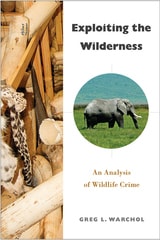
Exploiting the Wilderness
An Analysis of Wildlife CrimeGreg L. Warchol
Temple University Press, 2017
Illegally harvested ivory and endangered plants, mammals, reptiles, birds, and even insects are easily found for sale throughout East and Southern Africa. And this is just one part of the multi-billion-dollar illegal global trade in wildlife.
Wildlife is an important and even vital asset for both intrinsic and economic reasons. Yet it is illegally exploited on a massive scale to the point where some species now risk extinction. Exploiting the Wilderness provides a concise overview of this shameful business, describing some of the main species being exploited and examining select wildlife whose survival is imperiled due to heavy pressure from poachers to meet consumer demand.
Greg Warchol draws on his firsthand experience and research in Africa to examine the structure and operation of the illegal trade in wildlife. He identifies the participants as well as their motivations and operations, and explains the behavior of poachers, traffickers, and consumers of illegally obtained goods. He concludes with a description of legislative and law enforcement efforts to control and prevent wildlife exploitation along with a number of contemporary conservation initiatives designed to improve the ability of rangers to protect wildlife.
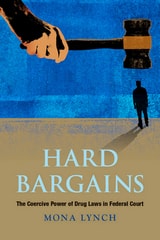
Hard Bargains
The Coercive Power of Drug Laws in Federal CourtMona Lynch
Russell Sage Foundation, 2016
As a result of the War on Drugs, the number of drug cases prosecuted each year in federal courts has increased fivefold since 1980. Lynch goes behind the scenes in three federal court districts and finds that federal prosecutors have considerable discretion in adjudicating these cases. Federal drug laws are wielded differently in each district, but with such force to overwhelm defendants’ ability to assert their rights. For drug defendants with prior convictions, the stakes are even higher since prosecutors can file charges that incur lengthy prison sentences—including life in prison without parole. Through extensive field research, Lynch finds that prosecutors frequently use the threat of extremely severe sentences to compel defendants to plead guilty rather than go to trial and risk much harsher punishment. Lynch also shows that the highly discretionary ways in which federal prosecutors work with law enforcement have led to significant racial disparities in federal courts. For instance, most federal charges for crack cocaine offenses are brought against African Americans even though whites are more likely to use crack. In addition, Latinos are increasingly entering the federal system as a result of aggressive immigration crackdowns that also target illicit drugs.
Hard Bargains provides an incisive and revealing look at how legal reforms over the last five decades have shifted excessive authority to federal prosecutors, resulting in the erosion of defendants’ rights and extreme sentences for those convicted. Lynch proposes a broad overhaul of the federal criminal justice system to restore the balance of power and retreat from the punitive indulgences of the War on Drugs.