Results by title
9 books match the query 'Critic'
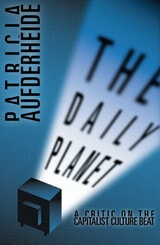
Daily Planet
A Critic on the Capitalist Culture BeatPatricia Aufderheide
University of Minnesota Press, 2000
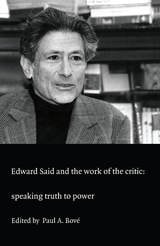
Edward Said and the Work of the Critic
Speaking Truth to PowerPaul A. Bové, ed.
Duke University Press, 2000
In two separate interviews, Said himself comments on a variety of topics, among them the response of the American Jewish community to his political efforts in the Middle East. Yet even as the Palestinian struggle finds a central place in his work, it is essential—as the contributors demonstrate—to see that this struggle rests on and gives power to his general "critique of colonizers" and is not simply the outgrowth of a local nationalism. Perhaps more than any other person in the United States, Said has changed how the U.S. media and American intellectuals must think about and represent Palestinians, Islam, and the Middle East. Most importantly, this change arises not as a result of political action but out of a potent humanism—a breadth of knowledge and insight that has nourished many fields of inquiry. Originally a special issue of boundary 2, the book includes new articles on minority culture and on orientalism in music, as well as an interview with Said by Jacqueline Rose.
Supporting the claim that the last third of the twentieth century can be called the "Age of Said," this collection will enlighten and engage students in virtually any field of humanistic study.
Contributors. Jonathan Arac, Paul A. Bové, Terry Cochran, Barbara Harlow, Kojin Karatani, Rashid I. Khalidi, Sabu Kohsu, Ralph Locke, Mustapha Marrouchi, Jim Merod, W. J. T. Mitchell, Aamir R. Mufti, Jacqueline Rose, Edward W. Said, Gayatri Chakravorty Spivak, Lindsay Waters
Inventing the Critic in Renaissance England
William Russell
University of Delaware Press, 2011
Published by University of Delaware Press. Distributed worldwide by Rutgers University Press.
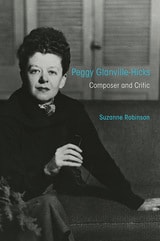
Peggy Glanville-Hicks
Composer and CriticSuzanne Robinson
University of Illinois Press, 2019
Drawing on interviews, archival research, and fifty-four years of extraordinary pocket diaries, Suzanne Robinson places Glanville-Hicks within the history of American music and composers. "P.G.H." forged alliances with power brokers and artists that gained her entrance to core American cultural entities such as the League of Composers, New York Herald Tribune, and the Harkness Ballet. Yet her impeccably cultivated public image concealed a private life marked by unhappy love affairs, stubborn poverty, and the painstaking creation of her artistic works.
Evocative and intricate, Peggy Glanville-Hicks clears away decades of myth and storytelling to provide a portrait of a remarkable figure and her times.
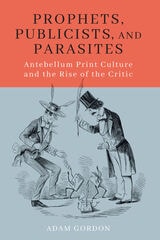
Prophets, Publicists, and Parasites
Antebellum Print Culture and the Rise of the CriticAdam Gordon
University of Massachusetts Press, 2020
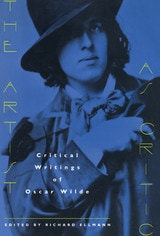
The Artist as Critic
Critical Writings of Oscar WildeOscar Wilde
University of Chicago Press, 1982
Included in Richard Ellmann's impressive collection of Wilde's criticism, The Artist as Critic, is a wide selection of Wilde's book reviews as well as such famous longer works as "The Portrait of Mr. W.H.," "The Soul Man under Socialism," and the four essays which make up Intentions. The Artist as Critic will satisfy any Wilde fan's yearning for an essential reading of his critical work.
"Wilde . . . emerges now as not only brilliant but also revolutionary, one of the great thinkers of dangerous thoughts."—Walter Allen, New York Times Book Review
"The best of Wilde's nonfictional prose can be found in The Artist as Critic."—Michael Dirda, Washington Post Book World
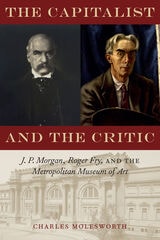
The Capitalist and the Critic
J. P. Morgan, Roger Fry, and the Metropolitan Museum of ArtBy Charles Molesworth
University of Texas Press, 2016
A skillful and fascinating retelling of the often testy relationship between J. P. Morgan and Roger Fry, two men who did more to establish the preeminence of the Metropolitan Museum of Art than any collector and curator before or since.
Shortly after the turn of the twentieth century, the Metropolitan Museum of Art began an ambitious program of collection building and physical expansion that transformed it into one of the world’s foremost museums, an eminence that it has maintained ever since. Two men of singular qualities and accomplishments played key roles in the Met’s transformation—J. P. Morgan, America’s leading financier and a prominent art collector, and Roger Fry, the headstrong English expert in art history who served as the Met’s curator of painting. Their complicated, often contentious relationship embodies and illuminates the myriad tensions between commerce and art, philanthropists and professional staff, that a great museum must negotiate to define and fulfill its mission.
In this masterful, multidisciplinary narrative, Charles Molesworth offers the first in-depth look at how Morgan and Fry helped to mold the cultural legacy of masterpieces of painting and the development of the “encyclopedic” museum. Structuring the book as a joint biography, Molesworth describes how Morgan used his vast wealth to bring European art to an American citizenry, while Fry brought high standards of art history from the world of connoisseurs to a general public. Their clashes over the purpose and functions of the Met, which ultimately led to Fry’s ouster, reveal the forces—personal and societal—that helped to shape the Metropolitan Museum and other major American cultural institutions during the twentieth century.
The Critic in the World
Essays in Honor of Fernando F. SegoviaAmy Lindeman Allen
SBL Press, 2024
A Pact of Love with Criticism, A Pact of Blood with the World
Building on the legacy of Fernando F. Segovia, the pioneering essays in this volume redefine the intersection of biblical studies and geopolitics. Through a thorough exploration of how ancient texts and modern readers influence and reflect geopolitical dynamics, each contributor reveals how biblical narratives have shaped and been shaped by historical power structures, territorial conflicts and climate changes, and cultural exchanges. Essays employ contemporary geopolitical concepts that move beyond traditional readings to offer fresh insights into the strategic and ideological forces behind scriptural texts. An annotated interview with Fernando F. Segovia traces his immigration journey as an adolescent and its indelible imprint on his scholarship as a postcolonial critic. Contributors include Efraín Agosto, Amy Lindeman Allen, Reimund Bieringer, Mark G. Brett, Ahida Calderón Pilarski, Greg Carey, Jorge E. Castillo Guerra, Jin Young Choi, Stephanie Buckhanon Crowder, Gregory L. Cuéllar, Musa W. Dube, Neil Elliott, Eleazar S. Fernandez, Bridgett A. Green, Leticia A. Guardiola-Sáenz, Jacqueline M. Hidalgo, Knut Holter, Ma. Maricel S. Ibita, Ma. Marilou S. Ibita, John F. Kutsko, Sung Uk Lim, Francisco Lozada Jr., Luis Menéndez-Antuña, Rubén Muñoz-Larrondo, Robert Myles, Wongi Park, Mitri Raheb, Elisabeth Schüssler Fiorenza, Fernando F. Segovia, Yak-hwee Tan, Ekaputra Tupamahu, Gerald O. West, Hans (J. H.) de Wit, and H. Daniel Zacharias.
The Feminist Spectator as Critic
Jill Dolan
University of Michigan Press, 2012
The Feminist Spectator as Criticbroke new ground as one of the pioneering books on feminist spectatorship, encouraging resistant readings to generate feminist meanings in performance. Approaching live spectatorship through a range of interdisciplinary methods, the book has been foundational in theater studies, performance studies, and gender/sexuality/women's studies. This updated and enlarged second edition celebrates the book's twenty-fifth anniversary with a substantial new introduction and up-to-the-moment bibliography, detailing the progress to date in gender equity in theater and the arts, and suggesting how far we have yet to go.