Results by title
2 books match the query 'Critical Digital Humanities'
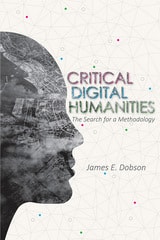
Critical Digital Humanities
The Search for a MethodologyJames E. Dobson
University of Illinois Press, 2019
Can established humanities methods coexist with computational thinking? It is one of the major questions in humanities research today, as scholars increasingly adopt sophisticated data science for their work. James E. Dobson explores the opportunities and complications faced by humanists in this new era. Though the study and interpretation of texts alongside sophisticated computational tools can serve scholarship, these methods cannot replace existing frameworks. As Dobson shows, ideas of scientific validity cannot easily nor should be adapted for humanities research because digital humanities, unlike science, lack a leading-edge horizon charting the frontiers of inquiry. Instead, the methods of digital humanities require a constant rereading. At the same time, suspicious and critical readings of digital methodologies make it unwise for scholars to defer to computational methods. Humanists must examine the tools--including the assumptions that went into the codes and algorithms--and questions surrounding their own use of digital technology in research. Insightful and forward thinking, Critical Digital Humanities lays out a new path of humanistic inquiry that merges critical theory and computational science.
[more]
Guerrilla Theory
Political Concepts, Critical Digital HumanitiesMatthew Applegate
Northwestern University Press, 2019
Guerrilla Theory examines the political, ontological, and technological underpinnings of the guerrilla in the digital humanities (DH). The figure of the guerrilla appears in digital humanities’ recent history as an agent of tactical reformation. It refers to a broad swath of disciplinary desires: digital humanities’ claim to collaborative and inclusive pedagogy, minimal and encrypted computing, and a host of minoritarian political interventions in its praxis, including queer politics, critical race studies, and feminist theory.
In this penetrating study, Matthew Applegate uses the guerrilla to connect popular iterations of digital humanities’ practice to its political rhetoric and infrastructure. By doing so, he reorients DH’s conceptual lexicon around practices of collective becoming, mediated by claims to conflict, antagonism, and democratic will.
Applegate traces Michael Hardt and Antonio Negri’s radical democratic ingresses into network theory, the guerrilla’s role in its discourse, and concerns for the digital humanities’ own invocation of the figure. The book also connects post- and decolonial, feminist, and Marxist iterations of DH praxis to the aesthetic histories of movements such as Latin American Third Cinema and the documentary cinema of the Black Panther Party. Concluding with a meditation on contemporary political modalities inherent in DH’s disciplinary expansion, Guerrilla Theory challenges the current political scope of the digital humanities and thus its future institutional impact.
[more]