Results by title

4 books match the query 'Critical Interventions'
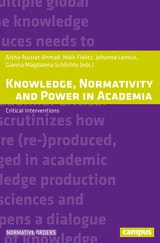
cover of Knowledge, Normativity and Power in Academia: Critical Interventions

Knowledge, Normativity and Power in Academia

Critical Interventions

Edited by Aisha-Nusrat Ahmad, Maik Fielitz, Johanna Leinius and Gianna Magdalena Schlichte

Campus Verlag, 2018
Despite its capacity to produce knowledge that can directly influence policy and affect social change, academia is still often viewed as a stereotypical ivory tower, detached from the tumult of daily life. Knowledge, Normativity, and Power in Academia argues that, in our current moment of historic global unrest, the fruits of the academy need to be examined more closely than ever. This collection pinpoints the connections among researchers, activists, and artists, arguing that—despite what we might think—the knowledge produced in universities and the processes that ignite social transformation are inextricably intertwined. Knowledge, Normativity, and Power in Academia provides analysis from both inside and outside the academy to show how this seemingly staid locale can still provide space for critique and resistance.
[more]
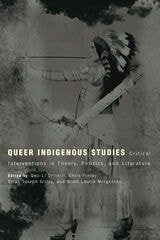
cover of Queer Indigenous Studies: Critical Interventions in Theory, Politics, and Literature

Queer Indigenous Studies

Critical Interventions in Theory, Politics, and Literature

Edited by Qwo-Li Driskill, Chris Finley, Brian Joseph Gilley, and Scott Lauria Morgensen

University of Arizona Press, 2011

“This book is an imagining.” So begins this collection examining critical, Indigenous-centered approaches to understanding gay, lesbian, bisexual, transgender, queer, and Two-Spirit (GLBTQ2) lives and communities and the creative implications of queer theory in Native studies. This book is not so much a manifesto as it is a dialogue—a “writing in conversation”—among a luminous group of scholar-activists revisiting the history of gay and lesbian studies in Indigenous communities while forging a path for Indigenouscentered theories and methodologies.

The bold opening to Queer Indigenous Studies invites new dialogues in Native American and Indigenous studies about the directions and implications of queer Indigenous studies. The collection notably engages Indigenous GLBTQ2 movements as alliances that also call for allies beyond their bounds, which the co-editors and contributors model by crossing their varied identities, including Native, trans, straight, non-Native, feminist, Two-Spirit, mixed blood, and queer, to name just a few.

Rooted in the Indigenous Americas and the Pacific, and drawing on disciplines ranging from literature to anthropology, contributors to Queer Indigenous Studies call Indigenous GLBTQ2 movements and allies to center an analysis that critiques the relationship between colonialism and heteropatriarchy. By answering critical turns in Indigenous scholarship that center Indigenous epistemologies and methodologies, contributors join in reshaping Native studies, queer studies, transgender studies, and Indigenous feminisms.

Based on the reality that queer Indigenous people “experience multilayered oppression that profoundly impacts our safety, health, and survival,” this book is at once an imagining and an invitation to the reader to join in the discussion of decolonizing queer Indigenous research and theory and, by doing so, to partake in allied resistance working toward positive change.
[more]
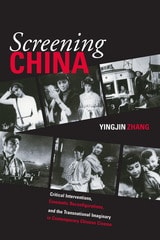
cover of Screening China: Critical Interventions, Cinematic Reconfigurations, and the Transnational Imaginary in Contemporary Chinese Cinema

Screening China

Critical Interventions, Cinematic Reconfigurations, and the Transnational Imaginary in Contemporary Chinese Cinema

Zhang Yingjin

University of Michigan Press, 2001

Yingjin Zhang guides the reader through the development of Chinese film criticism, pointing out that Western critics have studied a comparatively small number of films from a much larger body of work, often with a unidirectional Eurocentric bias. The result has been that the few have influenced the many, perpetuating a cycle of production of films from China that bow to the Western notion of "Chineseness." As a corrective, the author introduces readers to a much larger canon of film and proposes a multidirectional model of film studies, one that allows for a Western reading of Chinese film yet also recognizes Chinese cinema's own voice.
[more]
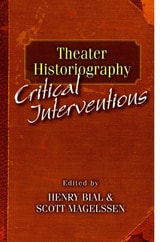
cover of Theater Historiography: Critical Interventions

Theater Historiography

Critical Interventions

Henry Bial and Scott Magelssen, editors

University of Michigan Press, 2010

Theater Historiography: Critical Interventions is a vital exploration of how we write, interpret, and understand the history of theater. Edited by Henry Bial and Scott Magelssen, this collection brings together leading voices in theater and performance studies to interrogate the methodologies, assumptions, and politics that shape the field. Each of the twenty-one essays offers a concise, thought-provoking intervention, examining topics from classical theater and Roman comedy to digital performance, ethnography, and ecocriticism.Far more than a survey of theatrical pasts, this book considers how the practice of writing theater history has been transformed by postmodern theory, multicultural perspectives, and interdisciplinary approaches. The contributors dig into the ethical dilemmas and evidentiary challenges of the archive, explore the stakes of representation, and confront the silences—as well as the voices—of marginalized or “unhistoried” communities.Organized into thematic sections—including “Unearthing the Past,” “The Stakes of Historiography,” “Historiography for a New Millennium,” “Performance as Historiography,” and “Theater History’s Discipline”—the volume covers a wide range of subjects, from Roman spectacle and colonial India to the impact of digital technology and the evolving relationship between theater history and performance studies. Throughout, Bial and Magelssen provide guidance for scholars and students alike, showing that theater historiography is a continual process of critical self-examination, innovation, and debate.Inspiring, accessible, and intellectually rigorous, Theater Historiography: Critical Interventions is essential reading for anyone interested in how we remember, teach, and make meaning from the rich and complex worlds of theater and performance.
[more]