Results by title
5 books match the query 'Critical discourse analysis'
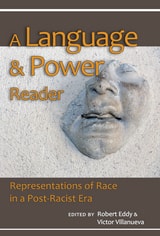
Language and Power Reader
Representations of Race in a "Post-Racist" EraRobert Eddy
Utah State University Press, 2014
A Language and Power Reader organizes reading and writing activities for undergraduate students, guiding them in the exploration of racism and cross-racial rhetorics.
Introducing texts written from and about versions of English often disrespected by mainstream Americans, A Language and Power Reader highlights English dialects and discourses to provoke discussions of racialized relations in contemporary America. Thirty selected readings in a range of genres and from writers who work in ?alternative? voices (e.g., Pidgin, African American Language, discourse of international and transnational English speakers) focus on disparate power relations based on varieties of racism in America and how those relations might be displayed, imposed, or resisted across multiple rhetorics. The book also directs student participation and discourse. Each reading is followed by comments and guides to help focus conversation.
Research has long shown that increasing a student?s metalinguistic awareness improves a student?s writing. No other reader available at this time explores the idea of multiple rhetorics or encourages their use, making A Language and Power Reader a welcome addition to writing classrooms.
Narrative Discourse
Authors and Narrators in Literature, Film, and ArtPatrick Colm Hogan
The Ohio State University Press, 2013
The Benevolent Gaslight
A Technology of Race-MakingLouis M. Maraj
Utah State University Press, 2026
At the intersection of rhetorical studies and critical race/ethnic studies, The Benevolent Gaslight analyzes cultural and political discourses that recharacterize acts of racial violence as teaching moments and learning opportunities. Naming this phenomenon “benevolent gaslighting,” Louis M. Maraj and Pritha Prasad explore its application across academic disciplines/epistemologies, educational history, and university race management, while also diving into how popular culture and political figures use benevolent gaslighting to reinscribe normative operations of race, gender, and sexuality.
Although this rhetoric usually presents as progressive, when used for the purposes of advancing “antiracism,” the benevolent gaslight re-centers the very whiteness it supposedly critiques. It prompts peoples of color to question their histories, memories, and realities by suggesting their pain has been necessary for positive social change and by situating racial trauma as opportunities for public learning. Specific examples include antiracist teaching initiatives and the sudden proliferation of apologies for past acts of racism by public figures. Both trends saw an uptick from 2020 onward as a result of publicity crises and public “reckonings” necessitated by Black Lives Matter protests in response to widely reported, hypervisible anti-Black violences like the murders of George Floyd, Breonna Taylor, and Ahmaud Arbery.
These discourses deflect blame for past or present racial violence by narrating it as an opportunity for “antiracist” growth and intervention. Utilizing conventional academic and creative/narrative methods to examine examples of the benevolent gaslight across US histories of education during the First Reconstruction, the post–Civil Rights management of student activists in the university, and the progressivist discourses of humanities disciplines and popular culture, this book reveals the insidious ways in which peoples of color are routinely (re)traumatized through mechanisms of “pedagogy.”
The Politics of Military Force
Antimilitarism, Ideational Change, and Post-Cold War German Security DiscourseFrank A. Stengel
University of Michigan Press, 2020
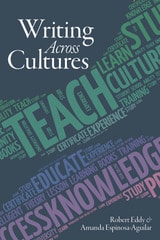
Writing Across Cultures
Robert Eddy
Utah State University Press, 2019
Robert Eddy and Amanda Espinosa-Aguilar offer a new framework for teaching that acknowledges the changing demographics of US college classrooms as the field of writing studies moves toward real equity and expanding diversity. Writing Across Cultures utilizes a streamlined cross-racial and interculturally tested method of introducing students to academic writing via sequenced assignments that are not confined by traditional and static approaches. They focus on helping students become engaged members of a new culture—namely, the rapidly changing collegiate discourse community. The book is based on a multi-racial rhetoric that assumes that writing is inherently a social activity. Students benefit most from seeing composing as an act of engaged communication, and this text uses student samples, not professionally authored ones, to demonstrate this framework in action.
Writing Across Cultures will be a significant contribution to the field, aiding teachers, students, and administrators in navigating the real challenges and wonderful opportunities of multi-racial learning spaces.