Results by title

4 books match the query 'Critically ill'
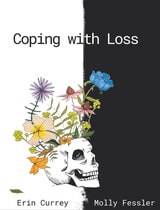
cover of Coping with Loss: A Guide to Death, Grief and Clinical Experiences with Dying Patients

Coping with Loss

A Guide to Death, Grief and Clinical Experiences with Dying Patients

Erin Currey

Michigan Publishing Services, 2025

In a cure-focused profession, the death of a patient can often feel like a failure. Yet, every patient will inevitably transition from health to illness, independence to dependence, and life to death. These transitions often mark some of the most meaningful interactions between patients and care providers. Coping with Loss is a self-directed workbook that provides addresses common questions, concerns, and emotional responses to these interactions with dying patients. Each lesson opens with real stories of professional grief that will resonate with healthcare professionals at multiple stages of their careers. Critical topics covered include recognizing the diverse presentations of grief, identifying dying patients, decompressing individually, and debriefing as a team. Significant portions of the text discuss how challenging patient cases impact the formation of professional identity.  Ultimately, this workbook provides a place for healthcare providers to reflect on their patient interactions and learn how to support themselves and their healthcare teams through grief.

[more]
cover of Dying in Character: Memoirs on the End of Life

Dying in Character

Memoirs on the End of Life

Jeffrey Berman

University of Massachusetts Press, 2012

In the past twenty years, an increasing number of authors have written memoirs focusing on the last stage of their lives: Elizabeth Kübler-Ross, for example, in The Wheel of Life, Harold Brodkey in This Wild Darkness, Edward Said in Out of Place, and Tony Judt in The Memory Chalet. In these and other end-of-life memoirs, writers not only confront their own mortality but in most cases struggle to "die in character"—that is, to affirm the values, beliefs, and goals that have characterized their lives.

Examining the works cited above, as well as memoirs by Mitch Albom, Roland Barthes, Jean-Dominique Bauby, Art Buchwald, Randy Pausch, David Rieff, Philip Roth, and Morrie Schwartz, Jeffrey Berman's analysis of this growing genre yields some surprising insights. While the authors have much to say about the loneliness and pain of dying, many also convey joy, fulfillment, and gratitude. Harold Brodkey is willing to die as long as his writings survive. Art Buchwald and Randy Pausch both use the word fun to describe their dying experiences. Dying was not fun for Morrie Schwartz and Tony Judt, but they reveal courage, satisfaction, and fearlessness during the final stage of their lives, when they are nearly paralyzed by their illnesses.

It is hard to imagine that these writers could feel so upbeat in their situations, but their memoirs are authentically affirmative. They see death coming, yet they remain stalwart and focused on their writing. Berman concludes that the contemporary end-of-life memoir can thus be understood as a new form of death ritual, "a secular example of the long tradition of ars moriendi, the art of dying."
[more]
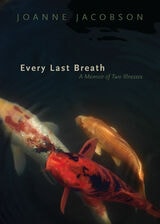
cover of Every Last Breath: A Memoir of Two Illnesses

Every Last Breath

A Memoir of Two Illnesses

Joanne Jacobson

University of Utah Press, 2020
When Joanne Jacobson’s writing about her mother’s respiratory illness was interrupted by her own diagnosis with a rare blood disorder, she found her perspective profoundly altered. Every Last Breath follows these two chronic illnesses as they grow unexpectedly intertwined. Rejecting a fixed, retrospective point of view and the forward-moving trajectory of conventional memoir, Jacobson brings the reader to the emotionally raw present—where potentially fatal illness and “end of life” both remain, emphatically, life. As chronic illness blurs the distinction between illness and wellness, she discovers how a lifetime of relapse and remission can invite transformation. Written at the fluid, unsettling boundary between prose and poetry, these essays offer a narrative diagnosis of ongoing revision.
[more]
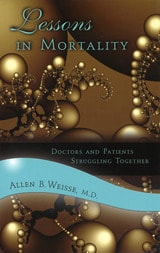
cover of Lessons in Mortality: Doctors and Patients Struggling Together

Lessons in Mortality

Doctors and Patients Struggling Together

Allen B. Weisse, M.D.

University of Missouri Press, 2006

It doesn’t take a trip to the doctor to know that the bond between physicians and patients isn’t what it used to be. Specialization, rising costs, managed care, the insurance industry, the shadow of litigation—so many factors have changed what was once a traditional relationship grounded in respect and caring. 
            In light of the altered climate in health care, this thoughtful book deals with the way that today’s doctors and patients view themselves and one another. Allen Weisse has observed the changing medical scene during half a century of treating patients and training future physicians, and he writes frankly here about how doctors and patients have come to deal with illness in the twenty-first century. 
Weisse first recalls his own brush with death as a young man diagnosed with testicular cancer—a time when one thinks of God and Death and little else. He then shares true stories of how different people have dealt with cancer, heart disease, stroke, infectious disease, AIDS, and other dire diagnoses—narratives enhanced by professional savvy and enriched by the kind of empathy that the survivor of such a calamity can provide.
Drawing from a storehouse of experiences shared by colleagues, patients, and friends, Weisse writes with passion, conviction, and clarity to encourage a renewal of the openness and trust that seem to be lacking in today’s doctor-patient relationships. These are accounts both uplifting and disturbing—some sad, others tinged with humor—intended to make doctors and patients alike come to a fuller realization that we are all together in this delicate but crucial business of staying alive.
            While not quite foreseeing a return to the Norman Rockwell image of the family physician, Weisse urges the kind of care and compassion that patients often feel is lacking from their doctors, and he reassures victims of seemingly hopeless conditions that, despite the obstacles they often face, there are still health care professionals who truly have their patients’ welfare foremost in mind. Lessons in Mortality is just what the doctor ordered for a health care system in crisis: an honest look at the medical profession that encourages greater understanding on the part of both physicians and patients, reminding us that what we most need is one another.
[more]